
Most of the older-adult DHEA trials examined here used 50 mg a day and found little consistent benefit; this tablet contains 100 mg, twice that dose. DHEA (dehydroepiandrosterone) is a steroid hormone made mainly by the adrenal glands and converted in the body into testosterone and estrogen. It is sold over the counter in the United States, but the U.S. Anti-Doping Agency states that in almost all other countries DHEA is treated as a controlled anabolic steroid, and it is banned in sport at all times.
Key Takeaways
- NCCIH (page last updated May 2017) says "the long-term safety of taking DHEA supplements is unknown" and that "some evidence suggests that even short-term use of these supplements may have harmful effects, including liver damage."
- A 2014 meta-analysis of 23 trials and 1,188 postmenopausal women found no significant improvement in libido (SMD 0.35, 95% CI −0.02 to 0.73) and no significant effect on lipids, glucose, weight or bone density, with low confidence in the results.
- A 2013 meta-analysis of 25 trials in 1,353 older men found a small fat-mass reduction (SMD −0.35) that disappeared after adjusting for conversion to testosterone and estradiol, and no effect on lipids, glucose, bone, sexual function or quality of life.
- In a 12-month trial of 119 adults aged 60 to 88 (50 mg/day), DHEA did not reduce abdominal fat or improve insulin action; triglycerides fell, but so did HDL ("good") cholesterol.
- The label warns against use by anyone under 18, and by women who are pregnant, nursing or of childbearing age, and lists side effects including acne, hair loss, facial hair in women and raised estrogen.
In this article:
- What Is DHEA, and Why Do People Take It?
- What the Trials in Older Adults Found
- The Dose Problem: 50 mg in the Trials, 100 mg in the Tablet
- Regulation and Sport: A Supplement Here, a Controlled Steroid Elsewhere
- Safety and the Label's Own Warnings
- Inside Amazing Formulas DHEA 100 mg
- Who Might Consider It, and Who Should Skip It
- Frequently Asked Questions
What Is DHEA, and Why Do People Take It?
According to NCCIH, DHEA "is a substance that's naturally made in the body, where it's converted into the hormones testosterone and estrogen." Production decreases as people age, "but the significance of this change, including whether it affects aging and menopause symptoms, is unclear." That uncertainty is the whole story of DHEA supplements: a hormone that falls with age is tempting to replace, but a falling level is not the same as a deficiency that causes symptoms.
The U.S. Anti-Doping Agency adds that DHEA levels peak in early adulthood and decline with age, and that the only FDA-approved clinical use it lists is a prescription vaginal form of prasterone (DHEA) used for some menopause symptoms. Beyond that, USADA states, "there is no evidence that DHEA supplements are a safe or effective treatment for any disease." NCCIH adds that guidelines from a task force of several professional societies "recommend against the routine use of DHEA." The oral tablet sold here is a different product from the prescription vaginal medicine.
What the Trials in Older Adults Found
Because DHEA is marketed for "healthy aging," the most relevant trials are those in older adults. Here are five, each summarized from its published abstract:
| Study | Who and how much | Result |
|---|---|---|
| Elraiyah et al., J Clin Endocrinol Metab, 2014 | 23 RCTs, 1,188 postmenopausal women with normal adrenal function | No significant improvement in libido or sexual function (SMD 0.35, 95% CI −0.02 to 0.73, p = 0.06); no significant effect on serious adverse effects, lipids, glucose, weight, BMI or bone density; low confidence |
| Corona et al., J Clin Endocrinol Metab, 2013 | 25 RCTs, 1,353 elderly men; mean follow-up 36 weeks | Small fat-mass reduction (SMD −0.35, 95% CI −0.65 to −0.05) that disappeared after adjusting for testosterone and estradiol; no effect on lipids, glucose, bone, sexual function or quality of life |
| Weiss et al., Am J Clin Nutr, 2009 | 113 adults aged 65–75; 50 mg/day; with vitamin D and calcium | Women: spine bone density up 1.7% at 1 year and 3.6% at 2 years; men: no difference; hip unchanged; testosterone and estradiol rose |
| Jankowski et al., Clin Endocrinol, 2011 | 58 women and 61 men aged 60–88; 50 mg/day for 12 months | No difference in abdominal fat or glucose metabolism; HDL cholesterol and triglycerides both fell |
| Sultana et al., Menopause, 2023 | 4 RCTs in postmenopausal women; all 50 mg/day | Only one positive result (a 4-week crossover study in 24 women, visual-spatial tests); "does not support a beneficial effect" on cognition; high risk of bias |
The one positive signal is spine bone density in women in the Weiss trial (2009), and it is not a consistent one: the 2014 meta-analysis of 23 trials in postmenopausal women found no significant effect on bone density. The Weiss result also comes with caveats: the placebo group's spine density rose 2.6% after crossing over to DHEA in year two, participants were also taking vitamin D and calcium, and hip density did not change. The mechanism is instructive too. The 2013 men's meta-analysis found DHEA's small body-composition effect was "strictly dependent" on its conversion into androgens or estrogens. In other words, DHEA works as a hormone precursor, which is both why it can have an effect and why it carries the risks of a hormone.
"Overall, this systematic review does not support a beneficial effect of DHEA therapy on cognitive performance in postmenopausal women."
— Sultana, Davis & Islam, Menopause, 2023 (systematic review of four randomized trials)The Dose Problem: 50 mg in the Trials, 100 mg in the Tablet
The two individual trials in the table, and all four trials in the 2023 cognition review, used 50 mg per day. The 2014 meta-analysis in women was more mixed: of the trials listed in its full text, 16 used 50 mg, three used 100 mg (the strength of this tablet) and one used 1,600 mg, and pooled together they still showed no significant benefit (Elraiyah et al., 2014). The 2013 meta-analysis in men does not report doses in its abstract. This product's Supplement Facts panel lists 100 mg per tablet, and the label directs one tablet daily. That is not a criticism of the tablet's accuracy; it is a statement that most of the safety and efficacy evidence above was gathered at half the strength on sale here. The listing itself describes it as a "higher-strength formula" that "is intended for adults familiar with DHEA supplementation." Nothing in the sources reviewed shows that doubling the trial dose produces more benefit, and because DHEA converts to sex hormones, a higher dose plausibly raises hormone levels further, as the label's own side-effect list acknowledges.
The U.S. FDA on how dietary supplements are regulated, the framework that lets DHEA be sold here.
Regulation and Sport: A Supplement Here, a Controlled Steroid Elsewhere
USADA is unusually blunt about how DHEA is treated internationally: "In almost all countries except the U.S., DHEA is treated as a controlled anabolic steroid. In the U.S., DHEA is exempt from the Controlled Substances Act." It is allowed in U.S. dietary supplements by the FDA, but it is prohibited at all times, in and out of competition, under the Anabolic Agents category of the World Anti-Doping Agency Prohibited List, "even if it is prescribed by a doctor and regardless of whether it is natural or synthetic." USADA also notes that DHEA "is by far the most common prohibited anabolic agent found in dietary supplements."
Two practical consequences follow. Anyone subject to anti-doping testing should not use it. And anyone travelling or ordering internationally should know that a product legal on a U.S. shelf may be a controlled substance elsewhere. If you follow sports nutrition more broadly, our pre-workout ingredients article grades other common performance ingredients.
Safety and the Label's Own Warnings
NCCIH's summary is short: the long-term safety of DHEA supplements is unknown, and some evidence suggests that even short-term use may cause harm, including liver damage. The product label is far more detailed than most, and its precautions are worth reading in full:
| Label instruction | Who it applies to |
|---|---|
| Not for use | Anyone under 18; women who are pregnant, nursing or of childbearing age |
| Consult a physician first | Any woman; anyone under age 40; anyone using another supplement, a prescription drug (including MAO inhibitors) or an over-the-counter drug |
| Consult a physician first (medical history) | Family history of, or a history of, prostate cancer, prostate enlargement, breast cancer or another hormone-sensitive disorder; heart disease, low HDL cholesterol, high blood pressure, diabetes; autoimmune, liver, kidney or thyroid disorders; psychiatric problems, anxiety, seizure disorder, stroke, pernicious anemia |
Read this table with the rest of the label in mind, which says to consult a physician about many other conditions and gives its own list of side effects.
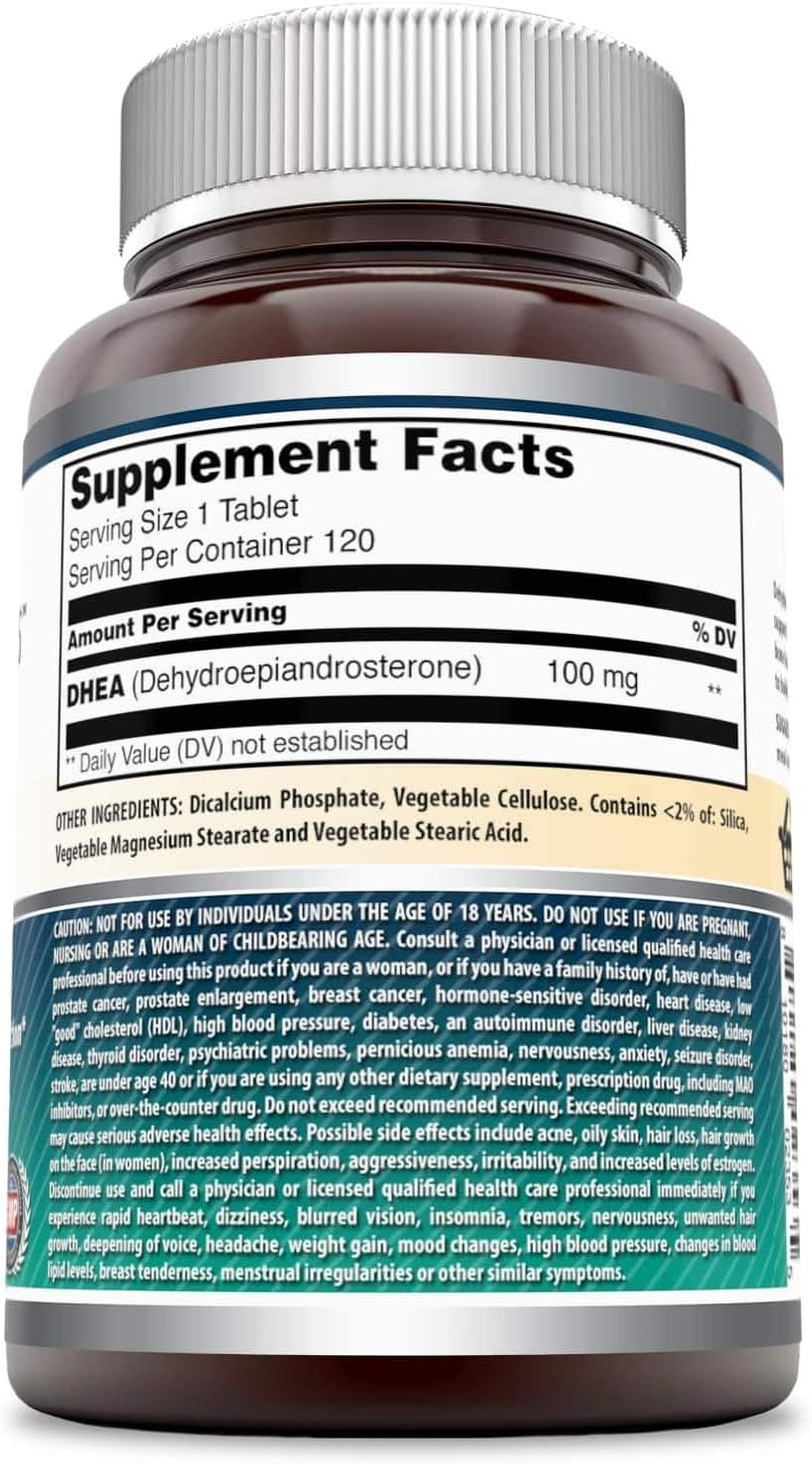
Genuine safety warning: the label lists possible side effects including acne, oily skin, hair loss, hair growth on the face in women, increased perspiration, aggressiveness, irritability and increased levels of estrogen, and says to discontinue use and call a physician immediately for rapid heartbeat, dizziness, blurred vision, insomnia, tremors, unwanted hair growth, deepening of voice, headache, weight gain, mood changes, high blood pressure, changes in blood lipid levels, breast tenderness or menstrual irregularities. Exceeding the recommended serving "may cause serious adverse health effects."
Read against the trials, the pattern is consistent: a hormone precursor with modest and inconsistent benefits, and a label that itself treats it as something to discuss with a clinician first. For women weighing DHEA for menopause symptoms, our soy isoflavones article looks at another menopause-marketed supplement where the research disagrees with itself. For men, our saw palmetto article covers prostate supplements.
Inside Amazing Formulas DHEA 100 mg
Amazing Formulas DHEA is a bottle of 120 tablets. The Supplement Facts panel lists a serving of one tablet, with 120 servings per container, containing 100 mg of DHEA (dehydroepiandrosterone), with no established Daily Value. Other ingredients are dicalcium phosphate and vegetable cellulose, with less than 2% of silica, vegetable magnesium stearate and vegetable stearic acid. The label directs adults to take one tablet daily, preferably with a meal or as directed by a health care professional, which makes the bottle a 120-day supply. It is made in the USA and distributed by Amazing Nutrition of Jersey City, New Jersey.
| This product | Typical trial dose | NIH RDA / AI | Tolerable Upper Limit | |
|---|---|---|---|---|
| DHEA | 100 mg per tablet; 1 tablet daily | 50 mg/day in most older-adult trials above; the 2014 meta-analysis also pooled trials at 25 to 1,600 mg, three of them at 100 mg | None: the body makes it and it is not an essential nutrient | None established; NCCIH: long-term safety unknown |
What the listing claims versus what the evidence supports: the store description says DHEA "supports the activities of the immune system," "helps to keep mood balanced," "promotes healthy aging," "contributes to bone health," "aids in the development of lean muscle mass" and "aids in healthy weight management," and that "it has been demonstrated that DHEA supports healthy metabolism." Those are manufacturer statements. The reviews above found no consistent benefit for metabolism, weight, lipids or cognition, a small body-composition effect in men that was explained by conversion to sex hormones, and a spine bone-density gain in women in one trial that the 2014 meta-analysis did not confirm. The listing does not mention the label's warnings or DHEA's status as a controlled substance in most countries.
Who Might Consider It, and Who Should Skip It
Who this is for: adults over 40 who have a clinician actively involved, have discussed DHEA specifically, have no hormone-sensitive condition, are not tested in any sport, and understand that the evidence for benefit is modest and inconsistent, and was mostly gathered at half this dose.
Who should skip it: anyone under 40 (the label advises consulting a physician), under 18, pregnant, nursing or of childbearing age; anyone with a personal or family history of prostate, breast or other hormone-sensitive cancers; anyone with heart, liver, kidney, thyroid or psychiatric conditions without medical clearance; any athlete subject to drug testing; and, frankly, most people, since the trials do not show a reliable benefit.
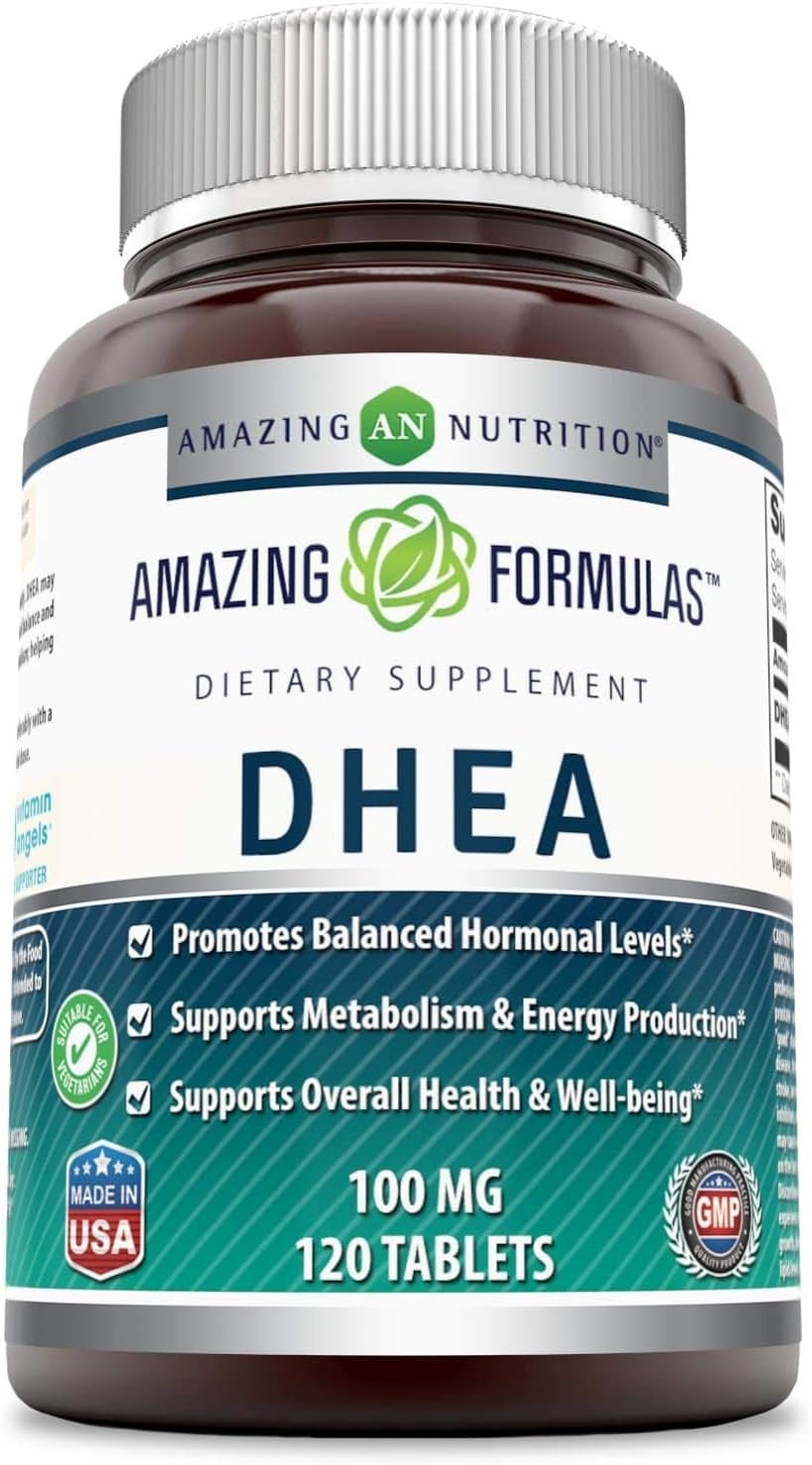
Amazing Formulas DHEA 100 mg — 120 Tablets
100 mg of DHEA per tablet, one tablet daily with a meal, 120-day supply. As covered above, most trials used 50 mg, evidence for benefit is inconsistent, and the label directs you to consult a physician in many situations. Browse more in our supplements.
View Product DetailsFrequently Asked Questions
Does DHEA slow aging?
No trial shows that. DHEA production declines with age, but NCCIH says the significance of that decline is unclear. Randomized trials in older adults at 50 mg per day found no consistent benefit for body composition, metabolism or cognition.
How much DHEA should I take per day?
No official dose exists. Most older-adult trials reviewed here used 50 mg daily. This label directs one 100 mg tablet daily, twice the trial dose. Because DHEA converts to sex hormones, discuss dosing with a physician rather than following the tablet strength.
Is DHEA safe?
Long-term safety is unknown, according to NCCIH, and some evidence suggests short-term use may cause harm, including liver damage. The label lists side effects such as acne, hair loss and increased estrogen, and advises consulting a physician in many situations.
Is DHEA banned in sport?
Yes. USADA states DHEA is prohibited at all times, in and out of competition, as an anabolic agent on the World Anti-Doping Agency list, even in a dietary supplement or when prescribed. It is the most common prohibited anabolic agent found in supplements.
Is DHEA legal?
In the United States it is legal as a dietary supplement and exempt from the Controlled Substances Act. USADA says in almost all other countries it is treated as a controlled anabolic steroid, so check local law before travelling with or ordering it.
Does DHEA help menopause symptoms or libido?
Not reliably by mouth. A 2014 meta-analysis of 23 trials in 1,188 postmenopausal women found no significant improvement in libido or sexual function, with low confidence. NCCIH says it is uncertain whether DHEA helps menopause symptoms.
Does DHEA build muscle or burn fat?
Slightly at most. A meta-analysis of 25 trials in older men found a small fat-mass reduction that disappeared after adjusting for conversion to testosterone and estradiol. A 12-month trial found no reduction in abdominal fat and lower HDL cholesterol.
Who should not take DHEA?
The label says not for anyone under 18 or for women who are pregnant, nursing or of childbearing age, and advises consulting a physician if you have hormone-sensitive conditions, heart, liver or kidney disease, or take other medicines. Athletes subject to testing should not use it.
Sources
- NIH National Center for Complementary and Integrative Health. "Menopausal Symptoms: In Depth" (DHEA section). Last updated May 2017. Accessed 29 September 2026. nccih.nih.gov
- U.S. Anti-Doping Agency. "What Should Athletes Know about DHEA?" Accessed 29 September 2026. usada.org
- Elraiyah T, et al. Clinical review: the benefits and harms of systemic dehydroepiandrosterone (DHEA) in postmenopausal women with normal adrenal function: a systematic review and meta-analysis. J Clin Endocrinol Metab, 2014;99(10):3536-3542. Accessed 29 September 2026. doi.org/10.1210/jc.2014-2261
- Corona G, et al. Dehydroepiandrosterone supplementation in elderly men: a meta-analysis study of placebo-controlled trials. J Clin Endocrinol Metab, 2013;98(9):3615-3626. Accessed 29 September 2026. doi.org/10.1210/jc.2013-1358
- Weiss EP, et al. Dehydroepiandrosterone replacement therapy in older adults: 1- and 2-y effects on bone. Am J Clin Nutr, 2009;89(5):1459-1467. Accessed 29 September 2026. doi.org/10.3945/ajcn.2008.27265
- Jankowski CM, et al. Oral dehydroepiandrosterone replacement in older adults: effects on central adiposity, glucose metabolism and blood lipids. Clin Endocrinol, 2011;75(4):456-463. Accessed 29 September 2026. doi.org/10.1111/j.1365-2265.2011.04073.x
- Sultana F, Davis SR, Islam RM. Effect of dehydroepiandrosterone therapy on cognitive performance among postmenopausal women: a systematic review of randomized clinical trial data. Menopause, 2023;30(11):1167-1173. Accessed 29 September 2026. doi.org/10.1097/gme.0000000000002251
This article is for educational purposes only and is not medical advice. It is not intended to diagnose, treat, cure, or prevent any disease. These statements have not been evaluated by the Food and Drug Administration. DHEA is a hormone precursor. Talk to your doctor before starting it, especially if you are pregnant, nursing, of childbearing age, under 40, have a hormone-sensitive condition, take any medication, or compete in tested sport.