A 2003 Cochrane review of 11 trials in 645 people concluded that kava extract “appears to be an effective symptomatic treatment option for anxiety,” yet a 16-week, 171-person trial published in 2020 found it no better than placebo for generalised anxiety disorder, and the FDA has warned about kava and liver injury since 2002. Kava (Piper methysticum) is a pepper-family plant from the South Pacific whose root is made into relaxing drinks and capsules, including the one sold here, which lists 1,000 mg of kava extract and 10 mg of ginkgo per two-capsule serving.
Key Takeaways
- The 2003 Cochrane review pooled 11 trials (645 people); in six (345 people) kava lowered the Hamilton Anxiety score 5.0 points more than placebo (95% CI 1.1 to 8.8) (Pittler and Ernst, 2003).
- In a 2020 trial of 171 adults with generalised anxiety disorder, 120 mg of kavalactones twice a day for 16 weeks gave remission in 17.4% versus 23.8% on placebo (p = 0.46), with more liver-test abnormalities on kava (Sarris et al., 2020).
- In 2002 the FDA warned of hepatitis, cirrhosis and at least 4 urgent liver transplants; a WHO review of 93 case reports counted 7 deaths and 14 transplants (FDA memo, 11 August 2020).
- This product’s label shows 1,000 mg of kava extract and 10 mg of ginkgo per 2 capsules, with no kavalactone figure; if the manufacturer’s “5%” graphic is right, that is about 50 mg, a fifth of the 2020 trial’s 240 mg a day.
- The listing says “one capsule daily” and “vegan”; the label shows a 2-capsule serving, a gelatin capsule and ginkgo at only 10 mg.
In this article:
- What Kava Is, and What a Label Rarely Tells You About It
- Does Kava Reduce Anxiety? Two Verdicts That Disagree
- The Liver Warning, and Where Regulators Landed
- Alcohol, Medicines, Driving and the Ginkgo in the Capsule
- Inside NatureBell Kava Kava 1,000 mg: Label Versus Listing
- Who Might Consider It, and Who Should Skip It
- Frequently Asked Questions
What Kava Is, and What a Label Rarely Tells You About It
According to the NIH National Center for Complementary and Integrative Health (NCCIH, last updated April 2025), Pacific Islanders have used kava drinks for thousands of years, and kava is now sold in the United States as dietary supplements promoted for anxiety.
The detail that matters most for a capsule buyer is how the root was extracted. The FDA’s toxicology memo (FDA, 11 August 2020) says commercially available kava formulations have been “primarily ethanol, methanol or acetone extracts, standardized to specified kavalactone content.” Kavalactones are the compounds usually treated as the active ones. NCCIH adds that the first reported liver cases involved alcohol- or acetone-extracted products, but others involved drinks “prepared with water.”
A 2020 review (Bian et al., 2020) put the research problem this way: “Major challenges lie in the diversity of kava products and the lack of standardization.”
Does Kava Reduce Anxiety? Two Verdicts That Disagree
Two verdicts, 17 years apart, point in opposite directions. NCCIH’s anxiety page (September 2024) sits between them: kava “may have a small effect” on anxiety but has been linked to severe liver injury.
| Source | What it covered | Result |
|---|---|---|
| Pittler and Ernst, Cochrane, 2003 | 11 trials; 645 participants; treatment of 1 to 24 weeks | Hamilton Anxiety score 5.0 points lower than placebo (95% CI 1.1 to 8.8; p = 0.01; 6 studies, 345 people) |
| Sarris et al., Australian & New Zealand Journal of Psychiatry, 2020 | 171 adults with generalised anxiety disorder; 16 weeks; aqueous root extract, 120 mg kavalactones twice daily | Non-significant difference, 1.37 points favouring placebo (p = 0.25); remission 17.4% kava vs 23.8% placebo (p = 0.46) |
| NCCIH, kava page, April 2025 | Summary of the research | “Kava does not appear to be helpful for symptoms of generalized anxiety disorder” |
The Cochrane authors judged kava “relatively safe for short-term treatment (1 to 24 weeks), although more information is required.” The 2020 trial was the larger and longer test, and its authors wrote that it “was not effective for diagnosed generalised anxiety disorder.” They added that research “generally supported Kava in non-clinical populations,” potentially for more “situational” anxiety.
“Kava supplements may be helpful for anxiety, but they may need to be taken for several weeks to produce an effect.”
— NCCIH, “Kava: Usefulness and Safety,” last updated April 2025Read together, older and smaller trials found a benefit on average, and the biggest recent trial in diagnosed disorder did not. No source we read tested the product below.
Scripps News Life, “3 Things to Know Before Drinking Kava.” General background; we could not read a transcript, so treat it as context, not evidence.
The Liver Warning, and Where Regulators Landed
The FDA memo (11 August 2020) says the agency issued a consumer advisory on 25 March 2002 warning of hepatitis, cirrhosis and “at least four urgent liver transplants.” The same memo reports that kava has been withdrawn or banned in France, Switzerland, the Czech Republic, Spain, the UK, Hungary, Portugal and Germany (the German ban ran “up to 2015”) and in Canada since 2002. In November 2017 the European Medicines Agency committee concluded that an EU herbal monograph on kava for anxiety disorders could not be established. Australia lists kava as Schedule 4 and caps water-based root extracts at 250 mg of kavalactones a day (TGA, October 2016).
“Various kava products have been linked to rare cases of liver injury, some of which have been serious or even fatal.”
— NCCIH, “Kava: Usefulness and Safety,” last updated April 2025The numbers behind “rare” are case series, not incidence rates. The FDA memo summarises a WHO review of 93 case reports of presumed kava hepatotoxicity: 79% involved women, average age 45, taking kava for anxiety; 7 died and 14 had liver transplants. Five had a positive rechallenge, meaning the injury returned when kava was restarted. The WHO listed organic-solvent extracts, excessive dose, heavy alcohol intake, pre-existing liver disease, certain liver-enzyme variants and interacting drugs as risk factors.
The picture is contested. In a German and Swiss series of 26 suspected cases re-analysed in 2008 (Teschke et al.), the memo says 18 were excluded and, of 8 with some degree of causality, only one “followed kava usage recommendations (≤120 mg/d kavalactones and ≤3 months).” The analysis concluded that kava taken as recommended carries a lower risk, and overdose, prolonged treatment and co-medication a higher one.
Safety warning: NCCIH says kava “may have special risks if taken during pregnancy or while breastfeeding.” Anyone with liver disease, who drinks heavily or who takes other liver-stressing medicines should talk to a clinician first. Seek care for yellow skin or eyes, dark urine, severe fatigue or abdominal pain.
Our guide to ashwagandha covers another herb where a liver signal sits next to a calming claim.
Alcohol, Medicines, Driving and the Ginkgo in the Capsule
NCCIH (April 2025) says kava should not be used with sedating substances such as benzodiazepines or alcohol, and lists digestive upset, headache and dizziness as side effects. It also lists trembling and shakiness among commonly reported effects (NCCIH anxiety page, September 2024).
The FDA memo (2020) adds that kava can interact with drugs handled by the enzymes CYP1A2, CYP2C19 and CYP3A or moved by P-glycoprotein, and with sedating or liver-toxic drugs; in mice it potentiated acetaminophen liver toxicity. A Fiji study linked driving within 12 hours of recreational kava to four-fold odds of an injury crash.
The capsule also contains ginkgo. NCCIH (ginkgo page, last updated February 2025) says ginkgo extract “may have a modest benefit for dementia symptoms, particularly at relatively high doses, but the evidence is inconsistent,” and that ginkgo “may increase the risk of bleeding in people who are taking anticoagulant drugs, such as warfarin.” Our ginkgo biloba guide covers the large NIH trial.
Inside NatureBell Kava Kava 1,000 mg: Label Versus Listing
The product is NatureBell Kava Kava Extract 1000mg with ginkgo, 200 capsules. Its Supplement Facts panel gives a serving as 2 capsules, 100 servings per container, under a “KavaMind™” header: Kava Kava Extract (Piper methysticum) 1000 mg and Ginkgo (Ginkgo biloba) Powder 10 mg, with no Daily Value. Other ingredients are rice flour, magnesium stearate, silicon dioxide and a gelatin capsule. Ginkgo is about 1% of the serving.
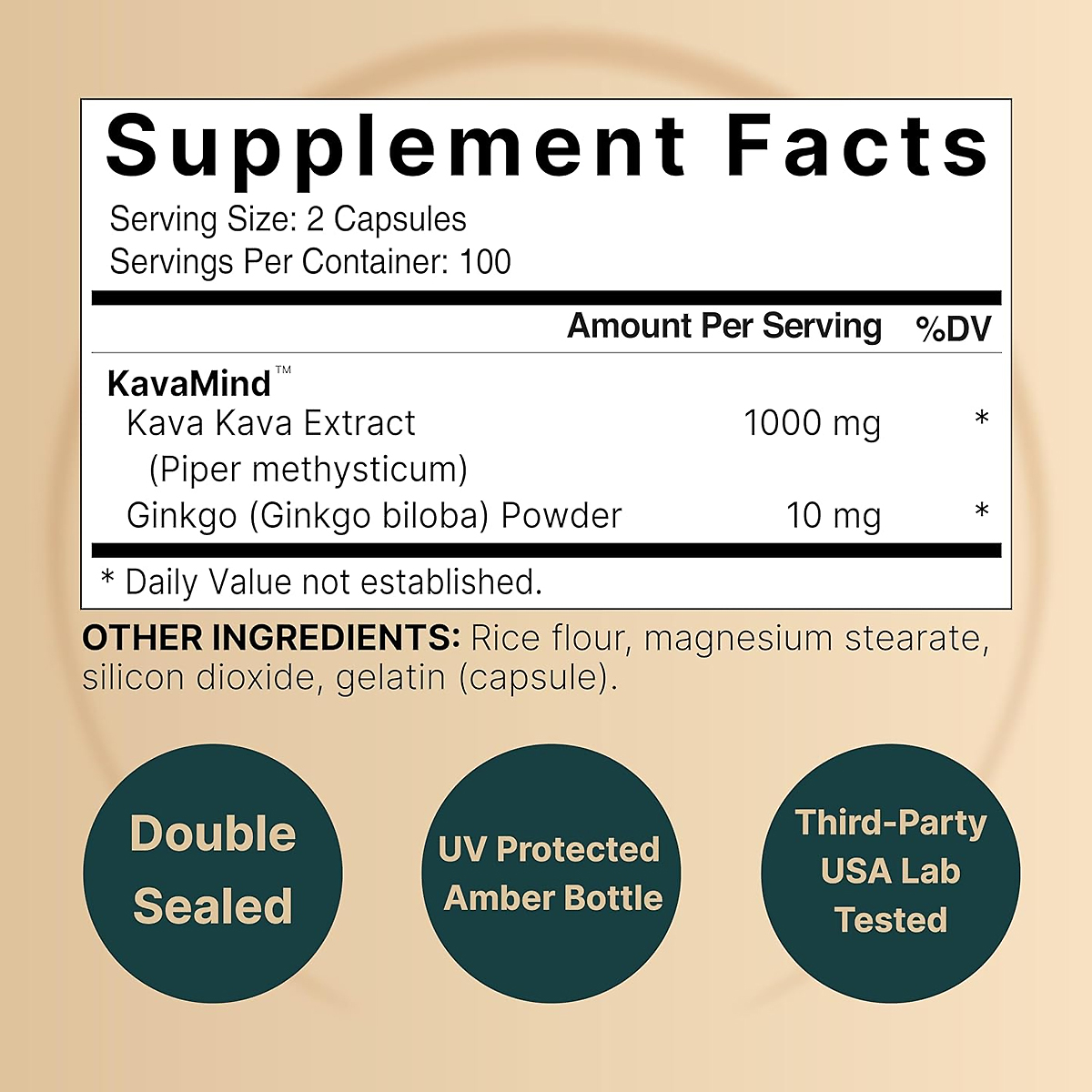
What the panel we could see does not say is as important. It gives no kavalactone amount, no extraction solvent, no plant part and no cultivar. A marketing graphic on the listing says “Traditional Noble Kava Kava Extract” and “Retains 5% Active Kavalactones,” a manufacturer claim with no assay shown; a “Third-Party USA Lab Tested” badge likewise appears without results. If 5% is accurate, a serving holds about 50 mg of kavalactones.
| This product (per 2-capsule serving) | 2020 trial (per day) | Teschke recommendation cited by the FDA (per day) | Australia TGA limit (per day) | |
|---|---|---|---|---|
| Kava extract | 1,000 mg | Aqueous root extract; amount not stated | Not stated | Not stated |
| Kavalactones | Not on the label; about 50 mg if the 5% claim holds | 240 mg (120 mg twice a day) | 120 mg or less, for 3 months or less | 250 mg or less; 125 mg or less per capsule |
| NIH recommended or maximum intake | None established: kava is not a nutrient, and NCCIH’s kava page gives no recommended or maximum amount | |||
On the manufacturer’s own 5% figure, the product sits under every ceiling in the table, at about a fifth of the 2020 trial’s amount. That cuts both ways: a trial that found no benefit at 240 mg gives no reason to expect one from 50 mg. The TGA limit applies to water-based root extracts; the label we read does not say whether this capsule is one.
| Detail | Store listing | Label photos |
|---|---|---|
| Daily amount | “Take one capsule daily” in the long description; “100-day supply at 2 capsules daily” in the short one | Serving is 2 capsules; no Suggested Use line in the photos we could see |
| What the 1,000 mg is | “1000mg of Kava Kava and Ginkgo Leaf Powder”; also “1,000 mg of kava (Piper methysticum) root per serving” | 1000 mg kava extract plus 10 mg ginkgo powder |
| Capsule | “Vegan” and “vegetarian and vegan-friendly” | “gelatin (capsule)” |
The listing’s claim that “KAVAMIND” gives “enhanced absorption of active kavalactones, providing faster results” is a manufacturer statement; a PubMed search for “KavaMind” run on 16 October 2026 returned 0 records. Gelatin is animal-derived, so the “vegan” labelling should be corrected. The listing does warn against combining it with alcohol or liver-stressing medications.
Not verified: this product’s solvent, potency, kavalactone content, contaminant testing or printed directions. The FDA’s supplement Q&A (current as of 27 August 2026) states: “Under DSHEA, FDA does not have the authority to approve dietary supplements before they are marketed.”
Who Might Consider It, and Who Should Skip It
Who this is for: healthy adults who are not pregnant or breastfeeding, drink little alcohol, take no sedatives or prescription medicines, have no liver disease, and want to try a low-dose kava and ginkgo capsule knowing the best recent trial found no benefit in diagnosed anxiety. Occasional use only, after asking a pharmacist or physician.
Who should skip it: most people. Skip it if you are pregnant or breastfeeding, have had liver problems, drink regularly, take benzodiazepines, other sedatives or drugs handled by the liver enzymes above, take warfarin or other blood thinners (ginkgo), need a vegan product, or hope to replace treatment for an anxiety disorder.
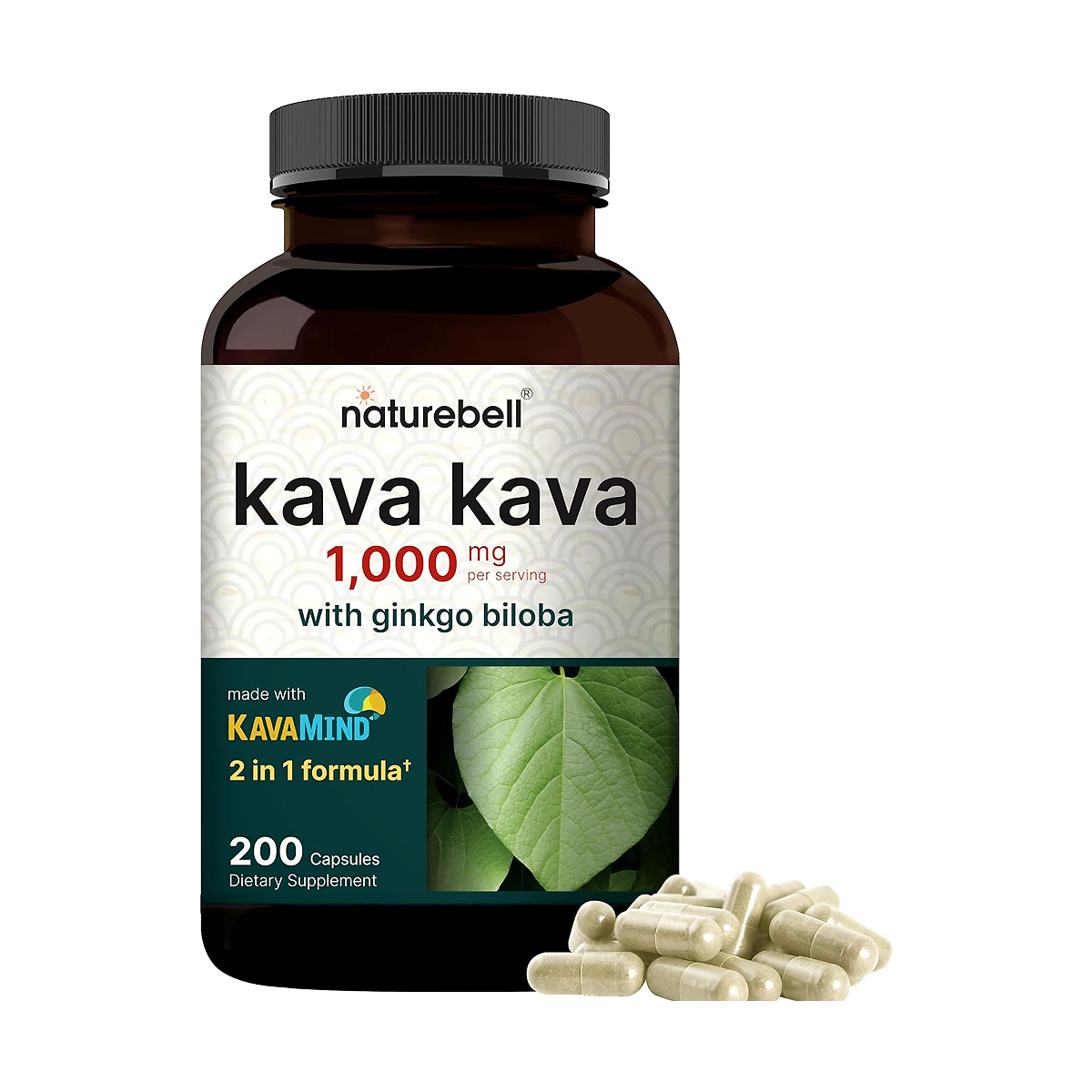
NatureBell Kava Kava Extract 1000mg with Ginkgo, 200 Capsules
Kava extract and ginkgo powder, 200 gelatin capsules (100 two-capsule servings). Browse more herbal supplements.
View Product DetailsFrequently Asked Questions
What is kava kava?
Kava (Piper methysticum) is a South Pacific plant in the pepper family. Its root has been made into ceremonial drinks for thousands of years and is now sold as capsules. NCCIH (April 2025) says supplements are promoted for anxiety, with too little evidence for other conditions.
Does kava help with anxiety?
The evidence conflicts. A 2003 Cochrane review of 11 trials found Hamilton Anxiety scores 5.0 points lower than on placebo, but a 2020 trial of 171 adults with generalised anxiety disorder found no significant benefit over 16 weeks. NCCIH says kava does not appear helpful for that disorder.
Is kava bad for your liver?
Some kava products have been linked to rare but serious liver injury. The FDA warned in 2002 of hepatitis, cirrhosis and urgent transplants, and a WHO review counted 7 deaths and 14 transplants among 93 case reports. Alcohol, liver disease, excessive doses and interacting drugs are listed risk factors.
How much kava is safe to take a day?
No NIH safe amount exists. The FDA memo cites a recommendation of 120 mg kavalactones a day or less for up to three months, and Australia caps water-based root extracts at 250 mg a day. Those are regulatory and research figures, not personal advice; a clinician should set any dose.
Can you take kava with alcohol or medicines?
NCCIH says kava should not be used with sedating substances such as benzodiazepines or alcohol, and to ask a provider before combining it with any medicine. The FDA memo adds possible interactions with drugs handled by CYP1A2, CYP2C19 and CYP3A, and worse acetaminophen liver toxicity in mice.
How long does kava take to work?
NCCIH says kava supplements may help anxiety but may need to be taken for several weeks to produce an effect. The 2020 trial ran 16 weeks and still found no benefit over placebo in diagnosed generalised anxiety disorder, so longer use is no guarantee.
Who should not take kava?
NCCIH warns of special risks in pregnancy and breastfeeding. People with liver disease, heavy drinkers, and people taking sedatives, blood thinners such as warfarin or liver-stressing drugs should ask a clinician first, as should anyone who drives soon after taking it.
Why is ginkgo in this kava capsule?
The listing markets a “2 in 1” formula, but the label shows 10 mg of ginkgo powder against 1,000 mg of kava extract. NCCIH (February 2025) says ginkgo has a modest, inconsistent benefit for dementia symptoms at relatively high doses, and may raise bleeding risk with warfarin.
Sources
- NIH National Center for Complementary and Integrative Health. “Kava: Usefulness and Safety.” Last updated April 2025. Accessed 16 October 2026. nccih.nih.gov
- NIH National Center for Complementary and Integrative Health. “Anxiety and Complementary Health Approaches.” Last updated September 2024. Accessed 16 October 2026. nccih.nih.gov
- NIH National Center for Complementary and Integrative Health. “Ginkgo: Usefulness and Safety.” Last updated February 2025. Accessed 16 October 2026. nccih.nih.gov
- US Food and Drug Administration, Center for Food Safety and Applied Nutrition. Memorandum, “Review of the published literature pertaining to the safety of Kava for use in conventional foods.” 11 August 2020. Accessed 16 October 2026. fda.gov
- Sarris et al. “Kava for generalised anxiety disorder: A 16-week double-blind, randomised, placebo-controlled study.” Australian & New Zealand Journal of Psychiatry, March 2020. Accessed 16 October 2026. PubMed record 31813230 (NLM)
- Pittler and Ernst. “Kava extract for treating anxiety.” Cochrane Database of Systematic Reviews, 2003. Accessed 16 October 2026. PubMed record 12535473 (NLM)
- Bian et al. “Kava as a Clinical Nutrient: Promises and Challenges.” Nutrients, October 2020. Accessed 16 October 2026. PubMed record 33027883 (NLM)
- US Food and Drug Administration. “Questions and Answers on Dietary Supplements.” Content current as of 27 August 2026. Accessed 16 October 2026. fda.gov
- US National Library of Medicine. PubMed search for “KavaMind,” run 16 October 2026 (0 records). PubMed search (NLM)
This article is for educational purposes only and is not medical advice. It is not intended to diagnose, treat, cure, or prevent any disease. These statements have not been evaluated by the Food and Drug Administration. Talk to your doctor before starting any new supplement, especially if you have liver disease, are pregnant or breastfeeding, drink alcohol regularly, or take any prescription medication.