
NCCIH says passionflower's "effect on anxiety and other conditions hasn't been studied extensively," and the trials that do exist are short (nine trials lasting from one day to 30 days in one systematic review) and at least one was industry-funded. Passionflower (Passiflora incarnata) is a climbing vine native to the southeastern United States and Central and South America, sold as a calming herb for anxiety, stress and sleep. It may help a little; it also carries an NIH warning about surgery, and the dose on this label sits below the 600 mg/day used in the 2024 sleep trial covered below.
Key Takeaways
- NCCIH (updated April 2025) says "a small amount of research suggests that oral passionflower might help to reduce symptoms of anxiety" but "conclusions are not definite," and that it might improve total sleep time in insomnia while its effects on falling and staying asleep are "mixed."
- A 2020 review of 9 clinical trials (1 to 30 days) found most reported reduced anxiety, "with the effect less evident in people with mild anxiety symptoms."
- A 110-person polysomnography trial (Lee et al., 2020) found a significant increase in total sleep time versus placebo (P = 0.049) after 2 weeks, but sleep efficiency and time awake after sleep onset did not differ from placebo.
- A 65-person trial (Harit et al., Cureus, 2024) found benefits at 600 mg/day for 30 days, and it was funded by JK Botanicals; this label directs 250–500 mg/day.
- NCCIH (April 2025) warns passionflower "might interact with some anesthesia drugs," says to avoid it before surgery unless a provider recommends it, to talk to a provider if taking it within 2 weeks of surgery, and says it "should not be used during pregnancy."
In this article:
What Is Passionflower, and What Does NCCIH Say?
According to NCCIH (updated April 2025), passionflower has traditionally been used as a sedative, was learned of by sixteenth-century Spanish explorers in South America, and was then introduced to European folk medicine. Today it "is promoted as a dietary supplement for anxiety (including anxiety before surgery), sleep problems, stress, attention-deficit hyperactivity disorder (ADHD), pain, and other conditions."
The agency's assessment is measured: "Passionflower's effect on anxiety and other conditions hasn't been studied extensively." On the conditions with the most research, it says a small amount of work suggests benefit for anxiety and for total sleep time, and that "there is not enough evidence to say whether passionflower is helpful for any other health conditions, including ADHD, congestive heart failure, menopausal symptoms, fibromyalgia, and stress." Note that last word: stress, the headline use on this bottle's marketing, is on NCCIH's not-enough-evidence list.
Anxiety: A Short-Trial Literature
A 2020 systematic review in Nutrients (Janda and colleagues) gathered nine randomized trials of Passiflora incarnata in neuropsychiatric conditions. The studies lasted from one day up to 30 days, enrolled adults, and used many different scales. The majority reported reduced anxiety after passionflower preparations, with the effect less evident in people with mild anxiety symptoms, and no adverse effects such as memory loss were observed. Several of the trials compared passionflower with sedative drugs before dental or surgical procedures: in one, tablets containing 500 mg were compared with oxazepam before surgery, and in another a 260 mg pill was compared with 15 mg of midazolam before wisdom-tooth extraction.
Those single-dose, pre-procedure studies are the most quoted, and they are the least like everyday supplement use. NCCIH's summary is that oral passionflower "might help to reduce symptoms of anxiety and anxiety before a surgical or dental procedure, but conclusions are not definite." The review's authors themselves conclude only that passionflower "may be helpful in treating some symptoms in neuropsychiatric patients." If you are comparing calming supplements, our L-theanine article covers another one with its own trial data.
"A small amount of research suggests that oral passionflower might help to reduce symptoms of anxiety and anxiety before a surgical or dental procedure, but conclusions are not definite."
— NIH National Center for Complementary and Integrative Health, Passionflower (last updated April 2025)Sleep: Two Trials, Two Kinds of Result
NCCIH says a small amount of research suggests oral passionflower "might improve total sleep time in adults with insomnia, but its effects on the time it takes to fall asleep and stay asleep are mixed." Two recent randomized trials show why:
| Trial | Design | Result |
|---|---|---|
| Lee et al., Int Clin Psychopharmacol, 2020 | 110 adults with insomnia disorder; passionflower extract or placebo for 2 weeks; overnight polysomnography; dose described as 60 mg/day by later authors | Total sleep time increased versus placebo (23.05 versus −0.16; P = 0.049); sleep efficiency and wake after sleep onset improved within the passionflower group but did not differ from placebo |
| Harit et al., Cureus, 2024 | 65 people with stress and insomnia (32 extract, 33 placebo); 600 mg/day of an aerial-parts extract (brand name SIVI) at bedtime for 30 days; funded by JK Botanicals | Significant reduction in Perceived Stress Scale score and increase in total sleep time versus placebo; improved general psychological health at days 15 and 30; no adverse effects reported |
Read carefully, the first trial found an objective (polysomnography) increase in total sleep time but not in the other measures compared with placebo. The second reports broader benefits at a much higher dose and longer duration, but it is small, was funded by JK Botanicals according to the paper, and tested a branded standardized extract. Neither is evidence that a different, unstandardized 250 mg capsule will do the same. The Cureus authors themselves attribute the first trial's weaker results to "the low dose (60 mg per day) and shorter duration (two weeks)."
Mayo Clinic's quick tips for better sleep, the baseline any sleep supplement is measured against.
If sleep is the goal, our melatonin article covers the most-used sleep supplement and the label-dose problem that comes with it.
Safety, Surgery and Pregnancy
NCCIH says passionflower "is likely safe when it's used as a flavoring in food," "may be safe when it's taken as a tea for up to 7 nights," and that "the daily use of passionflower extract may be safe for up to 8 weeks." Possible side effects include drowsiness, dizziness and confusion. Beyond eight weeks, the safety evidence in the sources reviewed here runs out.
| Form or situation | NCCIH statement |
|---|---|
| Flavoring in food | Likely safe |
| Tea | May be safe for up to 7 nights |
| Daily extract | May be safe for up to 8 weeks; possible drowsiness, dizziness, confusion |
| Applied to skin | Whether it is safe is not known |
| With anesthesia or surgery medicines | Might slow the nervous system too much; talk to your provider if used within 2 weeks of surgery |
| Pregnancy | Should not be used; may induce uterine contractions |
| Breastfeeding | Little is known |
Genuine safety warning: NCCIH says "passionflower might interact with some anesthesia drugs, so avoid its use before surgery unless recommended by a health care provider," that taking it with anesthesia or other medications used before and after surgery "might slow down the nervous system too much," and to talk to your health care provider if you are taking it within 2 weeks of a scheduled surgery. It also says passionflower "should not be used during pregnancy as it may induce uterine contractions and possibly lead to other problems," and that little is known about breastfeeding.
Because passionflower can cause drowsiness, the practical cautions are the ordinary ones for a sedating herb: do not combine it with driving or other tasks that need alertness until you know how it affects you, and ask your provider or pharmacist before combining it with sedatives or sleep medicines, since NCCIH (2019) notes that dietary supplements may interact with medications.
Inside Paradise Herbs Passion Flower
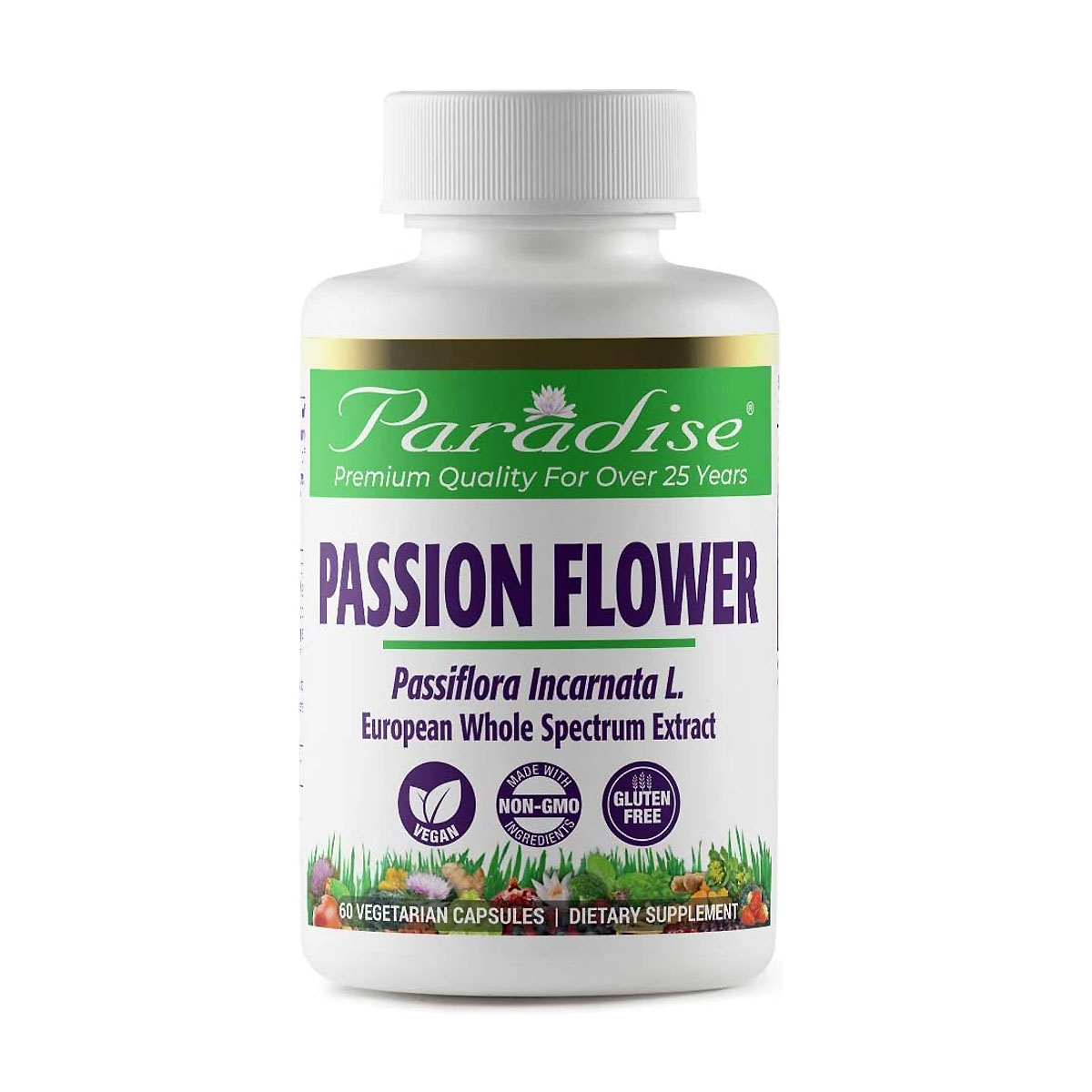
Paradise Herbs Passion Flower is a bottle of 60 vegetarian capsules, labeled "European Whole Spectrum Extract" of Passiflora incarnata L., vegan, non-GMO and gluten free. The Supplement Facts panel lists a serving of one capsule, with 60 servings per container, containing 250 mg of passion flower aerial parts extract, with no established Daily Value. The only other ingredient is the vegetarian (plant cellulose) capsule, and the label states it is made without fillers. It is made in the USA and distributed by Paradise Herbs & Essentials of Huntington Beach, California.
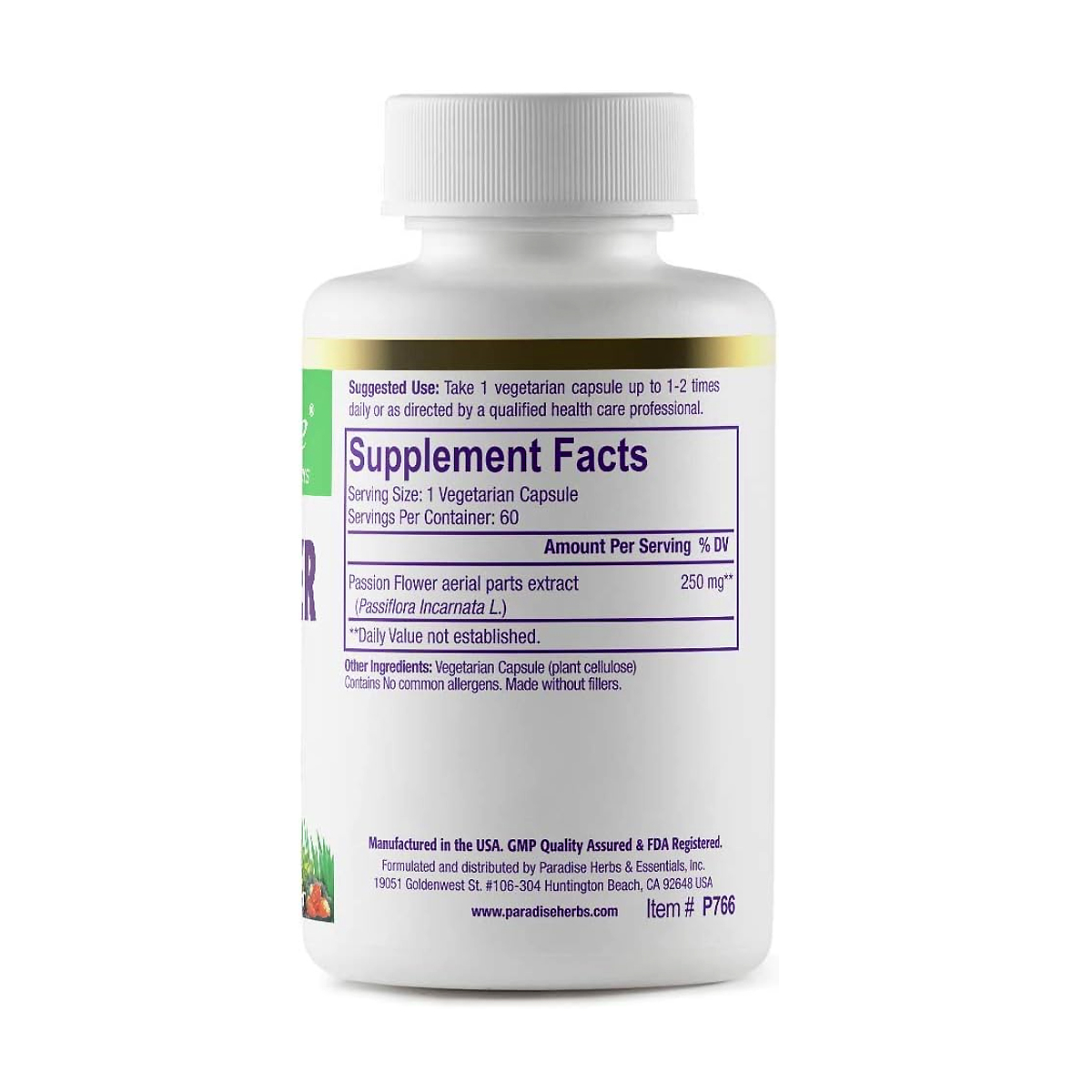
Two discrepancies between the store listing and the label are worth noting. The label's suggested use is "1 vegetarian capsule up to 1-2 times daily," or 250 to 500 mg a day, while the store's description says 1 to 3 capsules daily. We have used the label. And the store's name and short description call the product organic and "USDA Certified Organic," but the label photographs we examined show vegan, non-GMO and gluten-free marks and no organic certification mark, so we have not described it as organic here. The panel also states no standardization, such as a flavonoid percentage, so the extract cannot be matched to those in the trials.
| This product | Typical trial dose | NIH RDA / AI | Tolerable Upper Limit | |
|---|---|---|---|---|
| Passionflower extract | 250 mg per capsule; 250–500 mg/day at the label's 1 capsule up to twice daily (listing: up to 750 mg) | 600 mg/day for 30 days (Cureus trial); 60 mg/day for 2 weeks (Korean trial, as described by later authors); 500 mg single pre-surgery dose in one trial | None: not an essential nutrient | None established; NCCIH: extract may be safe up to 8 weeks |
What the listing claims versus what the evidence supports: the store description says passion flower offers "relaxation and mood balance," "stress relief," and that the supplement "is safe for daily use." Those are manufacturer statements. NCCIH puts stress on its not-enough-evidence list, and says daily extract use "may be safe for up to 8 weeks." The listing's customer testimonial that the product gives "natural relief without any unwanted side effects" is anecdote; NCCIH lists drowsiness, dizziness and confusion as possible side effects.
Who Might Consider It, and Who Should Skip It
Who this is for: healthy adults with occasional restlessness or poor sleep who have talked with a clinician, are not pregnant, have no surgery or procedure within two weeks, are not taking sedating medicines, and will use it for weeks rather than months.
Who should skip it: anyone pregnant; anyone facing surgery or anesthesia within two weeks; anyone taking sedatives or sleep medicines without their prescriber's agreement; anyone with an anxiety disorder or persistent insomnia who is considering it instead of care; and, frankly, most people, for whom sleep habits and a clinician's advice should come first.
Paradise Herbs Passion Flower — 60 Vegetarian Capsules
250 mg of Passiflora incarnata aerial parts extract per capsule, suggested use 1 capsule up to 1–2 times daily. As covered above, NCCIH says the evidence is limited and warns against use before surgery and during pregnancy. Browse more in our supplements.
View Product DetailsFrequently Asked Questions
Does passionflower help with anxiety?
Possibly a little. NCCIH says a small amount of research suggests oral passionflower might help reduce anxiety symptoms, but conclusions are not definite. A 2020 review of nine short trials found most reported reduced anxiety, less evident in mild anxiety.
Does passionflower help you sleep?
It may add to total sleep time. A 110-person trial published in 2020 found a significant increase in total sleep time versus placebo after two weeks, but no difference in sleep efficiency or time awake. NCCIH says effects on falling and staying asleep are mixed.
How much passionflower should I take?
No official dose exists. This label directs one 250 mg capsule up to twice daily. A 2024 trial used 600 mg at bedtime for 30 days, and it was industry-funded. Follow the label or your clinician's advice.
Is passionflower safe to take every day?
NCCIH says daily passionflower extract may be safe for up to 8 weeks, and tea for up to 7 nights. Possible side effects are drowsiness, dizziness and confusion. Safety beyond eight weeks has not been established in the sources reviewed.
Can you take passionflower before surgery?
Generally no. NCCIH says passionflower might interact with some anesthesia drugs and might slow the nervous system too much alongside pre- and post-surgery medicines. Avoid it before surgery unless your provider recommends it, and tell them if you use it within two weeks.
Is passionflower safe during pregnancy?
No. NCCIH says passionflower should not be used during pregnancy because it may induce uterine contractions and possibly lead to other problems. Little is known about whether it is safe while breastfeeding.
Is passionflower tea as effective as capsules?
Unknown. NCCIH says tea may be safe for up to 7 nights and daily extract for up to 8 weeks, but the sources reviewed here do not compare them. Doses in tea and capsules differ, so evidence from one form may not apply to the other.
Can passionflower replace anxiety medication?
No evidence supports that. Most trials comparing passionflower with anti-anxiety drugs used single doses before a procedure; the one longer comparison, in generalized anxiety disorder, lasted 28 days. NCCIH says conclusions are not definite. If you have an anxiety disorder, talk to a health care provider before stopping or replacing any prescribed treatment.
Sources
- NIH National Center for Complementary and Integrative Health. "Passionflower." Last updated April 2025. Accessed 29 September 2026. nccih.nih.gov
- Janda K, et al. Passiflora incarnata in neuropsychiatric disorders: a systematic review. Nutrients, 2020;12(12):3894. Accessed 29 September 2026. doi.org/10.3390/nu12123894
- Lee J, et al. Effects of Passiflora incarnata Linnaeus on polysomnographic sleep parameters in subjects with insomnia disorder: a double-blind randomized placebo-controlled study. Int Clin Psychopharmacol, 2020;35(1):29-35. Accessed 29 September 2026. doi.org/10.1097/yic.0000000000000291
- Harit MK, et al. Randomized, double-blind, placebo-controlled, clinical study of Passiflora incarnata in participants with stress and sleep problems. Cureus, 2024;16(3):e56530. Accessed 29 September 2026. doi.org/10.7759/cureus.56530
- NIH National Center for Complementary and Integrative Health. "Using Dietary Supplements Wisely." Last updated January 2019. Accessed 29 September 2026. nccih.nih.gov
This article is for educational purposes only and is not medical advice. It is not intended to diagnose, treat, cure, or prevent any disease. These statements have not been evaluated by the Food and Drug Administration. Talk to your doctor before starting any new supplement, especially if you are pregnant, breastfeeding, take sedatives, sleep medicines or any prescription medication, have surgery planned within two weeks, or have an anxiety disorder.