
NIH scientists reported in June 2025 that circulating taurine often rose or stayed flat with age in humans, monkeys and mice, which undercuts the claim, popular since a 2023 Science paper, that falling taurine drives aging. Taurine is a sulphur-containing amino acid that the body makes from methionine and cysteine (with vitamin B6) and also takes in from food. It is now sold as a capsule for the heart, the nerves and, on this store’s listing, digestion. The blood-pressure trials behind the strongest heart claims used 1 to 6 g a day, and the capsule reviewed here holds 0.5 g.
Key Takeaways
- A 2023 Science paper reported that taurine fed to middle-aged mice at 1,000 mg per kg a day raised median lifespan by 10 to 12%; its authors wrote that human trials “seem warranted”.
- NIH researchers reported on 5 June 2025 that circulating taurine often held steady or rose with age, with “no solid clinical data” on supplement benefit in humans.
- A 2024 meta-analysis of 20 randomised trials (808 people) found blood pressure lower by 4.0 mm Hg (systolic) and 1.4 mm Hg (diastolic); a 2018 review of 7 studies (103 people) found about 3 mm Hg at 1 to 6 g a day.
- A 2022 systematic review in heart failure found 11 eligible studies, only 1 of high quality, and no significant pooled effect on ejection fraction.
- Country Life Taurine Caps hold 500 mg of taurine and 8.5 mg of vitamin B6 per capsule; a 3 g dose would take 6 capsules and 51 mg of B6, against an EFSA limit of 12 mg a day (our calculation).
In this article:
- What Taurine Is, and Who Might Truly Run Short
- The Aging Claim: A 2023 Paper and a 2025 Correction
- Blood Pressure and Heart Trials: Real Signals, Small Studies
- The Digestion Claim on the Store Listing
- Safety: What EFSA Found, and What Nobody Has Tested
- Inside Country Life Taurine Caps 500 mg
- Who Might Consider It, and Who Should Skip It
- Frequently Asked Questions
What Taurine Is, and Who Might Truly Run Short
A review by Lourenço and Camilo (Nutricion Hospitalaria, November–December 2002) calls taurine the most abundant intracellular amino acid in humans, with roles in bile acid conjugation, heart rhythm, nervous-system signalling and retinal function. It also calls it “conditionally essential”: “In healthy individuals the diet is the usual source of taurine”, and the body can synthesise it when vitamin B6 is present.
The review names patients on long-term intravenous nutrition, premature infants, and people with chronic liver, heart or kidney failure as at risk of low taurine, and says “Further studies are required to determine the benefits of replenishing taurine pools”. We found no NIH recommended intake for taurine. The FDA (FDA consumer guidance, content current as of 21 October 2022) adds that it “is not authorized to approve dietary supplements for safety and effectiveness before they are marketed”.
The Aging Claim: A 2023 Paper and a 2025 Correction
Taurine became a longevity supplement because of a paper in Science (Singh et al., Science, 9 June 2023). It reported that circulating taurine fell with age in mice, monkeys and humans, and that restoring it raised healthy lifespan in worms and mice and healthspan in monkeys.
| Study | Who or what was studied | What it found |
|---|---|---|
| Singh et al., Science, June 2023 | Middle-aged (14-month-old) mice given 1,000 mg/kg of taurine a day; worms; monkeys; observational human data | Median lifespan of mice up 10–12%; worms up 10–23%. In humans, lower taurine correlated with several age-related diseases, and rose after acute endurance exercise |
| NIH / National Institute on Aging, Science, reported 5 June 2025 | Blood samples from humans, monkeys and mice | Circulating taurine “often increased or remained constant with age”; within-person differences often exceeded age-related changes |
| Marcangeli et al., Aging Cell, 2025 | 137 men aged 20–93, both inactive and active | No association between circulating taurine and age, muscle mass, strength, physical performance or mitochondrial function |
The 2023 result is animal science: 1,000 mg per kg is 60 g a day for a 60 kg person on simple scaling (our calculation; cross-species conversion is not that simple, so it is a scale marker only).
“Clinical trials in humans seem warranted to test whether taurine deficiency might drive aging in humans.”
— Singh et al., Science, 9 June 2023, final sentence of the abstractThe NIH Intramural Research Program (NIH IRP news item, 5 June 2025) then reported that taurine levels were “inconsistently associated with health outcomes across age, species, and cohorts”, adding: “there is no solid clinical data that shows its supplementation benefits humans.” The Aging Cell study (Aging Cell, 11 August 2025) said its result challenges taurine deficiency “as a primary driver of aging in humans”. This does not show taurine is harmful, only that the aging case is unproven in people.
NutritionFacts.org, “Randomized Controlled Trials of Taurine Supplementation in Humans”. We could not read a transcript, so it is background, not a source for any figure here.
Blood Pressure and Heart Trials: Real Signals, Small Studies
The better-supported research is on blood pressure and heart function, and the findings are modest but not nothing.
| Review | Scope | Result | Doses and caveats |
|---|---|---|---|
| Waldron et al., Current Hypertension Reports, July 2018 | 7 studies, 103 participants, searched to May 2018 | About 3 mm Hg fall in both systolic and diastolic pressure; no adverse events reported | 1 to 6 g a day, for 1 day to 12 weeks; authors call the findings preliminary |
| Tzang et al., Nutrition Journal, August 2024 | 20 randomised trials, 808 participants, searched to 2 January 2024 | Systolic −4.0 mm Hg (95% CI −7.3 to −0.7); diastolic −1.4 (CI −2.5 to −0.4); heart rate −3.6 bpm; ejection fraction +5.0% | Dose-response not statistically significant (systolic P = 0.113); healthy, heart-failure and other populations mixed |
| McGurk et al., Wellcome Open Research, July 2022 | 285 records screened, 11 studies in heart failure | Several improvements described, but the pooled ejection fraction and stroke volume association was not significant | 500 mg to 6 g a day, 2 to 48 weeks; one paper rated high quality; no significant safety concerns |
A fall of 3 to 4 mm Hg is small for any one person, the trials averaged about 40 participants (808 across 20, our calculation), and the 2024 dose analysis did not show more taurine giving a bigger effect. L-arginine has a similar profile, with label doses far below trial doses.
Safety warning — heart conditions and blood pressure: the heart-failure review concluded that “a formal clinical trial is needed” and notes taurine is “currently unlicensed in Europe and the United States for human medical treatment”. Do not use a taurine capsule in place of prescribed treatment for heart failure or hypertension, and ask your prescriber first if you take blood-pressure medicine, since the trials reported small falls in pressure. We found no interaction data in the sources we reviewed.
The Digestion Claim on the Store Listing
This product’s store title says “Digestive Health Support”. The bottle instead says “Supports the nervous system”, “Supports cardiovascular health” and “Includes Vitamin B6 for utilization”, each flagged with the FDA disclaimer asterisk. The digestion wording is the store’s, not the manufacturer’s.
Taurine does conjugate bile acids, but what the body does with its own taurine is not evidence that an extra 500 mg changes digestion. We reviewed no trial of oral taurine for digestive symptoms, and none of the reviews above measured it, so treat the digestive wording as a marketing claim. The listing also carries three named customer testimonials about digestion, which are unverified anecdotes, and its key features never mention the B6.
Safety: What EFSA Found, and What Nobody Has Tested
The best safety anchor is European. The European Food Safety Authority (EFSA news item, 12 February 2009) confirmed a No Observed Adverse Effect Level of 1,000 mg per kg of body weight a day for taurine as an energy-drink ingredient. That was 43 times the intake of a 60 kg high-level consumer drinking 1.4 cans a day, and the panel concluded exposure at those levels “is not a safety concern”. It also noted reports of acute harm, including deaths, in young people drinking very large amounts, exercising or mixing with alcohol, and said “the assumption of a causal relationship with taurine intake is lacking scientific evidence”; it considered high caffeine intake a possible cause.
The trial reviews reported no adverse events (Waldron, 2018) and no significant adverse effects against controls (Tzang, 2024). But we found no NIH upper intake level, the EFSA opinion concerns drinks rather than long-term capsules, and we found no data on pregnancy, breastfeeding or children. Short, small trials are reassuring, not proof of long-term safety.
Inside Country Life Taurine Caps 500 mg
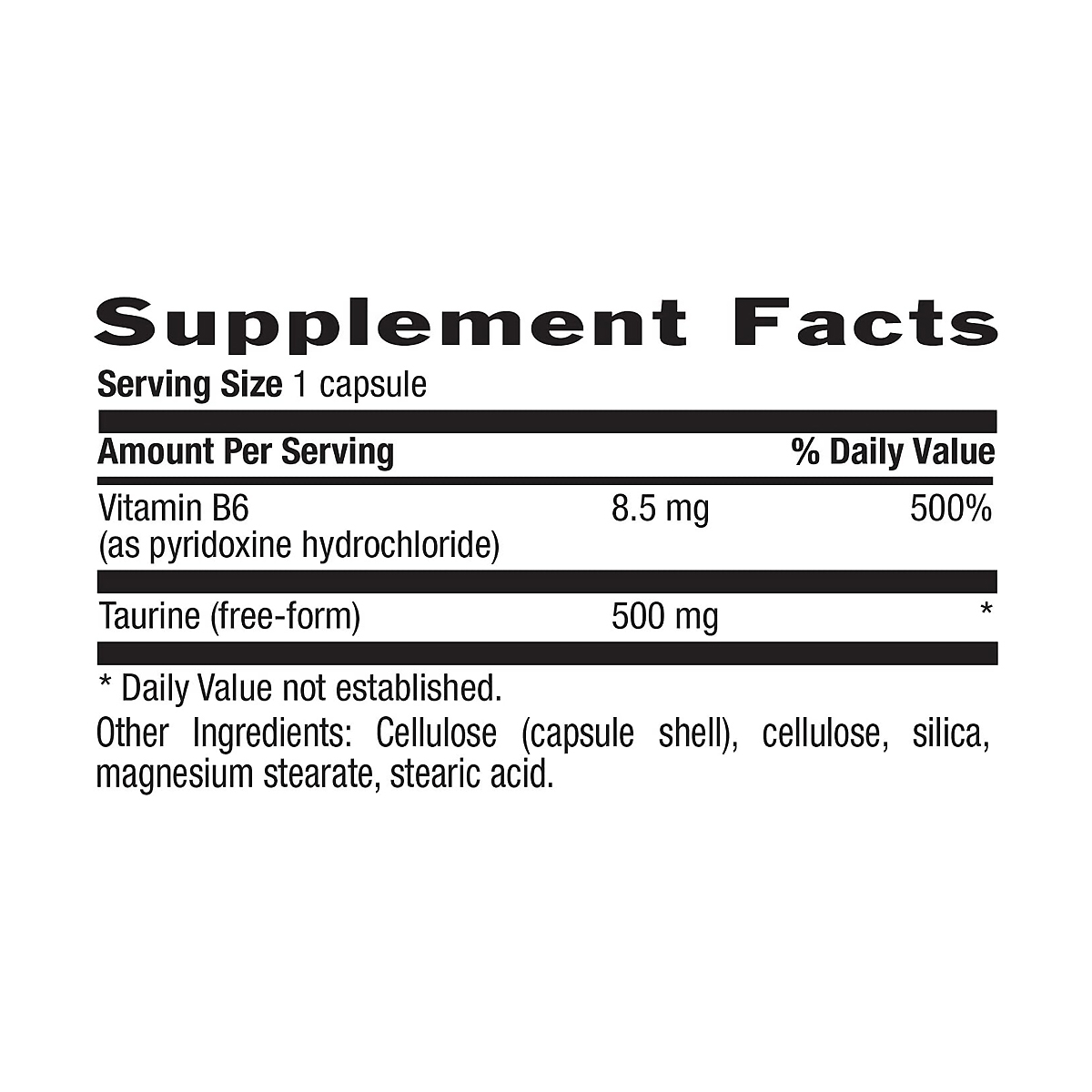
The product is Country Life Taurine Caps 500 mg, 100 vegan capsules. Per capsule, the Supplement Facts photo shows vitamin B6 (as pyridoxine hydrochloride) 8.5 mg, 500% of the Daily Value, and free-form taurine 500 mg, with no Daily Value. The store description says to take one capsule daily with food; the label photos do not show the directions panel, so we could not check that against the bottle.
| This product (per capsule) | Studied in trials | NIH RDA / AI | Upper limit | |
|---|---|---|---|---|
| Taurine | 500 mg | 1–6 g a day (Waldron 2018); 500 mg–6 g a day (McGurk 2022) | None found | None found from NIH; EFSA NOAEL 1,000 mg/kg a day (2009) |
| Vitamin B6 | 8.5 mg | Not applicable | 1.3 mg (adults 19–50; MedlinePlus, reviewed 21 January 2025) | 100 mg a day (US, adults); 12 mg a day (EFSA, 2023) |
One capsule is half the lowest dose in the blood-pressure review and one-twelfth of the highest; 1 g takes 2 capsules, 3 g takes 6 and 6 g takes 12 (our calculation). A bottle would last about 17 days at 6 capsules a day, against the listing’s 100 days at one.
The B6 is the part the listing does not mention. One capsule is about 6.5 times the 1.3 mg adult RDA (our calculation), below both limits. At 2 capsules (17 mg) it passes EFSA’s 12 mg figure, at 6 (51 mg) it is about half the US limit, and at 12 (102 mg) it exceeds the US limit of 100 mg. The NIH Office of Dietary Supplements (NIH ODS B6 fact sheet, updated 16 June 2023, archived copy) sets the US limit at half the dose in studies that found no sensory neuropathy (we read it from an archive snapshot, because the live page blocks automated requests), and MedlinePlus (MedlinePlus, reviewed 21 January 2025) lists numbness and poor coordination among the effects of large doses. See also our vitamin B6 guide.
We did not verify potency, purity or contaminant testing; the photos show “Certified Gluten-Free” wording but no laboratory results. Under DSHEA these statements have not been evaluated by the FDA, and the product is not intended to diagnose, treat, cure or prevent any disease.
Who Might Consider It, and Who Should Skip It
Who this is for: a healthy adult who understands that benefit at 500 mg is unproven and wants a modest taurine and B6 capsule after talking to a clinician.
Who should skip it: most people. Skip it, or ask first, if you take blood-pressure medicine, have heart, liver or kidney disease, are pregnant or breastfeeding (we found no data), or want it for anti-aging or digestion, where the evidence reviewed here does not support the claim. Do not stack B6-containing products without adding up the milligrams.
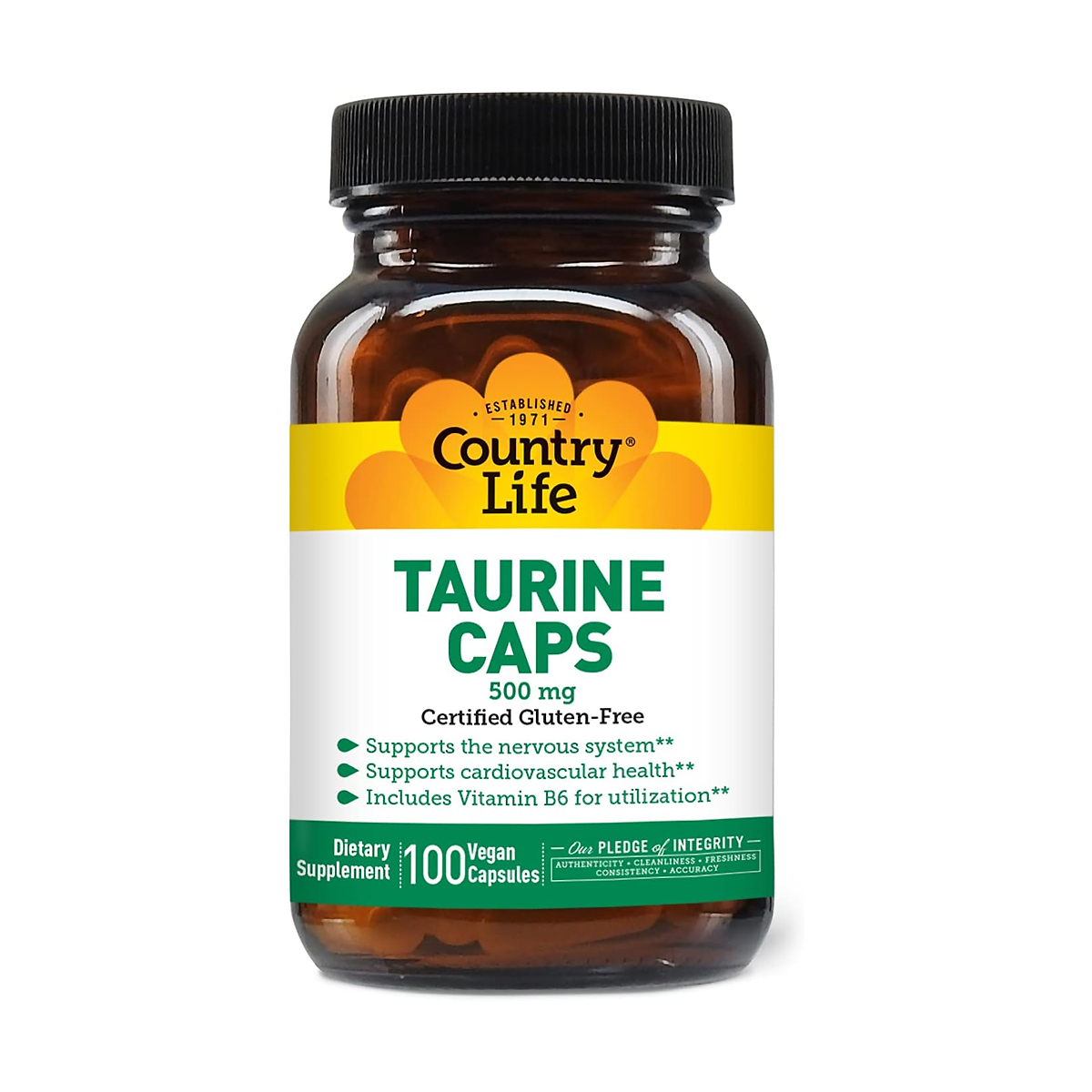
Country Life Taurine Capsules 500 mg, 100 Count
500 mg of free-form taurine and 8.5 mg of vitamin B6 per capsule; 100 vegan capsules; certified gluten-free. Browse more supplements.
View Product DetailsFrequently Asked Questions
What does taurine do in the body?
Taurine is a sulphur-containing amino acid, the most abundant intracellular one in humans, with roles in bile acid conjugation, heart rhythm and nervous-system signalling. A 2002 review calls it conditionally essential: food is the usual source, and the body also makes some with vitamin B6.
Does taurine slow aging or extend lifespan?
Not in humans, as far as the evidence shows. A 2023 paper found longer lifespan in mice and worms, but NIH researchers reported in June 2025 that circulating taurine often rose or stayed flat with age, and the NIH says there is no solid clinical data that supplements benefit humans.
Does taurine lower blood pressure?
Slightly, in trials. A 2024 meta-analysis of 20 randomised trials (808 people) found systolic pressure about 4.0 mm Hg lower and diastolic 1.4 mm Hg lower. A 2018 review found about 3 mm Hg at 1 to 6 g a day. The studies were small and varied.
Is 500 mg of taurine enough to work?
Unknown. The 2018 blood-pressure review used 1 to 6 g a day, so one 500 mg capsule is half of its lowest dose. A 2022 heart-failure review included studies from 500 mg but found one high-quality paper. Benefit at 500 mg is unproven.
Is taurine good for digestion?
Taurine helps the body conjugate bile acids, but we did not find a trial showing that a taurine capsule improves digestion. None of the three reviews cited here measured it. The digestive claim on this store’s listing is not on the manufacturer’s bottle, which cites the nervous system and cardiovascular health.
Is taurine safe to take every day?
EFSA (2009) confirmed a no-observed-adverse-effect level of 1,000 mg per kg of body weight a day, and trials reported no significant adverse effects. But that is short-term, small-trial and energy-drink-based evidence, and we found no NIH upper limit. Ask a clinician if you have heart, liver or kidney disease.
Is the taurine in energy drinks dangerous?
EFSA concluded in 2009 that taurine at typical energy-drink intakes was not a safety concern and that a causal link to reported harms was unproven, pointing instead to caffeine, very high intakes and alcohol. That does not cover every drink or every person.
Can I take taurine with blood-pressure medicine?
Ask your prescriber first. Trials found small blood-pressure falls on taurine, so combining it with medicine could matter, and we found no interaction data in the sources reviewed. This capsule also contains 8.5 mg of vitamin B6, which counts toward your total from other supplements.
Sources
- NIH Intramural Research Program. “IRP researchers conclude that taurine is unlikely to be a good aging biomarker.” News item, 5 June 2025. Accessed 22 October 2026. irp.nih.gov
- Singh P, Gollapalli K, Mangiola S et al. “Taurine deficiency as a driver of aging.” Science, 9 June 2023. Accessed 22 October 2026. PubMed Central
- Marcangeli V, Cefis M, Hammad R et al. “Experimental Evidence Against Taurine Deficiency as a Driver of Aging in Humans.” Aging Cell, 11 August 2025. Accessed 22 October 2026. PubMed Central
- Waldron M, Patterson SD, Tallent J, Jeffries O. “The Effects of Oral Taurine on Resting Blood Pressure in Humans: a Meta-Analysis.” Current Hypertension Reports, 13 July 2018. Accessed 22 October 2026. PubMed record 30006901 (NLM)
- Tzang CC, Lin WC, Lin LH et al. “Insights into the cardiovascular benefits of taurine: a systematic review and meta-analysis.” Nutrition Journal, 15 August 2024. Accessed 22 October 2026. PubMed Central
- McGurk KA, Kasapi M, Ware JS. “Effect of taurine administration on symptoms, severity, or clinical outcome of dilated cardiomyopathy and heart failure in humans: a systematic review.” Wellcome Open Research, 7 July 2022. Accessed 22 October 2026. PubMed Central
- Lourenço R, Camilo ME. “Taurine: a conditionally essential amino acid in humans? An overview in health and disease.” Nutricion Hospitalaria, November–December 2002. Accessed 22 October 2026. PubMed record 12514918 (NLM)
- European Food Safety Authority. “EFSA adopts opinion on two ingredients commonly used in some energy drinks.” News item, 12 February 2009. Accessed 22 October 2026. efsa.europa.eu
- NIH Office of Dietary Supplements. “Vitamin B6 — Health Professional Fact Sheet.” Updated 16 June 2023. Read from an archived copy on 22 October 2026 because the live page blocks automated requests. web.archive.org
- MedlinePlus (National Library of Medicine). “Vitamin B6.” Review date 21 January 2025. Accessed 22 October 2026. medlineplus.gov
- US Food and Drug Administration. “Information for Consumers on Using Dietary Supplements.” Content current as of 21 October 2022. Accessed 22 October 2026. fda.gov
This article is for educational purposes only and is not medical advice. It is not intended to diagnose, treat, cure, or prevent any disease. These statements have not been evaluated by the Food and Drug Administration. Talk to your doctor or pharmacist before starting any new supplement, especially if you take prescription medication, have heart, liver or kidney disease, are pregnant or breastfeeding, or are being treated for a medical condition.