
The Cochrane Collaboration’s 2008 review of 29 trials (5,489 patients) found St. John’s wort extracts beat placebo for major depression, yet in the largest US trial, 340 adults on 900–1,500 mg a day improved no more than those on placebo (−8.68 versus −9.20 Hamilton points, JAMA, 2002), and the same herb can lower blood levels of prescription drugs, including an HIV drug. St. John’s wort (Hypericum perforatum) is a yellow-flowered plant whose dried tops are made into extracts and capsules marketed for “positive mood”, including the 9,000 mg-per-serving product reviewed here.
Key Takeaways
- The Cochrane review (2008) pooled 29 trials in 5,489 patients: in the nine larger placebo-controlled trials the response rate ratio was 1.28 (95% CI 1.10–1.49), and against SSRIs in 12 trials it was 1.00, but trials from German-speaking countries reported more favourable results.
- The 2002 JAMA trial of 340 adults over 8 weeks found neither St. John’s wort nor sertraline significantly better than placebo on the primary measures; full response was 23.9% on St. John’s wort and 31.9% on placebo (P = .21).
- A 2017 meta-analysis of 27 trials (3,808 patients) found response comparable to SSRIs, but every trial lasted 4 to 12 weeks; NIH’s NCCIH (updated May 2025) calls it uncertain whether this holds for severe depression or beyond 12 weeks.
- St. John’s wort cut the HIV drug indinavir’s blood exposure by 57% in healthy volunteers (Lancet, 2000), and a 2016 CDC/FDA-authored review found breakthrough bleeding with oral contraceptives in 3 of 4 studies.
- This product’s label shows 600 mg of 15:1 extract per 2 capsules (the “9,000 mg” is a raw-plant equivalent), gives no hypericin or hyperforin content, and lists a gelatin capsule even though the store FAQ calls it vegan.
In this article:
- What St. John’s Wort Is, and What “Mood Support” Is Standing In For
- Does It Work? 29 Trials Say Yes, the Biggest US Trial Says No
- The Real Catch: A Herb That Changes How Your Body Handles Other Drugs
- Sun, Pregnancy and How Long Is Long Enough
- Inside NatureBell St. John’s Wort 9,000 mg: Label Versus Listing
- Who Might Consider It, and Who Should Skip It
- Frequently Asked Questions
What St. John’s Wort Is, and What “Mood Support” Is Standing In For
According to the NIH’s National Center for Complementary and Integrative Health (NCCIH, last updated May 2025), St. John’s wort is a plant used in traditional medicine, and its best-studied use today is for mild or moderate depression. A label saying “supports positive mood” is supplement wording for that same use.
The National Institute of Mental Health (NIMH, depression overview, page read 18 October 2026) is blunt about the regulatory position: “The FDA has not approved any natural products for treating depression.” It adds that findings are inconsistent and that these products “can come with risks, including, in some cases, interactions with prescription medications.”
If you are looking at other herbs sold for stress or low energy, our reviews of rhodiola and L-theanine use the same evidence-first approach.
Does It Work? 29 Trials Say Yes, the Biggest US Trial Says No
The evidence is positive in aggregate and unreliable in detail.
| Study | Design | What it found |
|---|---|---|
| Linde et al., Cochrane Database of Systematic Reviews, 2008 | 29 randomised double-blind trials, 5,489 patients with major depression | Versus placebo: response rate ratio 1.28 (nine larger trials) and 1.87 (nine smaller trials); versus SSRIs 1.00; fewer dropouts from side effects than SSRIs (OR 0.53) |
| Hypericum Depression Trial Study Group, JAMA, 2002 | 340 adults, HAM-D score of 20 or more, 8 weeks; extract LI-160 at 900–1,500 mg/day, sertraline, or placebo | HAM-D change −8.68 (St. John’s wort) vs −9.20 (placebo), P = .59; sertraline −10.53, P = .18; full response 23.9% vs 31.9% (placebo) |
| Ng, Venkatanarayanan and Ho, Journal of Affective Disorders, 2017 | 27 trials, 3,808 patients, compared with SSRIs; duration 4–12 weeks | Response pooled RR 0.983; remission RR 1.013; dropout OR 0.587 (fewer with St. John’s wort) |
The Cochrane authors concluded that the extracts tested were superior to placebo, similarly effective to standard antidepressants and had fewer side effects, but added that “the association of country of origin and precision with effects sizes complicates the interpretation.” In plain terms, the smaller trials and those from German-speaking countries reported larger effects, which makes the pooled figure harder to interpret.
“This study fails to support the efficacy of H perforatum in moderately severe major depression.”
— Hypericum Depression Trial Study Group, JAMA, 10 April 2002, conclusion of the abstractThat trial ran in 12 US clinics with a “well-characterized” extract. But sertraline also failed to beat placebo on the primary measures, and the authors acknowledged the result “may be due to low assay sensitivity of the trial.” It did not demonstrate a benefit over placebo in moderately severe depression. The 2017 meta-analysis states that it is unclear whether St. John’s wort helps in severe depression or in people at high suicide risk, and NCCIH says the same about severe depression and periods beyond 12 weeks.
NCCIH, “How does St. John’s Wort Interact with Drugs? Q and A with Dr. Gurley.” We could not read a transcript, so it is background, not a source for any figure here.
The Real Catch: A Herb That Changes How Your Body Handles Other Drugs
Safety warning — prescription medicines: NCCIH (May 2025) states: “It has been clearly shown that St. John’s wort can interact in dangerous, sometimes life-threatening ways with a variety of medicines.” If you take any prescription medicine, speak to a pharmacist or physician before starting this herb.
The mechanism is well understood. A 2020 review in the British Journal of Pharmacology explains that St. John’s wort preparations are potent activators of the pregnane-X receptor and so induce the liver enzyme CYP3A4 and the transporter P-glycoprotein, which clear many drugs from the blood. The degree of CYP3A4 induction “correlates significantly with the hyperforin content in the preparation.” Three of that review’s four authors disclosed that they work for a manufacturer of a St. John’s wort medicine.
| Medicine or class | What the source reports | Source and year |
|---|---|---|
| Indinavir (HIV protease inhibitor) | Exposure (area under the curve) down a mean 57%; 8-hour trough down 81%; authors warn of possible resistance and treatment failure | Piscitelli et al., Lancet, 2000 (healthy volunteers) |
| Combined oral contraceptives | 4 studies met criteria: breakthrough bleeding increased in 3; one showed increased follicular growth and probable ovulation; authors say limited evidence “raises concern for decreased contraceptive efficacy” | Berry-Bibee et al., Contraception, 2016 |
| Cyclosporine (transplant) | An interaction in 2000 caused acute rejection in two heart transplant patients | Nicolussi et al., Br J Pharmacol, 2020 |
| SSRIs and other serotonergic drugs | May lead to “increased serotonin-related side effects, which can be serious” | NCCIH, May 2025 |
| Others NCCIH names | Warfarin, digoxin, ivabradine, simvastatin, phenytoin, carbamazepine, nevirapine, irinotecan, imatinib, docetaxel, amitriptyline, bupropion: effects can be weakened | NCCIH, May 2025 |
One detail in the contraceptive review matters for labels like this one: the only study that showed no significant pharmacokinetic difference examined a product containing a low amount of hypericin. Interaction strength tracks what is in the capsule, and, as the next sections show, this label does not say.
Sun, Pregnancy and How Long Is Long Enough
- Duration. NCCIH says that in people not taking any medicine it “appears to be safe when used for up to 12 weeks,” with some studies indicating a year or more.
- Side effects. NCCIH lists diarrhea, dizziness, trouble sleeping, restlessness and skin tingling, and says large oral doses or skin application “might cause severe skin reactions after sun exposure.”
- Pregnancy and breastfeeding. NCCIH: it “may be unsafe to use St. John’s wort during pregnancy because it may increase the risk of birth defects,” and breastfed infants of mothers who take it can experience colic, drowsiness and lethargy.
- Depression itself. If you or someone you know is struggling or having thoughts of suicide, NIMH directs people to call or text the 988 Suicide and Crisis Lifeline at 988, or call 911 in a life-threatening situation.
Inside NatureBell St. John’s Wort 9,000 mg: Label Versus Listing
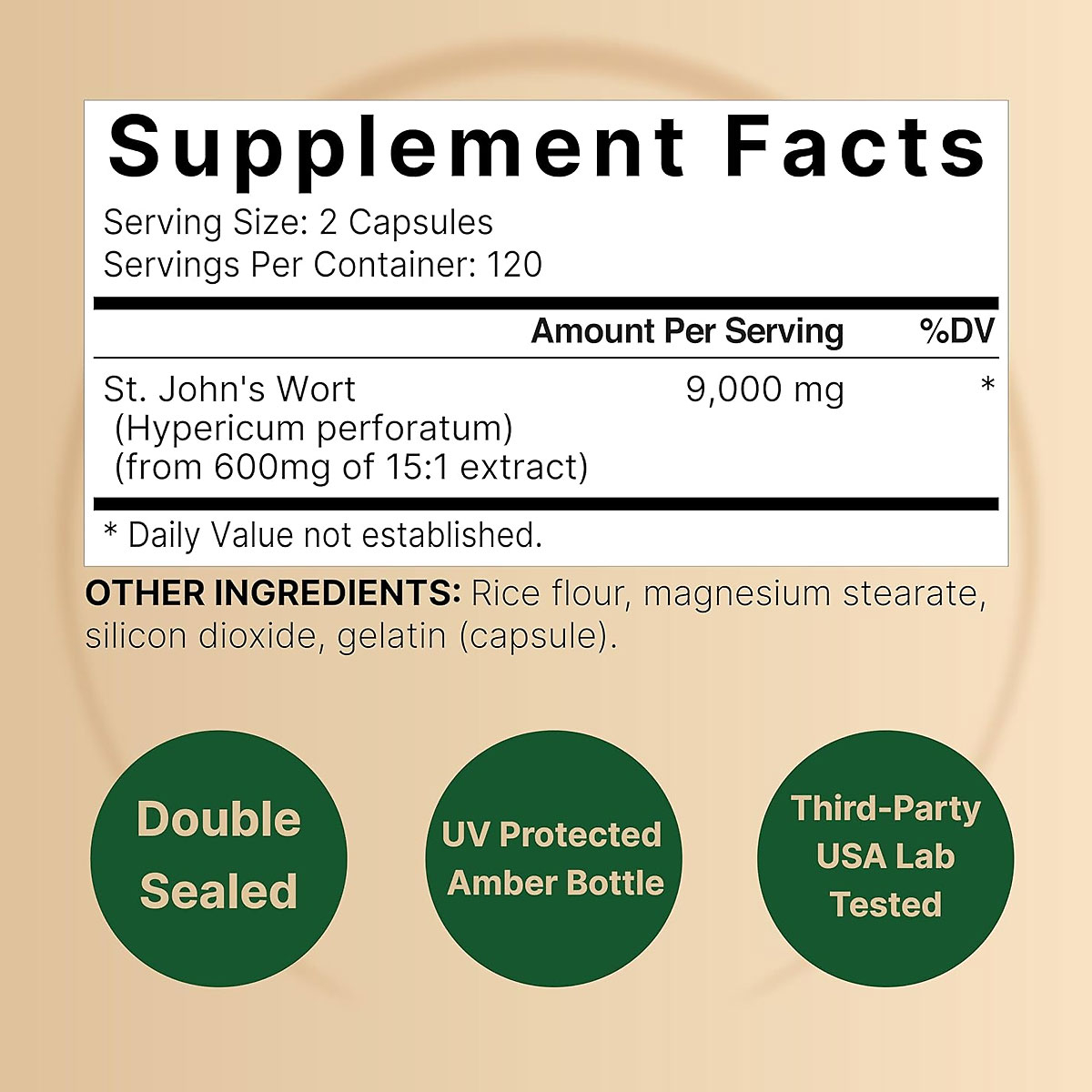
The product is NatureBell St. John’s Wort 9,000 mg, 240 capsules. Its Supplement Facts panel gives a serving as 2 capsules and 120 servings per container, with one active line: St. John’s Wort (Hypericum perforatum) 9,000 mg “from 600mg of 15:1 extract”, Daily Value not established. Other ingredients are rice flour, magnesium stearate, silicon dioxide and a gelatin capsule. At the label directions of 2 capsules daily, a bottle lasts 120 days, and each capsule holds about 300 mg of extract (our calculation).
| This product (per 2-capsule serving) | 2002 JAMA trial (per day) | NIH RDA / AI | Tolerable Upper Limit | |
|---|---|---|---|---|
| St. John’s wort extract | 600 mg of 15:1 extract (labelled as 9,000 mg herbal equivalent) | 900–1,500 mg of extract LI-160 | None established | None established |
| Hypericin / hyperforin content | Not stated on the label | “Well-characterized” extract per the abstract; percentages not given there | Not applicable | Not applicable |
St. John’s wort is not a nutrient, so no RDA or Upper Limit exists; “none established” does not mean “safe at any amount”. The “9,000 mg” counts plant material before extraction, the way the 15:1 ratio is defined; the trial doses are the weight of a different, characterised extract. The two numbers cannot be compared directly, and without a hypericin or hyperforin percentage on the label, a reader cannot tell whether 600 mg of this extract corresponds to anything that was tested. The missing hyperforin figure also means the label gives no way to judge how strongly it may affect other drugs.
| Claim | Store listing | What we checked |
|---|---|---|
| Vegan | FAQ: “vegan-friendly and free of animal-derived ingredients” | The Supplement Facts photo lists “gelatin (capsule)”; gelatin is an animal-derived ingredient, so the FAQ answer cannot be right if the panel is accurate |
| Side effects | FAQ: “side effects are rare”; mild gastrointestinal discomfort | NCCIH (May 2025) lists diarrhea, dizziness, sleeplessness, restlessness, tingling and severe sun-related skin reactions |
| Testing and origin | “Third-Party USA Lab Tested” badge; “harvested in North America” | No laboratory name or results appear in the photos or listing we read; we could not verify either claim |
The listing’s directions (2 capsules daily with water, preferably with meals) and its 120-day supply match the panel’s 120 servings. Under DSHEA, the FDA (FDA consumer guidance, content current as of 21 October 2022) is “not authorized to approve dietary supplements for safety and effectiveness before they are marketed.” Not verified: this product’s potency, purity, contaminant testing or the source of its extract.
Who Might Consider It, and Who Should Skip It
Who this is for: adults who have already discussed low mood with a clinician, take no prescription or over-the-counter medicines that could interact, are not pregnant or breastfeeding, and understand that the trial evidence is for short courses (4 to 12 weeks) in mild-to-moderate depression, using extracts that were characterised in ways this label is not.
Who should skip it: most people. Skip it if you take birth control, an antidepressant, HIV, transplant, seizure, heart, blood-thinning, cancer or statin medicine; if you are pregnant, trying to conceive or breastfeeding; if you have severe depression or thoughts of self-harm; or if you want a product that is strictly vegan.
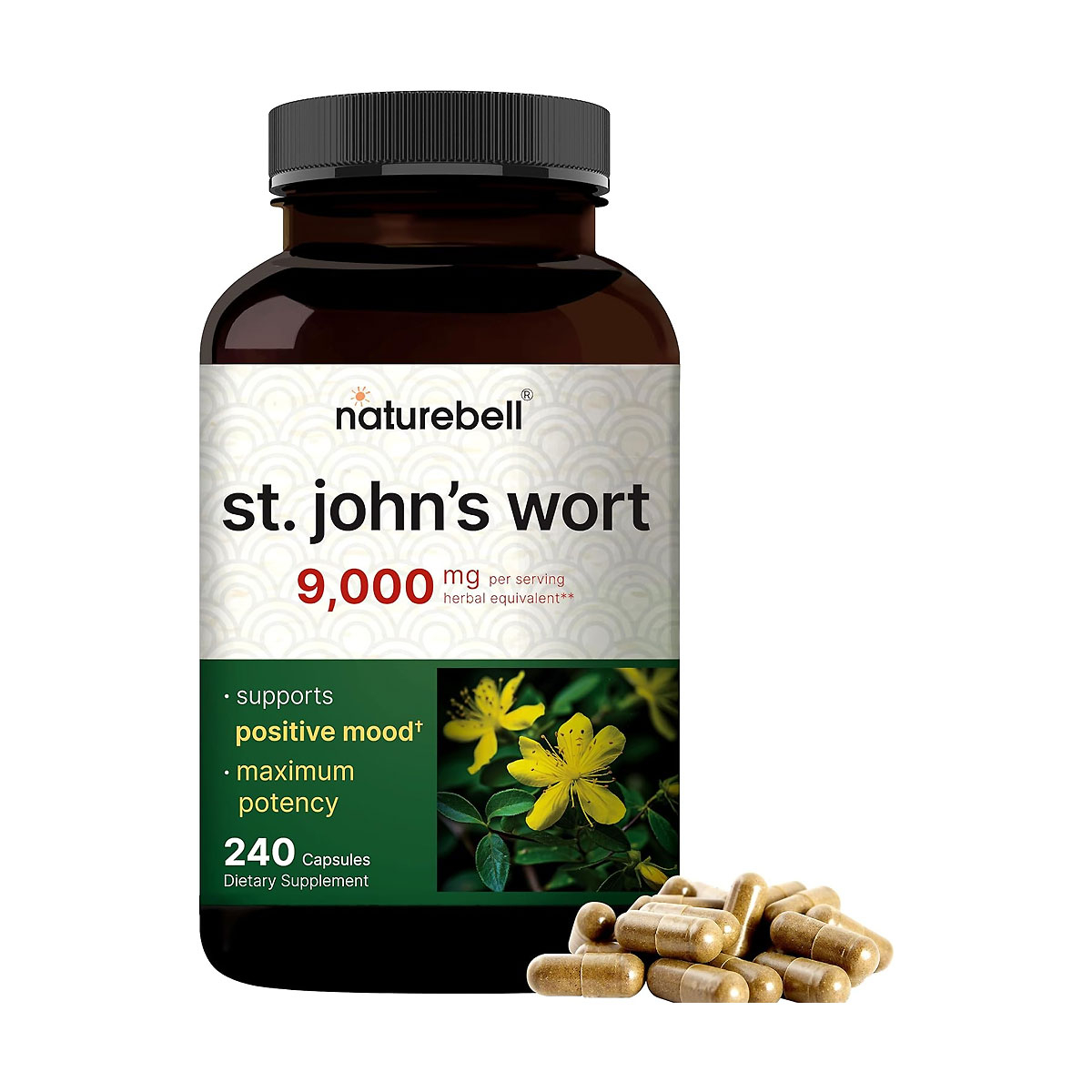
NatureBell St. John’s Wort 9,000 mg, 240 Capsules
600 mg of 15:1 Hypericum perforatum extract (labelled 9,000 mg herbal equivalent) per 2-capsule serving; 120 servings; gelatin capsule. Browse more herbal supplements.
View Product DetailsFrequently Asked Questions
What is St. John’s wort used for?
St. John’s wort (Hypericum perforatum) is a flowering plant whose extracts are mainly studied for mild-to-moderate depression. NCCIH (updated May 2025) says it appears more effective than placebo for that use, while evidence for other conditions is insufficient to reach definite conclusions.
Does St. John’s wort work for depression?
Evidence is mixed. A 2008 Cochrane review of 29 trials found it superior to placebo, but the largest US trial (340 adults, JAMA 2002) found no significant difference from placebo. NIMH says the FDA has not approved any natural product for treating depression.
Is St. John’s wort as effective as an SSRI?
In trials, yes, on average: a 2017 meta-analysis of 27 trials (3,808 patients) found comparable response to SSRIs, with fewer dropouts. But the trials lasted only 4 to 12 weeks.
Is St. John’s wort safe to take every day?
NCCIH says that in people taking no medicines it appears safe for up to 12 weeks, with some studies suggesting a year or more. It can cause severe skin reactions after sun exposure, and it may be unsafe during pregnancy. Daily use is not safe with many medicines.
What medicines does St. John’s wort interact with?
NCCIH names some antidepressants, birth control pills, cyclosporine, phenytoin, carbamazepine, digoxin, indinavir, nevirapine, warfarin, simvastatin and several cancer drugs.
Does St. John’s wort make birth control fail?
A 2016 CDC- and FDA-authored systematic review found breakthrough bleeding in 3 of 4 studies and, in one, increased follicular growth and probable ovulation. It concluded that limited evidence raises concern for decreased contraceptive efficacy.
Can I take St. John’s wort with an antidepressant?
Not without a prescriber’s agreement. NCCIH warns that combining it with certain antidepressants or other serotonin-affecting drugs may increase serotonin-related side effects that “can be serious.” Do not stop a prescribed antidepressant to try this herb.
Is 9,000 mg a high dose of St. John’s wort?
Not in the way it sounds. The label says 9,000 mg is a herbal equivalent of 600 mg of 15:1 extract. The 2002 JAMA trial used 900 to 1,500 mg a day of a different extract, so the figures are not directly comparable.
Sources
- National Center for Complementary and Integrative Health (NIH). “St. John’s Wort.” Last updated May 2025. Accessed 18 October 2026. nccih.nih.gov
- Linde K, Berner MM, Kriston L. “St John’s wort for major depression.” Cochrane Database of Systematic Reviews, 8 October 2008. Accessed 18 October 2026. PubMed record 18843608 (NLM)
- Hypericum Depression Trial Study Group. “Effect of Hypericum perforatum (St John’s wort) in major depressive disorder: a randomized controlled trial.” JAMA, 10 April 2002. Accessed 18 October 2026. PubMed record 11939866 (NLM)
- Ng QX, Venkatanarayanan N, Ho CY. “Clinical use of Hypericum perforatum (St John’s wort) in depression: a meta-analysis.” Journal of Affective Disorders, 1 March 2017. Accessed 18 October 2026. PubMed record 28064110 (NLM)
- Piscitelli SC et al. “Indinavir concentrations and St John’s wort.” The Lancet, 12 February 2000. Accessed 18 October 2026. PubMed record 10683007 (NLM)
- Berry-Bibee EN et al. “Co-administration of St. John’s wort and hormonal contraceptives: a systematic review.” Contraception, December 2016. Accessed 18 October 2026. PubMed Central
- Nicolussi S et al. “Clinical relevance of St. John’s wort drug interactions revisited.” British Journal of Pharmacology, March 2020. Accessed 18 October 2026. PubMed Central
- National Institute of Mental Health. “Depression.” No review date shown on the page text we read. Accessed 18 October 2026. nimh.nih.gov
- US Food and Drug Administration. “Information for Consumers on Using Dietary Supplements.” Content current as of 21 October 2022. Accessed 18 October 2026. fda.gov
This article is for educational purposes only and is not medical advice. It is not intended to diagnose, treat, cure, or prevent any disease. These statements have not been evaluated by the Food and Drug Administration. Talk to your doctor or pharmacist before starting any new supplement, especially if you take prescription medication, are pregnant or breastfeeding, or are being treated for depression. If you are in crisis in the US, call or text 988.