
The NIH's National Center for Complementary and Integrative Health says "there isn't enough reliable evidence to determine whether rhodiola or its components are useful for any health-related purpose" — yet the store copy for this supplement says clinical studies show it improves mental and physical performance. Rhodiola (Rhodiola rosea) is an herb from cold, high-altitude regions, also called golden root or rose root, and it is sold as an "adaptogen" for stress and fatigue. The research is real, but it is small, contradictory and, in the words of one systematic review, limited by methodological flaws.
Key Takeaways
- NCCIH (page last updated April 2025) states that "most of the research in people is of low-to-moderate quality" and that it has not learned enough to say whether rhodiola is useful for any health-related purpose.
- A 2012 systematic review of 11 trials found that only 2 of 6 physical-fatigue trials and 3 of 5 mental-fatigue trials reported benefit, and all 11 had a high or unclear risk of bias (BMC Complement Altern Med, 2012).
- In a 57-person 12-week depression trial, the change on the Hamilton scale was −5.1 for rhodiola versus −4.6 for placebo and −8.2 for sertraline, with no significant difference between groups (Phytomedicine, 2015).
- A 2025 meta-analysis of 26 trials (668 healthy people) found improved VO2max (effect size 0.32), while a 2023 review of 13 trials called most studies unclear or high risk of bias.
- This capsule holds 250 mg of extract standardized to 3% rosavins and at least 1% salidrosides; the label's 2 capsules a day is 500 mg, below the 576 mg used in a 2009 stress-fatigue trial and the >600 mg subgroup in the 2025 meta-analysis.
In this article:
- What Is Rhodiola, and What Does NCCIH Say?
- Stress and Fatigue: Small Trials, Big Flaws
- Mood: A Trial Where Placebo Nearly Matched It
- Athletic Performance: Two Reviews, Two Tones
- Safety, Interactions and the Adulteration Problem
- Inside Life Extension Rhodiola Extract 250 mg
- Who Might Consider It, and Who Should Skip It
- Frequently Asked Questions
What Is Rhodiola, and What Does NCCIH Say?
According to NCCIH, rhodiola grows in cold regions and at high altitudes in Europe, Asia and North America, and has a long history of use in Russia, Scandinavia and elsewhere in Europe for work performance, endurance, fatigue, depression and altitude sickness. Today, NCCIH says, it is "promoted for improving athletic performance, mood, and cognition; increasing energy; and reducing stress."
The agency's assessment of the evidence is unusually blunt: "There isn't enough reliable evidence to determine whether rhodiola or its components are useful for any health-related purpose. Most of the research in people is of low-to-moderate quality." Under "What have we learned?" it repeats that it has not learned enough to say whether rhodiola is useful. "Adaptogen" is the label the supplement industry uses; NCCIH assesses rhodiola on specific outcomes instead. For the same evidence-first treatment of the better-known adaptogen, see our ashwagandha article.
Stress and Fatigue: Small Trials, Big Flaws
The claim on this bottle is "Promotes Cellular and Physical Energy," and the store description adds that it "encourages higher measures of mental performance like associative thinking, short-term memory & concentration." The best way to test that is to look at the reviews that gathered every trial. A 2012 systematic review in BMC Complementary and Alternative Medicine (Ishaque and colleagues) found 11 eligible trials of rhodiola for physical and mental fatigue:
| Question | Trials reporting benefit | Quality |
|---|---|---|
| Physical fatigue in healthy people | 2 of 6 | All 11 included studies had a high risk of bias or reporting flaws |
| Mental fatigue | 3 of 5 | Same |
| Authors' conclusion | "Research regarding R. rosea efficacy is contradictory"; a rigorously designed RCT is needed | |
One of the more informative individual trials is a phase III study by Olsson and colleagues (Planta Medica, 2009). Sixty adults aged 20 to 55 who met Swedish diagnostic criteria for fatigue syndrome took either four tablets a day of the extract SHR-5 (576 mg of extract per day) or four placebo tablets for 28 days. Both groups improved on burnout, mental health, depression and attention scores, which is the placebo effect in action. Compared head-to-head, though, the extract beat placebo on the Pines burnout scale and on several attention measures, and it changed the cortisol response to awakening. The authors concluded it has an anti-fatigue effect. It is a genuine positive signal, but it is one trial of 60 people, on one specific extract, for 28 days.
"There isn't enough reliable evidence to determine whether rhodiola or its components are useful for any health-related purpose. Most of the research in people is of low-to-moderate quality."
— NIH National Center for Complementary and Integrative Health, RhodiolaMayo Clinic on how stress affects the body, the problem adaptogens are marketed to address.
Mood: A Trial Where Placebo Nearly Matched It
Mood is the other headline use. A 2015 randomized trial in Phytomedicine (Mao and colleagues) assigned 57 people with mild to moderate major depressive disorder to 12 weeks of a standardized rhodiola extract, sertraline, or placebo:
| Group | Change in Hamilton depression score (95% CI) | Participants reporting adverse events |
|---|---|---|
| Sertraline | −8.2 (−12.7 to −3.6) | 63.2% |
| Rhodiola rosea extract | −5.1 (−8.8 to −1.3) | 30.0% |
| Placebo | −4.6 (−8.6 to −0.6) | 16.7% |
All three groups improved modestly and the differences between them were not statistically significant (p = 0.79 for the Hamilton scale). Rhodiola was numerically closer to placebo than to the antidepressant. The authors described it as producing "less antidepressant effect versus sertraline" while being better tolerated. That is a proof-of-concept result in a small group, not evidence that a capsule can stand in for treatment. NCCIH's own caution is worth repeating: depression can be a serious illness, and anyone who may have it should consult a health care provider.
Athletic Performance: Two Reviews, Two Tones
The most encouraging recent pooled result concerns endurance. A 2025 meta-analysis in Frontiers in Nutrition (Wang and colleagues) pooled 26 randomized trials involving 668 healthy participants with a mean age of 22, on supplementation averaging 33 days. It reported improved VO2max (11 studies; effect size 0.32), time to exhaustion (7 studies; 0.38) and time-trial performance (5 studies; −0.40, where lower is better), plus lower creatine kinase and lactate, but no significant effect on inflammatory markers such as IL-6 and CRP. Subgroup analysis found larger VO2max gains at doses above 600 mg per day.
A 2023 systematic review in Phytotherapy Research (Sanz-Barrio and colleagues) read a smaller set of trials more cautiously: 13 studies with 263 participants, results "heterogenous," 11 with some positive effects and 2 with none, and "unclear or high risk of bias in most of the studies." It found that acute supplementation helped endurance performance and perceived exertion, while chronic supplementation helped anaerobic performance but not endurance, and called for more high-quality studies. The two reviews agree on direction and disagree on confidence, which is what NCCIH's "low-to-moderate quality" verdict looks like in practice.
Safety, Interactions and the Adulteration Problem
NCCIH says rhodiola "is possibly safe for up to 12 weeks." Side effects "may include dizziness, headache, insomnia, and either dry mouth or excessive saliva production." It also notes that "interactions between rhodiola and losartan (a drug used for high blood pressure) have been reported," and that little is known about safety in pregnancy or breastfeeding. The label on this product echoes the insomnia point, advising you to take it early in the day if it interferes with your sleep. Our melatonin article covers the other side of that problem.
The less obvious risk is identity. A 2026 review in Frontiers in Pharmacology (Li and colleagues) states that "market and economic factors have fueled widespread adulteration in the global Rhodiola product market," and that authenticating the species inside processed products is "particularly challenging" because standard morphological, microscopic and genetic methods can be defeated by manufacturing. That is a statement about the category, not about this brand, and this product is standardized to declared marker compounds. But it is a reason to treat the species on the label as a claim you cannot easily check.
Inside Life Extension Rhodiola Extract 250 mg
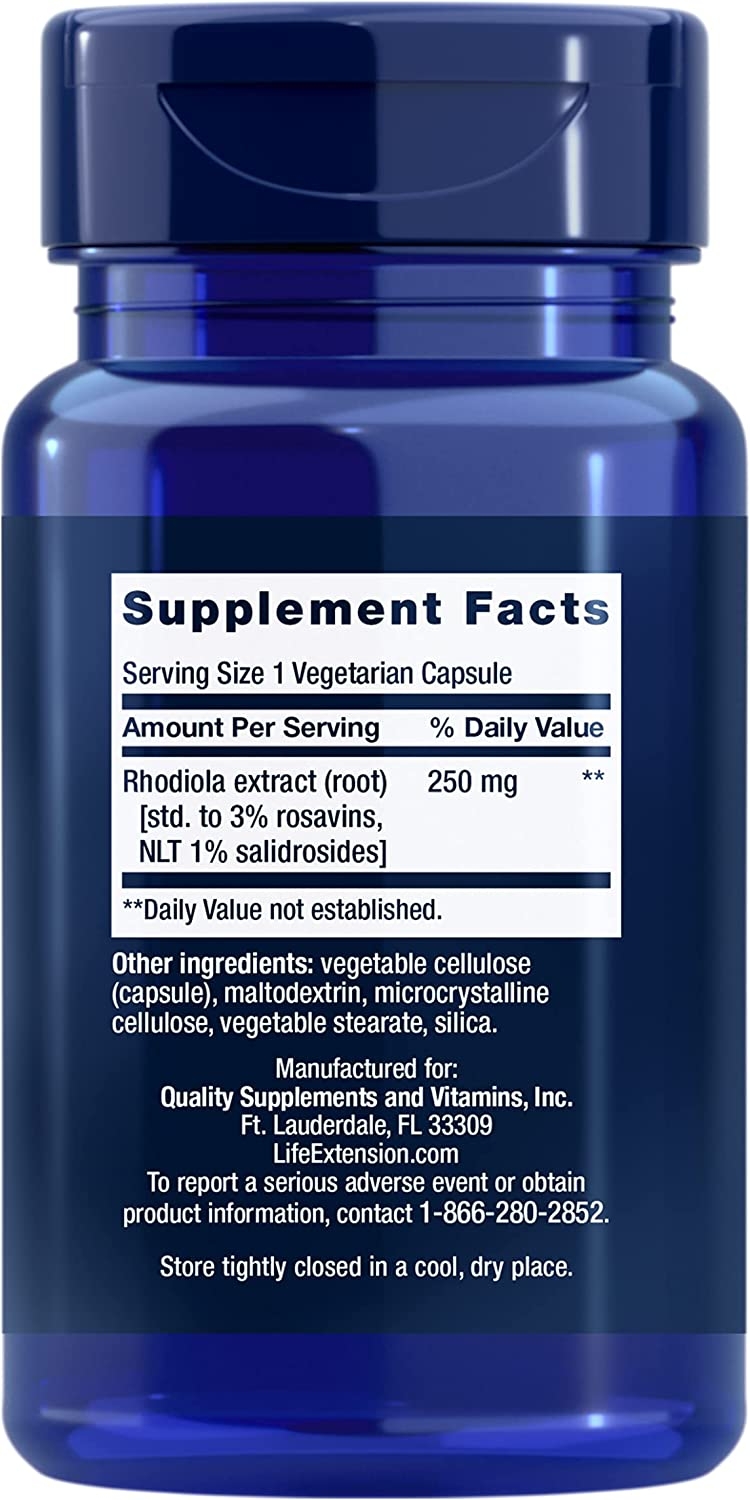
Life Extension Rhodiola Extract is a 60-count bottle of vegetarian capsules. The Supplement Facts panel lists a serving of one capsule containing 250 mg of rhodiola root extract "std. to 3% rosavins, NLT 1% salidrosides," with no established Daily Value. Other ingredients are vegetable cellulose (the capsule), maltodextrin, microcrystalline cellulose, vegetable stearate and silica. The label directs one capsule twice daily on an empty stomach, which makes the bottle a 30-day supply.
| This product | Typical trial dose | NIH RDA / AI | Tolerable Upper Limit | |
|---|---|---|---|---|
| Rhodiola extract | 250 mg per capsule; 500 mg/day at the label's 1 capsule twice daily | 576 mg/day SHR-5 (fatigue trial); 290–1,500 mg/day across five RCTs in a 2026 review; endurance gains larger above 600 mg/day | None: not an essential nutrient | None established; NCCIH calls it possibly safe up to 12 weeks |
At the label dose this product sits below the 576 mg used in the fatigue trial and the 600 mg threshold in the endurance subgroup, though the extracts differ in composition and standardization, so a milligram-for-milligram comparison is not exact. The label declares its marker compounds but, on the Supplement Facts panel, does not name the species; the store listing describes it as made from genuine Rhodiola rosea.
What the listing claims versus what the evidence supports: the store description says "clinical studies indicate that Rhodiola rosea improves mental and physical performance, physical endurance," that it "promotes efficient ATP production," and that it encourages higher associative thinking, short-term memory and concentration. Those are manufacturer statements. NCCIH says the evidence is not enough to say rhodiola is useful for any health-related purpose, and the ATP-production mechanism is not addressed by any of the human trials reviewed here.
Who Might Consider It, and Who Should Skip It
Who this is for: healthy adults who have talked with a clinician, are curious about a standardized extract for stress-related tiredness or endurance training, will limit use to the 12 weeks NCCIH describes as possibly safe, and understand that the expected effect is modest and unproven.
Who should skip it: anyone taking losartan; anyone pregnant or breastfeeding; anyone with depression or a family history of it who is considering it instead of care (NCCIH advises consulting a provider); anyone sensitive to stimulating effects or prone to insomnia; and, frankly, most people whose fatigue has not been checked by a clinician first.
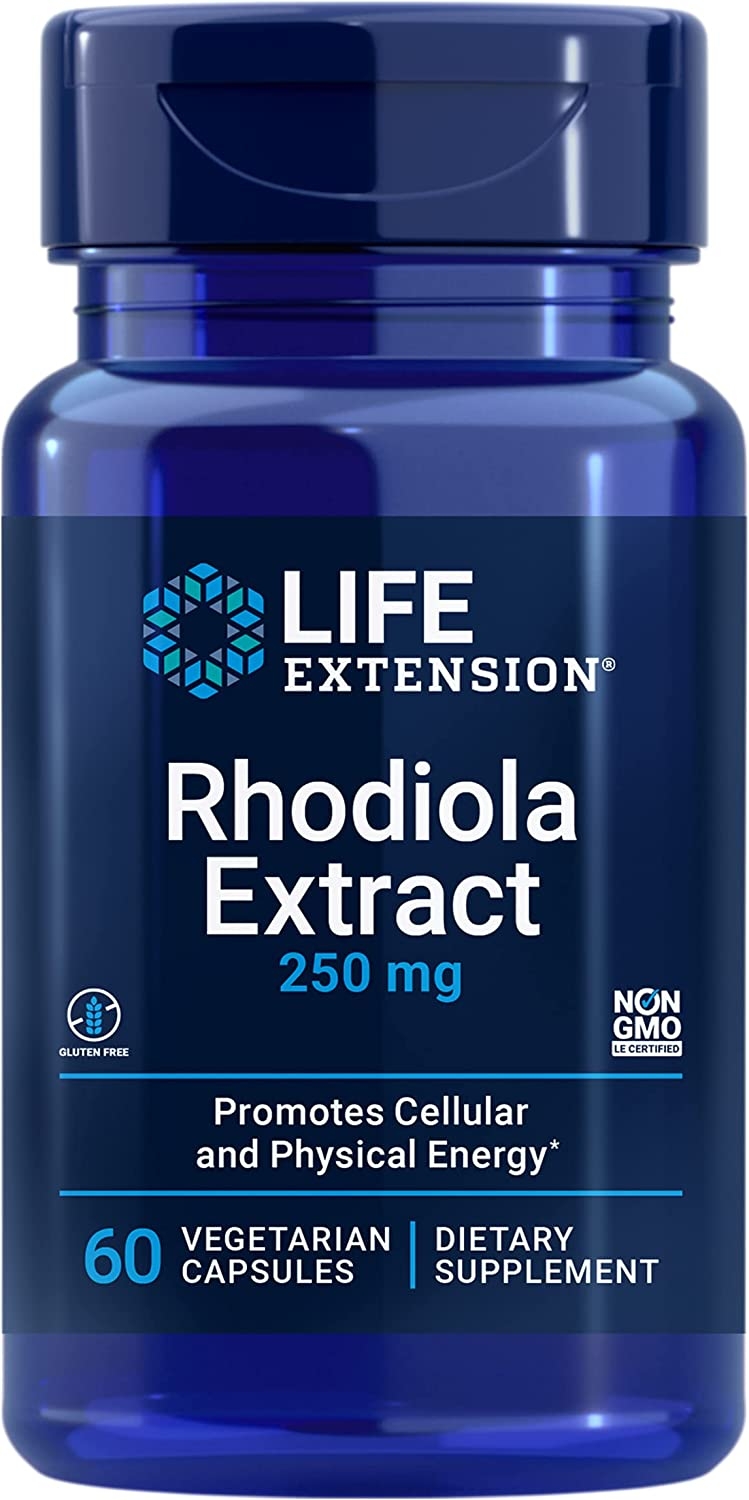
Life Extension Rhodiola Extract 250 mg — 60 Vegetarian Capsules
250 mg of root extract per capsule, standardized to 3% rosavins and not less than 1% salidrosides, directed as 1 capsule twice daily on an empty stomach. As covered above, NCCIH says the evidence for rhodiola is not yet enough to say it is useful for any purpose. Browse more in our specialty supplements.
View Product DetailsFrequently Asked Questions
Does rhodiola help with stress and fatigue?
Possibly a little, but the evidence is weak. A 2012 systematic review found benefit in only 2 of 6 physical-fatigue and 3 of 5 mental-fatigue trials, all at high or unclear risk of bias. NCCIH says there is not enough reliable evidence to call it useful.
How much rhodiola should I take per day?
No official dose exists. Five trials in a 2026 review used 290 to 1,500 mg of extract daily; a 2009 fatigue trial used 576 mg. This label directs one 250 mg capsule twice daily, or 500 mg. Follow the label or your clinician's advice.
Is rhodiola safe to take every day?
NCCIH says rhodiola is possibly safe for up to 12 weeks, with possible dizziness, headache, insomnia and dry mouth or excess saliva. Long-term safety is not established, and little is known about pregnancy or breastfeeding.
Can rhodiola replace an antidepressant?
No. In a 57-person 2015 trial, rhodiola produced a smaller Hamilton score drop (−5.1) than sertraline (−8.2), though it was not significantly different from placebo (−4.6). NCCIH advises anyone who may have depression to consult a health care provider.
Does rhodiola interact with medications?
NCCIH reports interactions between rhodiola and losartan, a blood pressure drug. It also warns that some herbs and medicines interact harmfully, so if you take any medicine, ask your health care provider or pharmacist before starting.
What do rosavins and salidrosides on the label mean?
They are marker compounds used to standardize rhodiola extracts. This label lists 3% rosavins and at least 1% salidrosides. Standardization tells you how much of those markers are in the extract; it does not prove the extract will work like the ones used in trials.
Is rhodiola good for athletic performance?
Evidence is mixed. A 2025 meta-analysis of 26 trials found improved VO2max and time to exhaustion, while a 2023 review of 13 studies found heterogeneous results and mostly unclear or high risk of bias. More high-quality trials are needed.
Is rhodiola the same as ashwagandha?
No. Both are sold as adaptogens, but they are different plants with different research bases. Rhodiola is Rhodiola rosea; ashwagandha is Withania somnifera. NCCIH's assessment of rhodiola's evidence is that it is not yet sufficient.
Sources
- NIH National Center for Complementary and Integrative Health. "Rhodiola." Last updated April 2025. Accessed 29 September 2026. nccih.nih.gov
- Ishaque S, et al. Rhodiola rosea for physical and mental fatigue: a systematic review. BMC Complement Altern Med, 2012;12:70. Accessed 29 September 2026. doi.org/10.1186/1472-6882-12-70
- Olsson EM, von Schéele B, Panossian AG. A randomised, double-blind, placebo-controlled, parallel-group study of the standardised extract SHR-5 of the roots of Rhodiola rosea in the treatment of subjects with stress-related fatigue. Planta Med, 2009;75(2):105-112. Accessed 29 September 2026. doi.org/10.1055/s-0028-1088346
- Mao JJ, et al. Rhodiola rosea versus sertraline for major depressive disorder: a randomized placebo-controlled trial. Phytomedicine, 2015;22(3):394-399. Accessed 29 September 2026. doi.org/10.1016/j.phymed.2015.01.010
- Wang X, et al. The effect of Rhodiola rosea supplementation on endurance performance and related biomarkers: a systematic review and meta-analysis. Front Nutr, 2025;12:1645346. Accessed 29 September 2026. doi.org/10.3389/fnut.2025.1645346
- Sanz-Barrio PM, et al. Rhodiola rosea supplementation on sports performance: a systematic review of randomized controlled trials. Phytother Res, 2023;37(10):4414-4428. Accessed 29 September 2026. doi.org/10.1002/ptr.7950
- Li J, Sun X, Li G. Adulteration prevention-oriented systematic review of chemical constituents in the genus Rhodiola. Front Pharmacol, 2026;17:1872755. Accessed 29 September 2026. doi.org/10.3389/fphar.2026.1872755
- Łuszczak J, Kocki J. Clinical evidence for the adaptogenic effects of Withania somnifera and Rhodiola rosea. Ann Agric Environ Med, 2026;33(1):3-11. Accessed 29 September 2026. doi.org/10.26444/aaem/213417
- NIH National Center for Complementary and Integrative Health. "Using Dietary Supplements Wisely." Last updated January 2019. Accessed 29 September 2026. nccih.nih.gov
This article is for educational purposes only and is not medical advice. It is not intended to diagnose, treat, cure, or prevent any disease. These statements have not been evaluated by the Food and Drug Administration. Talk to your doctor before starting any new supplement, especially if you are pregnant, breastfeeding, take any medication (including losartan or other blood pressure drugs), have depression, or have a medical condition.