
A prenatal vitamin that promises “100% of 14 essential nutrients” can still supply just 50 mg of choline — about 11% of the 450 mg a day the National Academies set for pregnancy. A prenatal vitamin is a multivitamin-mineral supplement whose amounts of nutrients such as folic acid and iron are adjusted for pregnancy. That does not make it pointless: its folic acid has the strongest evidence in the category. But a label’s “100%” and the evidence do not always measure the same thing.
Key Takeaways
- The US Preventive Services Task Force (USPSTF, August 2023) gives an A grade to 400–800 mcg of daily folic acid for anyone who could become pregnant, started at least 1 month before conception.
- This product prints 14 of 17 vitamins and minerals at 100% of the FDA value, but choline is 9%, calcium 15% and magnesium 13%.
- Its label lists a 200 mg algal “DHA complex”, at most 40% of the 500 mg DHA a 2018 Cochrane review of 70 trials found optimal; overall, more omega-3 cut preterm birth risk by 11%.
- Iron is 27 mg, exactly the pregnancy RDA (MedlinePlus, 2025), against a 45 mg upper limit; iodine is 290 mcg against a 1,100 mcg limit (National Academies).
- In a 47-product lab test reported in May 2025, only 26% of prenatal vitamins listed choline, and only 5 of those 12 contained the labelled amount.
In this article:
- Why “100%” Is Not the Pregnancy RDA
- Folic Acid or Methylfolate: What the Evidence Covers
- Choline, Calcium and DHA: Where Labels Run Short
- Iron, Iodine and Vitamin A: Upper Limits
- Do Prenatal Multivitamins Change Birth Outcomes?
- Inside Pink Stork Total Prenatal + DHA
- How to Use a Prenatal Vitamin Sensibly
- Frequently Asked Questions
Why “100%” on a Prenatal Label Is Not the Pregnancy RDA
Supplement-panel percentages are Daily Values, an FDA labelling convention, not the RDAs clinicians use. For products aimed at pregnant women, the FDA’s rule in 21 CFR 101.9 (current text, read 28 October 2026) sets a single reference value shared by pregnant and lactating women. The rule does not say which life stage each value comes from, and set against MedlinePlus it is a mix: iodine (290 mcg) and vitamin A (1,300 mcg) match the breastfeeding RDAs, while iron (27 mg) matches the pregnancy RDA, three times the 9 mg needed while breastfeeding.
So a product can print “100%” beside a number above what pregnancy alone requires. MedlinePlus (iodine and vitamin A pages, both reviewed January 2025) gives pregnancy RDAs of 220 mcg of iodine and 770 mcg of vitamin A; the label values are 290 mcg and 1,300 mcg.
| Nutrient | Adults and children 4+ | Pregnant and lactating women |
|---|---|---|
| Vitamin A (mcg RAE) | 900 | 1,300 |
| Vitamin D (mcg) | 20 | 15 |
| Folate (mcg DFE) | 400 | 600 |
| Iron (mg) | 18 | 27 |
| Iodine (mcg) | 150 | 290 |
| Choline (mg) | 550 | 550 |
| Calcium (mg) | 1,300 | 1,300 |
Folic Acid or Methylfolate: What the Evidence Covers
The best-established reason to take a prenatal vitamin is folic acid. The USPSTF’s August 2023 recommendation reaffirmed an A grade: all persons planning to or who could become pregnant should take a daily supplement containing 0.4 to 0.8 mg (400 to 800 mcg) of folic acid, starting at least one month before conception and continuing through the first 2 to 3 months of pregnancy. MedlinePlus (updated September 2025) says getting enough folic acid before and during pregnancy “prevents most neural tube defects,” the birth defects of the brain and spine.
"Good evidence from studies in settings without fortification of food suggests that an over-the-counter multivitamin with between 0.4 mg (400 μg) (the generally available dose) and 0.8 mg (800 μg) of folic acid daily reduces the risk for neural tube defects."
— US Preventive Services Task Force, folic acid recommendation, August 2023Notice the wording: folic acid, the synthetic form. The USPSTF defines it as the form found in supplements and fortified foods, distinct from the many forms of folate that occur naturally in food. Many prenatal vitamins now use L-methylfolate and market it as superior. The USPSTF statement does not make that comparison, and nothing in the sources I could read reports a trial of L-methylfolate against neural tube defects. Under research gaps, the Task Force lists the need to understand how gene variants such as MTHFR slow folate metabolism. Our methylfolate article covers the homocysteine trials.
That is not an argument against methylfolate; it is an argument for reading the label. A label that gives “mcg DFE” and no folic acid figure leaves you to ask your clinician whether it fits their advice.
March of Dimes, in a video titled “Birth Defects Prevention Month: Folic Acid.”
Choline, Calcium and DHA: Where Labels Run Short
Three nutrients tend to come up short in prenatal capsules because they are bulky: a capsule holding 17 vitamins and minerals cannot also hold 450 mg of choline or 1,300 mg of calcium.
Choline. The Food and Nutrition Board of the National Academies recommends 450 mg a day during pregnancy and 550 mg during lactation, with a tolerable upper limit of 3,500 mg. A University of Colorado Anschutz team tested 47 prenatal vitamins in a study reported in May 2025. Only 12 products, about 26%, listed choline at all, and only five of those (42%) held the labelled amount, within a 20% tolerance. For iodine, 53% of products listed it and only four (16%) contained the claimed amount. Lead turned up in 68.1% of products and cadmium in 61.7%, though none exceeded US Pharmacopeia daily limits, and the authors still said prenatal supplements remain important. Our lecithin and choline article covers food sources.
DHA. A 2018 Cochrane review of 70 randomised trials tested more long-chain omega-3 in pregnancy; its results are below.
| Outcome | Result with more long-chain omega-3 |
|---|---|
| Birth before 37 weeks | 11% lower risk (134 to 119 per 1,000) |
| Birth before 34 weeks | 42% lower risk (46 to 27 per 1,000) |
| Baby under 2,500 g | 10% lower risk |
| Dose the reviewers found optimal | 500–1,000 mg a day of long-chain omega-3, at least 500 mg of it DHA, from 12 weeks |
"It's worth noting though that many supplements currently on the market don't contain the optimal dose or type of omega-3 for preventing premature birth."
— Associate Professor Philippa Middleton, lead author, Cochrane press release, November 2018Iron, Iodine and Vitamin A: Where the Upper Limits Matter
The National Academies’ Tolerable Upper Intake Levels (the highest daily intake likely to pose no risk to almost everyone) are the guardrail. For pregnancy at ages 19–30 they are 45 mg for iron, 1,100 mcg for iodine, 3,000 mcg for preformed vitamin A, 1,000 mcg for synthetic folate and 2,500 mg for calcium.
Iron is needed in larger amounts: the pregnancy RDA is 27 mg a day (MedlinePlus, reviewed January 2025), up from 18 mg for women aged 19–50. Our iron article covers the FDA warning that applies to every iron-containing supplement.
Genuine safety warning: FDA rules (21 CFR 101.17(e), current text) require iron-containing supplements to carry this statement: “WARNING: Accidental overdose of iron-containing products is a leading cause of fatal poisoning in children under 6. Keep this product out of reach of children. In case of accidental overdose, call a doctor or poison control center immediately.” Store a prenatal bottle where a toddler cannot reach it.
Vitamin A is where form matters. MotherToBaby, a pregnancy-exposure information service, notes that preformed vitamin A (retinol) can build up to toxic amounts, while provitamin A from beta-carotene does not, because the body controls how fast it converts beta-carotene. The National Academies’ limit applies to preformed vitamin A only. MotherToBaby suggests meeting the RDA and avoiding more than 10,000 IU a day of preformed vitamin A unless a clinician directs otherwise.
Do Prenatal Multivitamins Change Birth Outcomes?
The strongest evidence for a multiple-micronutrient product is a Cochrane review, last updated in March 2019, that pooled 20 trials with 141,849 women. Compared with iron with or without folic acid, multiple micronutrients reduced low-birthweight babies (high-quality evidence) and probably reduced small-for-gestational-age babies and preterm births (moderate-quality evidence). The reviewers found no important benefit or harm for stillbirths or newborn deaths. The 2015 version of the same review had reported fewer stillbirths; the 2019 update did not confirm that.
Read the scope first: 19 of the 20 trials ran in low- and middle-income countries, and the authors framed the result as a basis for replacing iron-and-folic-acid supplements for women there. It does not say a US woman eating a varied diet gains the same. For her, the folic acid recommendation is the firmest ground. MedlinePlus is plain about the foundation: a balanced diet, because “eating for two does not mean eating twice as much food” — about 300 extra calories a day.
Inside Pink Stork Total Prenatal + DHA: What Is Actually on the Label
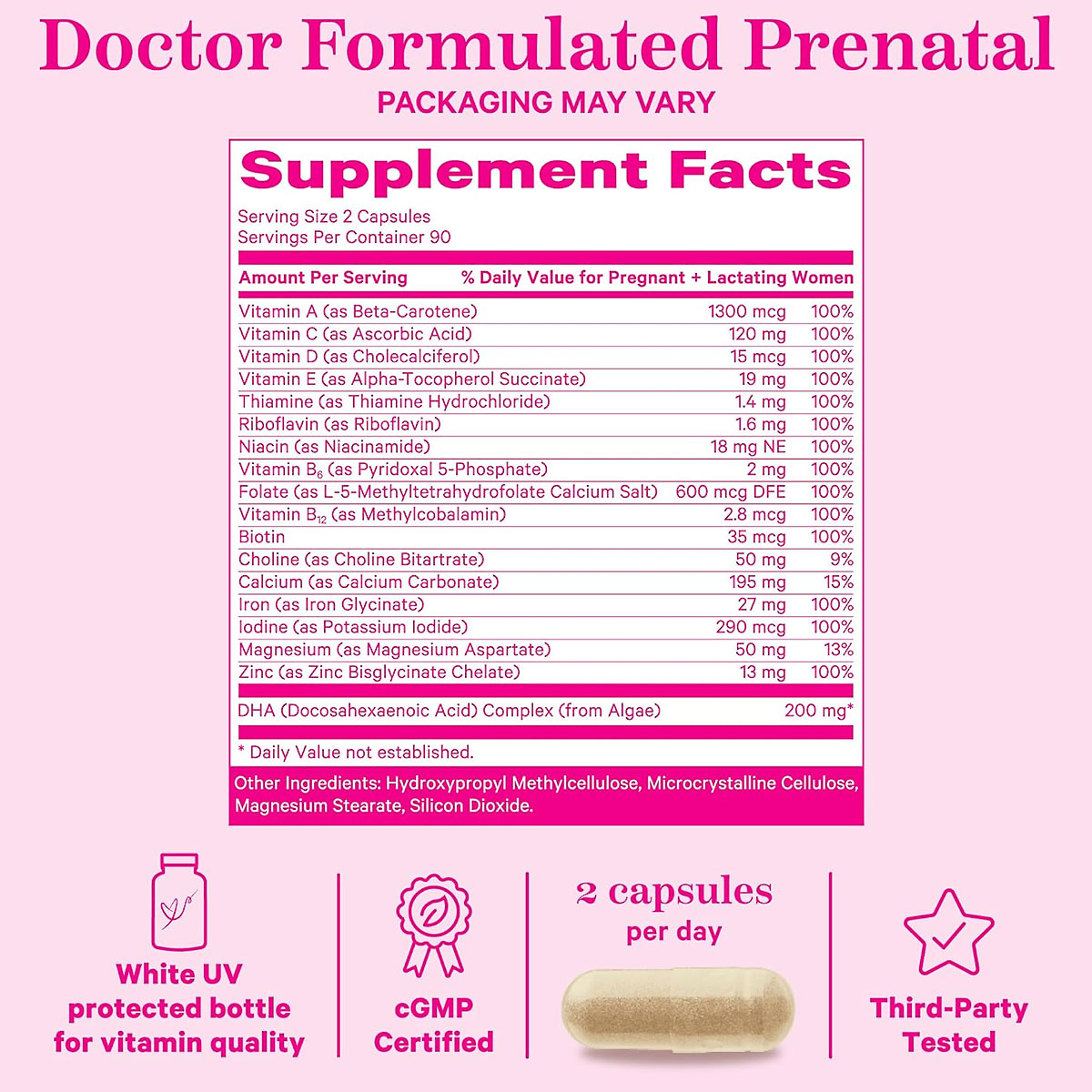
Pink Stork’s Total Prenatal + DHA is a 180-capsule bottle. The Supplement Facts panel on the product photo sets the serving at two capsules, 90 servings per container: a 90-day supply. Its folate is L-5-methyltetrahydrofolate calcium salt, its iron is iron glycinate, its iodine is potassium iodide and its DHA comes from algae. The panel lists 200 mg of “DHA (Docosahexaenoic Acid) Complex (from Algae)” and does not say how much of that complex is DHA itself, so 200 mg is a ceiling, not a confirmed DHA dose.
| This product | Typical shelf dose | Pregnancy RDA / AI / reference value | Tolerable Upper Limit | |
|---|---|---|---|---|
| Folate | 600 mcg DFE (L-methylfolate) | Not surveyed | 600 mcg DFE (FDA reference value) | 1,000 mcg (synthetic folate only) |
| Iron | 27 mg | Not surveyed | 27 mg (RDA) | 45 mg |
| Iodine | 290 mcg | Only 53% of 47 products listed it (2025) | 220 mcg (RDA) | 1,100 mcg |
| Vitamin A (beta-carotene) | 1,300 mcg | Not surveyed | 770 mcg RAE (RDA) | 3,000 mcg, preformed vitamin A only |
| Choline | 50 mg | Only 26% of 47 products listed it (2025) | 450 mg (AI) | 3,500 mg |
| Calcium | 195 mg | Not surveyed | 1,300 mg (FDA label value, not an RDA) | 2,500 mg |
| DHA | 200 mg DHA complex (DHA share not stated) | Not surveyed | 500–1,000 mg long-chain omega-3, at least 500 mg DHA (trial dose, not an RDA) | Not established in the sources checked |
Iron is exactly the pregnancy RDA, iodine is 132% of its RDA and 26% of its upper limit, and vitamin A is 169% of the RDA but supplied as beta-carotene, to which the upper limit does not apply. The gaps are choline (11% of the AI), calcium (15% of the label value) and DHA (at most 40% of the trial dose). The store page’s “100% of 14 nutrients” is accurate as arithmetic: exactly 14 of the 17 are printed at 100%. It says nothing about the other three, or the DHA.
Corrections to the store listing, for accuracy: The listing’s usage text says each bottle holds “90 capsules” for a 3-month supply. The title and the label say 180 capsules, 90 servings of two. The listing says the formula has 100% of 14 nutrients “including methylated Folate, Choline, Iron, and Omega-3 DHA”; on the panel, choline is 9% and DHA has no Daily Value. The 14 at 100% are other nutrients. We used the label throughout. “OB-GYN recommended,” “third-party tested” and “GMP + NSF certified facility” are the manufacturer’s claims; we could not verify them, and a certified facility is not a certified product.
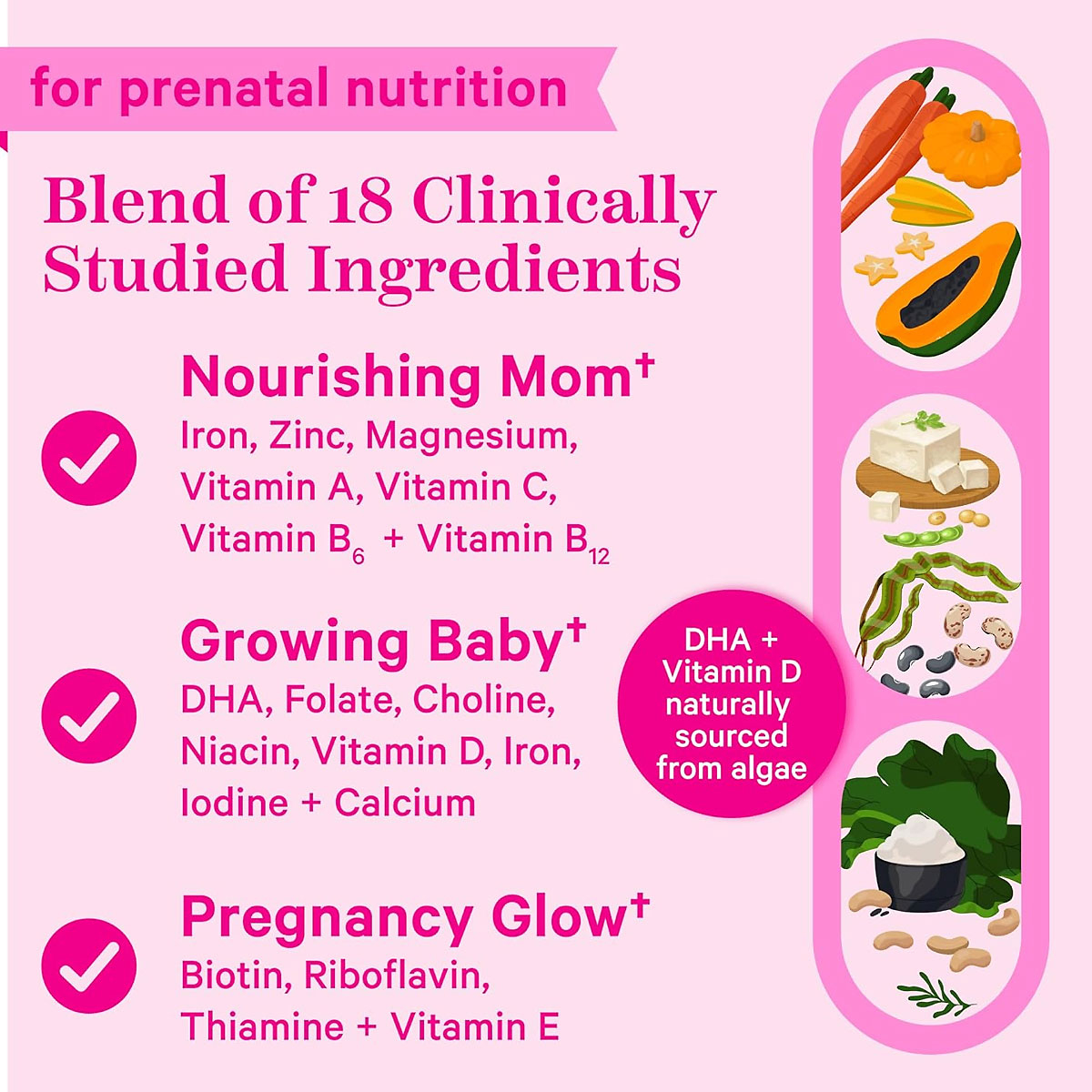
Who this is for: Someone whose clinician has said a standard prenatal is fine and who wants iron, iodine, methylfolate and an algal DHA source in two capsules a day, with the understanding that a 200 mg DHA complex is below the Cochrane trial dose.
Who should skip it: Anyone whose clinician has prescribed a specific folic acid dose or prenatal formula, since this label does not state folic acid micrograms; anyone told to limit iron, including people with hemochromatosis, for whom MedlinePlus advises no iron supplements; anyone on anti-thyroid medicine, since MedlinePlus notes high iodine intake with these drugs can cause hypothyroidism; anyone with a previous pregnancy affected by a neural tube defect, or taking antiseizure medicines or methotrexate, whom the USPSTF recommendation explicitly does not cover; and most readers who assume one product covers choline, calcium and trial-level DHA. It does not.
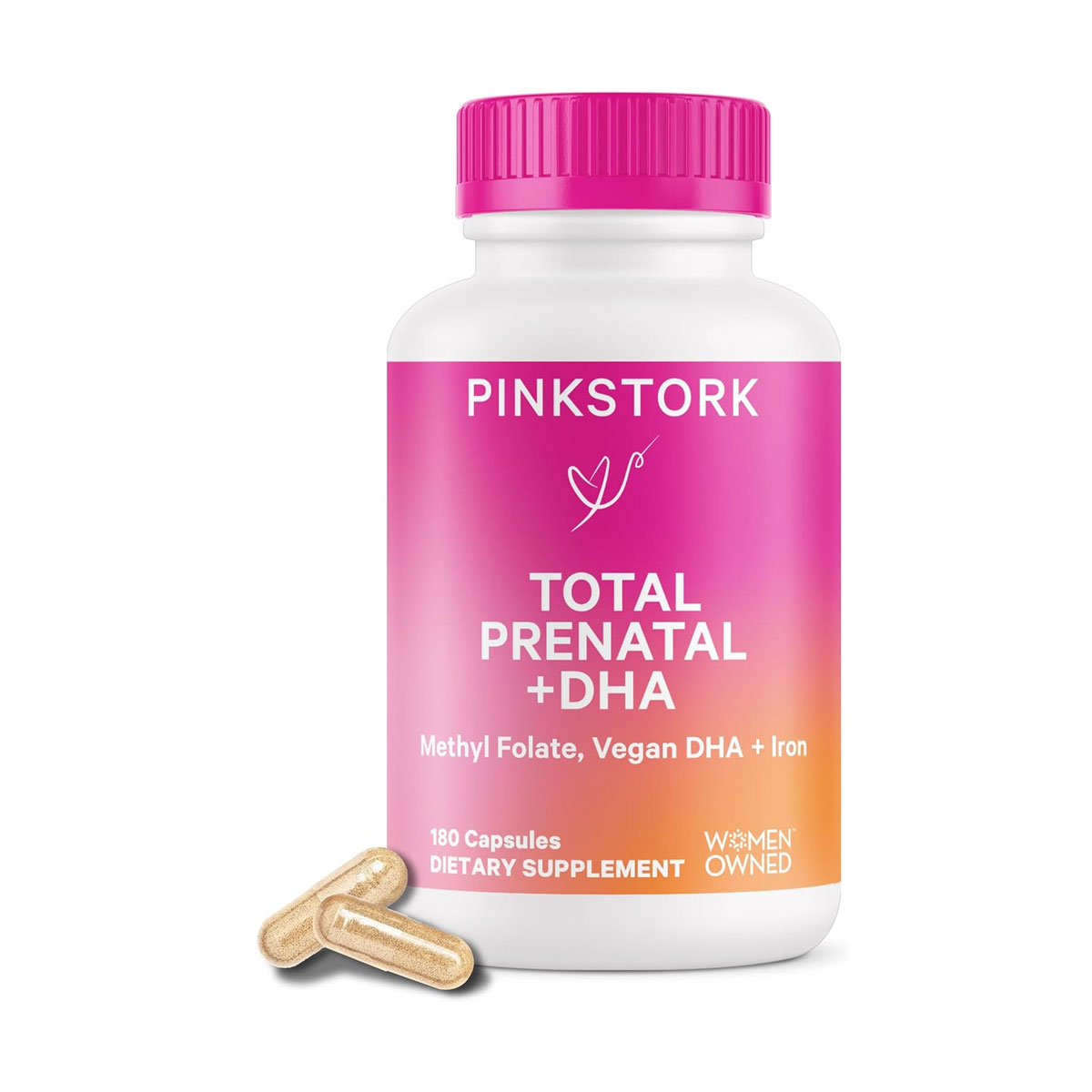
Pink Stork Prenatal Vitamins DHA, Folate & Iron — 180 Capsules
Two capsules a day for 90 days: 600 mcg DFE L-methylfolate, 27 mg iron, 290 mcg iodine, a 200 mg algal DHA complex and 50 mg choline. Confirm the formula with your prenatal clinician first.
View Product DetailsHow to Use a Prenatal Vitamin Sensibly
- Start early. The USPSTF says to begin folic acid at least one month before conception.
- Take it as labelled. This label directs two capsules a day; more moves iron toward its upper limit.
- Fill the gaps with food. Eggs, fish, meat and dairy supply what capsules skimp on; ask your clinician about separate choline or DHA.
- Store it safely. The iron warning above is not boilerplate.
Frequently Asked Questions
When should I start taking prenatal vitamins?
The USPSTF (August 2023) says anyone planning to become pregnant, or who could, should take 400 to 800 mcg of folic acid daily, starting at least one month before conception and continuing through the first 2 to 3 months of pregnancy.
Is methylfolate better than folic acid in a prenatal vitamin?
The evidence for preventing neural tube defects is for folic acid. The USPSTF recommendation is written for folic acid, and the sources checked here report no trial of L-methylfolate against these defects. Ask your clinician if MTHFR gene variants concern you.
Do prenatal vitamins contain enough choline?
Often not. The National Academies set 450 mg a day for pregnancy. In a 47-product test reported in May 2025, only 26% listed choline and five of those 12 held the labelled amount. This product lists 50 mg, about 11% of 450 mg.
How much DHA do I need during pregnancy?
No RDA exists. A 2018 Cochrane review of 70 trials found 500 to 1,000 mg a day of long-chain omega-3, with at least 500 mg DHA, from 12 weeks was optimal for lowering preterm birth. This product lists a 200 mg algal DHA complex without stating how much of it is DHA.
Can you take too much iron or vitamin A from a prenatal vitamin?
Yes. For pregnancy at ages 19 to 30 the National Academies upper limits are 45 mg of iron and 3,000 mcg of preformed vitamin A. This product has 27 mg of iron and 1,300 mcg of vitamin A as beta-carotene, which that limit does not cover.
Why does the daily value on my prenatal label differ from my RDA?
Under 21 CFR 101.9, one set of reference values serves both pregnant and breastfeeding women. For iodine it equals the breastfeeding RDA, so 290 mcg reads 100% though the pregnancy RDA is 220 mcg (MedlinePlus, reviewed 2025). For iron it is the pregnancy RDA, 27 mg.
Does a prenatal vitamin replace a healthy diet?
No. MedlinePlus advises a balanced diet in pregnancy, with only about 300 extra calories a day. A prenatal vitamin is a safety net for hard-to-get nutrients such as folic acid, not a substitute for food.
How many Pink Stork prenatal capsules do I take, and how long does a bottle last?
Two capsules a day, with 90 servings per container, so the 180-capsule bottle lasts 90 days. The listing’s usage text says 90 capsules, which does not match the title or the panel.
Sources
- US Preventive Services Task Force. Folic Acid Supplementation to Prevent Neural Tube Defects. August 1, 2023. Accessed 28 October 2026.
- MedlinePlus (NLM). Neural Tube Defects. Updated September 16, 2025. Accessed 28 October 2026.
- eCFR. 21 CFR 101.9, Nutrition labeling of food. Current text. Accessed 28 October 2026.
- eCFR. 21 CFR 101.17, Food labeling warning statements. Current text. Accessed 28 October 2026.
- MedlinePlus. Iron in diet. Reviewed January 21, 2025. Accessed 28 October 2026.
- MedlinePlus. Iodine in diet. Reviewed January 21, 2025. Accessed 28 October 2026.
- MedlinePlus. Vitamin A. Reviewed January 21, 2025. Accessed 28 October 2026.
- MedlinePlus. Eating right during pregnancy. Reviewed November 8, 2024. Accessed 28 October 2026.
- National Academies Food and Nutrition Board. Dietary Reference Intakes: Tolerable Upper Intake Levels (prepublication copy). Undated. Accessed 28 October 2026.
- CU Anschutz Medical Campus. Prenatal vitamin choline and iodine study. May 8, 2025. Accessed 28 October 2026.
- Cochrane. Omega-3 fatty acids reduce the risk of premature birth (Middleton et al.). November 2018. Accessed 28 October 2026.
- Cochrane. Multiple-micronutrient supplementation for women during pregnancy (Haider et al., news release). November 20, 2015. Accessed 28 October 2026.
- Keats EC, Haider BA, Tam E, Bhutta ZA. Multiple-micronutrient supplementation for women during pregnancy. Cochrane Database of Systematic Reviews (PubMed abstract). March 14, 2019. Accessed 28 October 2026.
- MotherToBaby. Vitamin A fact sheet. March 1, 2026. Accessed 28 October 2026.
This article is for educational purposes only and is not medical advice. It is not intended to diagnose, treat, cure, or prevent any disease. These statements have not been evaluated by the Food and Drug Administration. Talk to your doctor or midwife before starting or changing any supplement, especially if you are pregnant, planning a pregnancy, breastfeeding, or taking other medicines.