
In a 12-month randomized trial of benfotiamine for diabetic nerve damage (the BOND study, 2026), 57 people took 300 mg twice a day for 12 months and, in the authors' words, it "had no significant effects on multiple morphometric, neurophysiological and clinical measures of neuropathy." Benfotiamine is a lab-made, fat-soluble derivative of thiamin (vitamin B1) sold to support nerve health and glucose metabolism. Two earlier trials lasting 3 and 6 weeks found modest symptom improvements, and a 2026 review concluded that outside documented thiamine deficiency its routine use "cannot be recommended based on current evidence."
Key Takeaways
- The 12-month BOND trial (2026, 57 participants, 300 mg twice daily) found no difference from placebo in its primary endpoint (corneal nerve fiber length) or in secondary nerve, symptom and quality-of-life measures; it was well tolerated.
- A 2008 trial (165 patients randomized, 6 weeks) found the Neuropathy Symptom Score improved significantly in the per-protocol analysis (p = 0.033) but only borderline in the intention-to-treat analysis (p = 0.055), with no significant change in Total Symptom Score.
- A 2005 pilot (40 inpatients, 3 weeks, 400 mg/day) found a significant improvement in a neuropathy score (p = 0.0287) but no change in the tuning-fork test.
- A 2026 review says benfotiamine's clinical evidence "remains limited to short-duration, symptom-based studies, with no large-scale, long-term trials published."
- Per the label, a 2-capsule serving contains 300 mg benfotiamine plus 100 mg thiamin, which is 8,333% of the Daily Value; MedlinePlus states there is "no known poisoning linked to excessive intake of thiamin."
In this article:
What Is Benfotiamine, and Who Needs Extra Thiamin?
Thiamin (vitamin B1) is an essential nutrient. The MedlinePlus Medical Encyclopedia (reviewed January 2025) lists the adult Recommended Dietary Allowance as 1.2 mg a day for men aged 14 and older and 1.1 mg for women 19 and older, and says a lack of thiamin can cause weakness, fatigue, confusion, psychosis and nerve damage. In the United States, deficiency "is most often seen in people who consume too much alcohol," which can lead to beriberi and, in severe cases, brain conditions such as Wernicke disease and Korsakoff syndrome.
| Group | RDA (mg/day) |
|---|---|
| Children, 1–3 years | 0.5 |
| Children, 4–8 years | 0.6 |
| Children, 9–13 years | 0.9 |
| Females, 14–18 years | 1.0 |
| Females, 19 and older | 1.1 (1.4 during pregnancy and lactation) |
| Males, 14 and older | 1.2 |
Benfotiamine is different from thiamin: a 2023 review in Heliyon (Bozic and Lavrnja) describes it as a thiamin precursor developed to compensate for deficiency, "more bioavailable and has higher tissue penetration than thiamine." It is also promoted for diabetic nerve damage, on the theory that it activates an enzyme called transketolase, diverting sugar breakdown products away from pathways that damage small blood vessels. The trials below test whether that theory translates into results people can feel or measure.
The Early Trials: Short and Symptom-Based
The best-known positive results come from two short studies in people with diabetic polyneuropathy:
| Trial | Design | Result |
|---|---|---|
| BEDIP, Int J Clin Pharmacol Ther, 2005 | 40 inpatients; two 50 mg tablets four times daily (400 mg/day) or placebo; 3 weeks | Significant improvement in neuropathy score (p = 0.0287) and in pain (p = 0.0414); no significant change in the tuning fork test; no side effects attributable to benfotiamine |
| BENDIP, Exp Clin Endocrinol Diabetes, 2008 | 165 randomized (133 analyzed by intention to treat); 600 mg/day, 300 mg/day or placebo; 6 weeks | Neuropathy Symptom Score significant per protocol (p = 0.033), borderline by intention to treat (p = 0.055); Total Symptom Score not significant; improvement more pronounced at the higher dose; well tolerated |
| BOND, BMJ Open Diabetes Res Care, 2026 | 57 participants with type 2 diabetes and mild-to-moderate symptomatic neuropathy; 300 mg twice daily or placebo; 12 months | No difference in corneal nerve fiber length (primary endpoint) or in secondary morphometric, functional, clinical and quality-of-life measures; Neuropathy Symptom Score only tended to improve (p = 0.098) |
Read across the three, a pattern emerges. The short trials measured symptoms, chiefly a neuropathy score and pain, and found modest, borderline or per-protocol-only improvements. Even there, the 2008 trial's total symptom score did not change significantly. The 2026 review of the field describes exactly this gap: strong biochemical rationale, but clinical evidence "limited to short-duration, symptom-based studies." Symptoms in diabetic neuropathy can fluctuate and respond to expectation, which is why longer trials with objective nerve measures matter.
"Treatment with benfotiamine for 12 months was well tolerated, but had no significant effects on multiple morphometric, neurophysiological and clinical measures of neuropathy."
— Ziegler et al., BMJ Open Diabetes Research & Care, 2026 (BOND randomized trial, 57 participants)The BOND Trial: Twelve Months, No Effect
The BOND study is the most thorough test so far in people with diagnosed diabetic neuropathy: its authors note that the four earlier double-blind trials in this group, run over 3 to 52 weeks, focused mainly on symptoms rather than objective measures of nerve function and structure. It randomized 57 people with type 2 diabetes and mild-to-moderate symptomatic diabetic sensorimotor polyneuropathy to benfotiamine 300 mg twice a day or placebo for a full year. Its primary endpoint, change in corneal nerve fiber length measured by corneal confocal microscopy (an imaging technique for small nerve fibers), did not differ between groups. Neither did the secondary measures, which included skin biopsy, 13 nerve conduction measures, quantitative sensory testing, cardiovascular and sweat-gland autonomic tests, clinical scales and 13 quality-of-life and depression instruments.
Two details are worth stressing. First, the treatment clearly reached the body: benfotiamine "increased the concentrations of all six thiamine analytes studied" in blood. So the null result is not explained by non-absorption. Second, safety was unremarkable, with no relevant difference in adverse events. The trial was small and a phase II study, so it cannot rule out a modest benefit, but it does not support the claim that benfotiamine changes the course of diabetic neuropathy over a year. Nor is it the longest trial: a 24-month trial in 67 people with type 1 diabetes taking 300 mg a day (Fraser et al., Diabetes Care, 2012) also found no significant effect on peripheral nerve function, although, as the BOND authors note, only 16% of those who completed it had probable neuropathy at the start. If you are exploring supplements for diabetic nerve symptoms, our alpha-lipoic acid article covers the supplement with the most randomized evidence, and the same 2026 review calls ALA the "most established adjunctive metabolic therapy for symptomatic DPN."
Mayo Clinic on what may be behind tingling hands and feet, a reason to see a clinician before self-treating.
Safety and the Thiamin Question
Safety is the reassuring part. MedlinePlus (reviewed January 2025) states: "There is no known poisoning linked to excessive intake of thiamin." The BOND trial found no relevant differences in adverse events at 600 mg a day over 12 months, and the earlier trials reported no side effects attributable to benfotiamine or good tolerability. The sources reviewed here do not cover pregnancy, breastfeeding or interactions with medicines, so those are questions for a clinician.
A more useful caution is about what supplements can hide. Numbness, tingling or burning in the feet and hands has many causes, including deficiency of other B vitamins. Our vitamin B6 article covers a nutrient where too much, not too little, can itself damage nerves, and our vitamin B12 article covers another common B-vitamin story. Persistent nerve symptoms deserve an evaluation, not just a capsule. The 2026 review's bottom line is direct: "Outside of documented thiamine deficiency, its routine use cannot be recommended based on current evidence."
Inside NatureBell Benfotiamine
NatureBell Benfotiamine is a bottle of 240 vegetarian capsules. The Supplement Facts panel lists a serving of two capsules, with 120 servings per container, containing 300 mg of benfotiamine (no established Daily Value) and 100 mg of thiamin (vitamin B1) as thiamine mononitrate, which the label states is 8,333% of the Daily Value. Other ingredients are silicon dioxide, magnesium stearate, rice flour and the vegetable cellulose capsule. The front label reads "benfotiamine 300 mg per serving with thiamine 100 mg per serving," described as "fat and water soluble." The store directs 2 capsules daily with meals, which makes the bottle a 120-day supply.
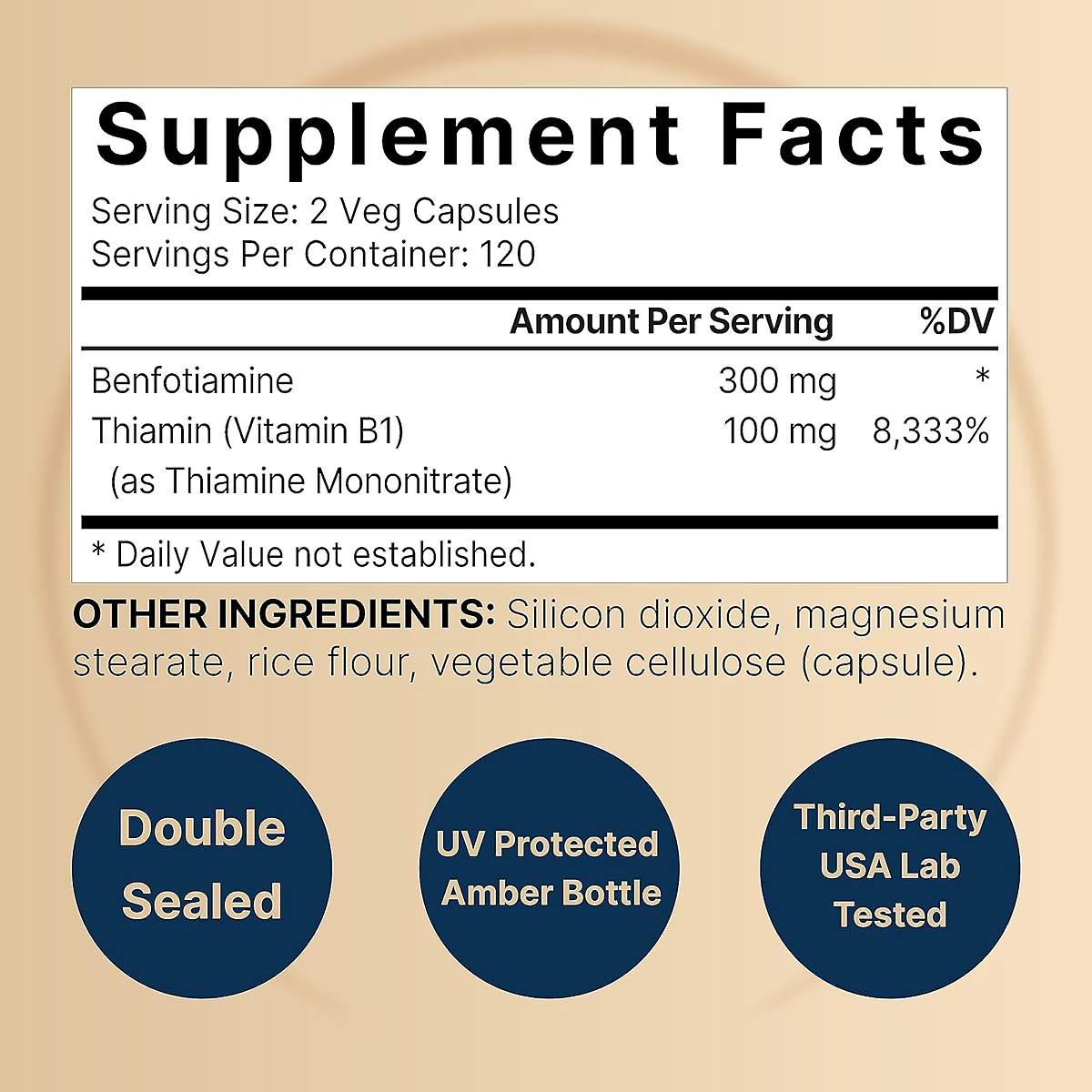
A correction, for accuracy: this store's FAQ says a bottle is a "60-day supply" at two capsules a day. The label says 120 servings per container, and 240 capsules divided by 2 is 120, so the bottle lasts 120 days (the store's own short description says four months). We have used the label figures. The store's long description also says the product "provides a total of 120 servings," which agrees with the label.
| This product | Typical trial dose | NIH RDA / AI | Tolerable Upper Limit | |
|---|---|---|---|---|
| Benfotiamine | 300 mg per 2-capsule serving; 300 mg/day at the store's 2 capsules daily | 400 mg/day (3 weeks); 300 or 600 mg/day (6 weeks); 600 mg/day (12 months) | None: not an essential nutrient | None established |
| Thiamin (as mononitrate) | 100 mg per serving (8,333% DV) | Not separately studied in these trials | 1.2 mg men, 1.1 mg women (MedlinePlus) | No known poisoning from excess intake (MedlinePlus) |
At the store's suggested 2 capsules a day, this product supplies 300 mg of benfotiamine, the lower arm of the 6-week trial and half the daily dose in the 12-month trial. The thiamin component is roughly 83 times the adult RDA (100 mg ÷ 1.2 mg), which is a fact about scale, not a sign of danger, given MedlinePlus's statement on excess thiamin.
What the listing claims versus what the evidence supports: the store's short description says benfotiamine is "significantly more bioavailable than standard water-soluble thiamine, especially for nerve and tissue penetration" and "has been studied for its role in supporting nerve health, healthy glucose metabolism, and combating glycation." The bioavailability claim matches the 2023 review's description. The studied-for claims are accurate in that it has been studied, but the 12-month BOND trial and a 24-month trial in type 1 diabetes both found no effect on nerve measures, and the sources reviewed here do not show a glucose or glycation benefit in people. The listing's testimonials about "energy levels" are anecdotes.
Who Might Consider It, and Who Should Skip It
Who this is for: people whose clinician has documented a thiamine deficiency or a reason to supplement B1, or who have discussed benfotiamine for diabetic neuropathy as a low-risk experiment, will keep taking their prescribed treatment, and understand that trials lasting 12 and 24 months found no benefit.
Who should skip it: anyone with unexplained numbness, tingling or weakness who has not been evaluated; anyone expecting it to repair nerve damage; anyone who would substitute it for diabetes care; anyone pregnant or breastfeeding without medical advice; and, frankly, most people, whose thiamin needs are met by diet.
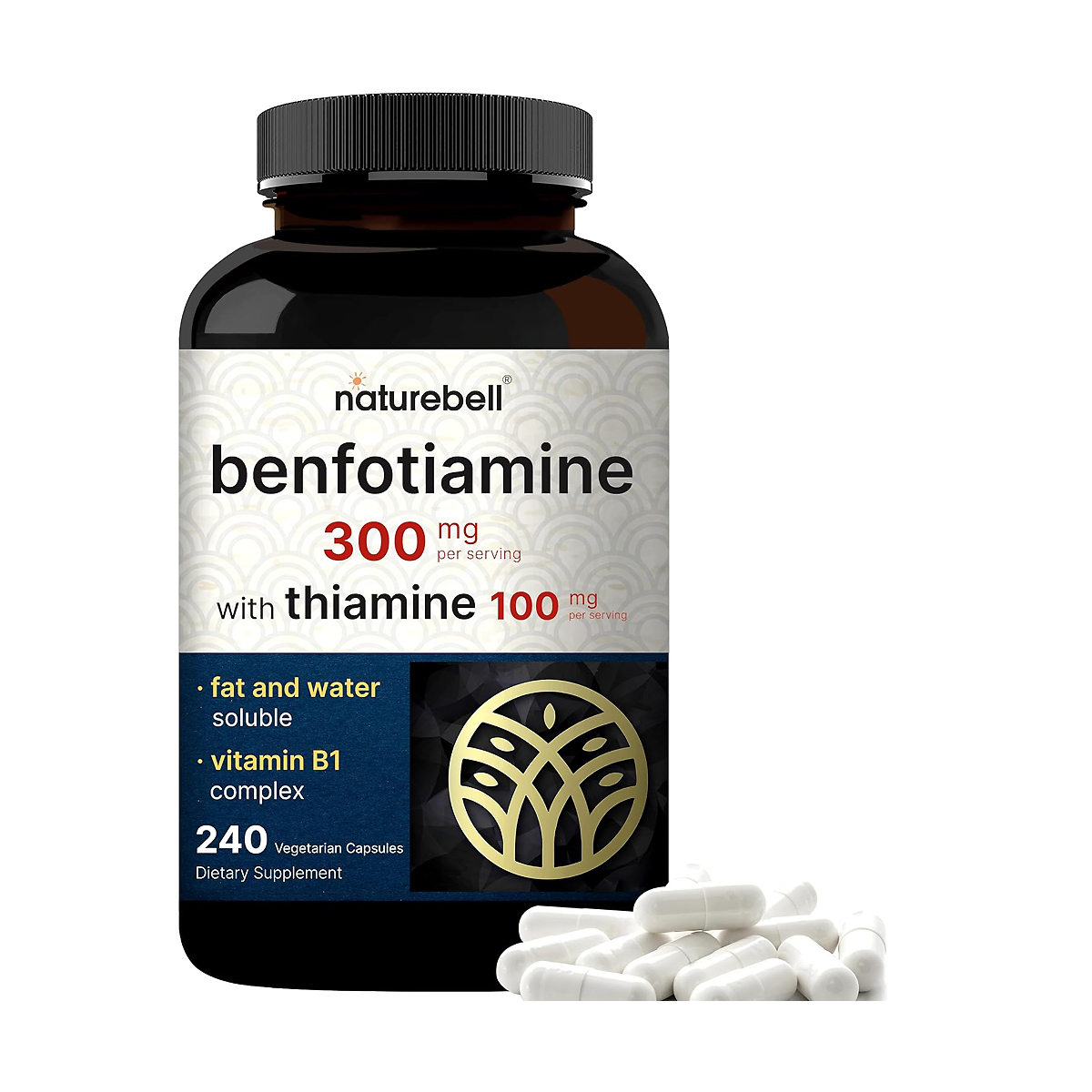
NatureBell Benfotiamine 300 mg with Thiamin — 240 Vegetarian Capsules
300 mg of benfotiamine and 100 mg of thiamin per two-capsule serving, 120 servings per bottle. As covered above, randomized trials lasting 12 and 24 months found no effect on nerve measures; discuss nerve symptoms with a clinician. Browse more in our individual vitamins.
View Product DetailsFrequently Asked Questions
Does benfotiamine help diabetic neuropathy?
Evidence is mixed. Trials of 3 and 6 weeks found modest symptom improvements, but a 12-month randomized trial of 57 people found no significant effect on nerve measures, symptoms or quality of life. A 2026 review says routine use cannot be recommended.
How much benfotiamine should I take?
No official dose exists. Trials used 300 to 600 mg a day. This label lists 300 mg per two-capsule serving, and the store directs two capsules daily. Follow the label or your clinician's advice.
What is the difference between benfotiamine and thiamine?
Benfotiamine is a fat-soluble, lab-made derivative of thiamin (vitamin B1), described in a 2023 review as more bioavailable with higher tissue penetration. Thiamin is the natural, water-soluble vitamin. This product contains both.
Is benfotiamine safe?
It appears well tolerated. A 12-month trial at 600 mg a day found no relevant difference in adverse events versus placebo, and MedlinePlus states there is no known poisoning linked to excessive thiamin intake. Pregnancy and drug interaction data were not found.
Is 100 mg of thiamin too much?
Based on MedlinePlus, no known poisoning is linked to excessive thiamin intake. This label's 100 mg is 8,333% of the Daily Value and about 83 times the adult RDA of 1.2 mg for men, but it is water-soluble, and MedlinePlus reports no known toxicity.
Who is at risk of thiamin deficiency?
MedlinePlus says deficiency in the United States is most often seen in people who consume too much alcohol, since heavy drinking makes it hard to absorb thiamin. Deficiency can cause weakness, fatigue, confusion and nerve damage, and needs medical care.
Will benfotiamine reverse nerve damage?
No trial has shown that. The 2026 BOND trial found no effect on nerve fiber length or other nerve measures after 12 months, and a 2026 review of alpha-lipoic acid and benfotiamine says no study has demonstrated structural nerve regeneration.
How long does one bottle last?
At the store's two capsules daily, 120 days. The label lists 120 servings of two capsules from 240 capsules. The store's FAQ says 60 days, which is incorrect; the short description's four months matches the label.
Sources
- MedlinePlus Medical Encyclopedia (National Library of Medicine). "Thiamin." Review date 21 January 2025. Accessed 29 September 2026. medlineplus.gov
- Ziegler D, et al. Effects of benfotiamine treatment over 12 months on morphometric, neurophysiological and clinical measures in type 2 diabetes patients with symptomatic polyneuropathy: a randomized, placebo-controlled, double-blind clinical trial (BOND study). BMJ Open Diabetes Res Care, 2026;14:e005773. Accessed 29 September 2026. doi.org/10.1136/bmjdrc-2025-005773
- Stracke H, et al. Benfotiamine in diabetic polyneuropathy (BENDIP): results of a randomised, double blind, placebo-controlled clinical study. Exp Clin Endocrinol Diabetes, 2008;116(10):600-605. Accessed 29 September 2026. doi.org/10.1055/s-2008-1065351
- Haupt E, Ledermann H, Köpcke W. Benfotiamine in the treatment of diabetic polyneuropathy: a three-week randomized, controlled pilot study (BEDIP study). Int J Clin Pharmacol Ther, 2005;43(2):71-77. Accessed 29 September 2026. doi.org/10.5414/cpp43071
- Ciubotaru A, et al. Alpha-lipoic acid and benfotiamine in diabetic peripheral neuropathy: a critical review of mechanistic rationale and clinical evidence within a nutritional therapeutic framework. Nutrients, 2026;18:1538. Accessed 29 September 2026. doi.org/10.3390/nu18101538
- Bozic I, Lavrnja I. Thiamine and benfotiamine: focus on their therapeutic potential. Heliyon, 2023;9(11):e21839. Accessed 29 September 2026. doi.org/10.1016/j.heliyon.2023.e21839
- Fraser DA, Diep LM, Hovden IA, et al. The effects of long-term oral benfotiamine supplementation on peripheral nerve function and inflammatory markers in patients with type 1 diabetes: a 24-month, double-blind, randomized, placebo-controlled trial. Diabetes Care, 2012;35(5):1095-1097. Accessed 20 October 2026. doi.org/10.2337/dc11-1895
This article is for educational purposes only and is not medical advice. It is not intended to diagnose, treat, cure, or prevent any disease. These statements have not been evaluated by the Food and Drug Administration. Talk to your doctor before starting any new supplement, especially if you are pregnant, breastfeeding, have diabetes, take any medication, or have numbness, tingling or weakness that has not been evaluated.