
A 2015 Cochrane review of 32 randomized trials and 2,640 people reported that its authors "failed to find any evidence of efficacy for lysine" in preventing cold sores — yet lysine is among the best-known supplements people reach for when a tingle appears on the lip. Lysine is an essential amino acid, meaning the body cannot make it and must get it from food; most people eating a normal diet already take in more than they need. In a 1984 trial, 624 mg a day — almost exactly one capsule of this product — did not work. The small trials that reported fewer outbreaks used 1,248 mg and 3,000 mg a day, while others at 1,000 mg and 1,200 mg found no overall benefit.
Key Takeaways
- The Cochrane Collaboration's 2015 review of 32 trials (2,640 people) found no evidence that lysine prevents cold sores.
- In a 1984 crossover trial of 41 patients, 1,248 mg a day of lysine monohydrochloride was linked to fewer recurrences, but 624 mg a day — the size of one capsule of this product — was not effective (Cutis).
- Other small trials split: 1,000 mg a day (65 patients, 1980) and 1,200 mg a day (21 patients, 1984) found no overall benefit, while 3,000 mg a day (52 patients, 1987) reported fewer outbreaks (Acta Dermato-Venereologica, Archives of Dermatology, Dermatologica).
- A 2017 review concluded lysine looks ineffective below 1 g a day without a low-arginine diet, and called for longer trials above 1.2 g a day.
- The label allows 1 to 3 capsules (620–1,860 mg) daily; a 2019 systematic review of 71 studies set a provisional no-adverse-effect level of 6,000 mg a day, so the label maximum sits at about 31% of it.
In this article:
- What Is Lysine, and Does Anyone Lack It?
- What Are Cold Sores, and What Is the Standard Advice?
- Does Lysine Prevent Cold Sores? What the Trials Found
- Why the Dose and the Arginine Question Matter
- How Safe Is Lysine at Supplement Doses?
- Inside Life Extension L-Lysine 620 mg: What Is in the Capsule
- How to Use Lysine Sensibly
- Frequently Asked Questions
What Is Lysine, and Does Anyone Lack It?
Lysine (L-lysine) is one of the amino acids the body uses to build proteins, and it is "essential" in the nutritional sense: humans cannot synthesise it. According to the Wikipedia summary of nutrition research (accessed 29 October 2026), the adult requirement is roughly 30 mg per kilogram of body weight a day, which works out to about 2,100 mg for a 70 kg adult, and that requirement is "commonly met in a western society" through meat and plant protein. One capsule of this product supplies 620 mg, about 30% of that.
So most adults do not need a capsule to meet a basic requirement. The real question is different: does extra lysine stop cold sores? That claim is not on the bottle.
| Figure | Amount per day | What it is |
|---|---|---|
| Adult requirement (about 30 mg/kg) | ~2,100 mg at 70 kg | Estimated need, met mostly from food |
| One capsule of this product | 620 mg | Label serving |
| Three capsules (label maximum) | 1,860 mg | Highest label direction |
| Provisional no-adverse-effect level | 6,000 mg | 2019 systematic review, gastrointestinal symptoms |
What Are Cold Sores, and What Is the Standard Advice?
Cold sores are caused by the herpes simplex virus (HSV). According to MedlinePlus, a service of the US National Library of Medicine (page undated, accessed 29 October 2026), type 1 usually causes oral herpes and "infects more than half of the U.S. population by the time they reach their 20s", though some people never have symptoms. MedlinePlus states that there is no cure for cold sores, that they normally go away on their own in a few weeks, and that antiviral medicines can help them heal faster and can help prevent them in people who get them often.
That is the baseline lysine has to beat. The MedlinePlus Medical Encyclopedia advises contacting a provider if symptoms are severe or last beyond 2 weeks, if sores are near your eyes, or if you have a weakened immune system; that needs a clinician, not a capsule.
Does Lysine Prevent Cold Sores? What the Trials Found
The most reliable answer comes from the Cochrane Collaboration. Its 2015 review of interventions for preventing cold sores searched databases up to May 2015, included 32 randomized trials covering 2,640 immunocompetent people and 19 treatments, and rated the overall evidence low to moderate for most outcomes.
"We failed to find any evidence of efficacy for lysine, LongoVital® supplementation, gamma globulin, herpes simplex virus (HSV) type I subunit vaccine, and yellow fever vaccine in preventing HSL."
— Chi et al., Cochrane Database of Systematic Reviews, 2015 (HSL = herpes simplex labialis, cold sores)"No evidence of efficacy" is not the same as "proven not to work", and the individual trials show why people remain interested. Four small double-blind, placebo-controlled trials tested lysine doses from 624 mg to 3,000 mg a day; the first two used a crossover design.
| Trial | People | Dose per day | Result reported by the authors |
|---|---|---|---|
| McCune et al., Cutis, 1984 | 41 | 624 mg and 1,248 mg (lysine monohydrochloride) | 1,248 mg showed "evidence of decreasing the recurrence rate"; 624 mg "was not effective"; neither shortened healing time |
| Milman et al., Acta Dermato-Venereologica, 1980 | 65 | 1,000 mg for 12 weeks, then placebo | "No effect" on recurrence rate overall, though significantly more people were recurrence-free on lysine (p = 0.05), suggesting "certain patients may benefit"; no effect on healing |
| DiGiovanna and Blank, Archives of Dermatology, 1984 | 21 | 1,200 mg (400 mg lysine hydrochloride three times a day) | "Unable to detect any substantial benefit" for treating outbreaks or preventing recurrences |
| Griffith et al., Dermatologica, 1987 | 52 completed | 3,000 mg (1,000 mg three times a day) for 6 months | An average of 2.4 fewer outbreaks than placebo, with milder symptoms and faster healing (all p < 0.05) |
Read together, they are not a clean win: the encouraging 1984 trial enrolled only 41 people, and trials at 1,000 mg and 1,200 mg did not reproduce it. The clearest positive result, the 1987 trial, used 3,000 mg a day, more than this product's three-capsule label maximum, and only 52 people completed it. A 2017 review by Mailoo and Rampes in Integrative Medicine pulled the literature together and concluded that lysine "appears to be ineffective" for prophylaxis or treatment of herpes simplex lesions at doses below 1 g a day without low-arginine diets, and that doses above 3 g a day appear to improve patients' subjective experience of the disease, a conclusion that rests largely on the 1987 trial above. They called for longer controlled studies at more than 1.2 g a day to settle it.
A Mayo Clinic Minute on cold sores, published by Mayo Clinic. We have confirmed the title and channel only; it is background on the condition, not evidence about lysine.
Why the Dose and the Arginine Question Matter
The reason lysine was ever tested is laboratory biology. The 1980 Milman paper opens by noting that L-lysine "has an inhibitory effect on the multiplication of herpes simplex virus in cell cultures". The common explanation is that lysine competes with another amino acid, arginine, which the virus is said to need. That mechanism is a hypothesis built on cell-culture work; it is not a measured result in people, and none of the trial abstracts we read confirmed it.
Two conclusions follow. Dose may matter, though not cleanly: 624 mg failed and 1,248 mg showed a signal in the same trial, 1,200 mg failed in another, and the clearest positive result came at 3,000 mg. And the 2017 review attaches a condition, "without low-arginine diets", so any effect may depend on what else a person eats.
How Safe Is Lysine at Supplement Doses?
Lysine is generally well tolerated at label doses, though "no one has proven harm" is a weaker statement than "proven safe". A 2019 systematic review in Amino Acids by Hayamizu and colleagues searched four databases and evaluated 71 human studies of oral L-lysine. Doses ranged from 16.8 to 17,500 mg a day. The adverse events were mainly gastrointestinal — nausea, stomach ache and diarrhoea — and the review set a provisional no-observed-adverse-effect level of 6,000 mg per person per day.
The authors state plainly that "there are no guidelines for the upper limit of ingestion" for amino acids. So 6,000 mg is a research-derived marker, not a Tolerable Upper Intake Level, and it is a provisional figure from published studies. It does not cover every condition a reader might have.
Who should check first: Mailoo and Rampes wrote that people with cardiovascular or gallbladder disease "should be cautioned and warned of the theoretical risks of lysine supplementation" (2017 review). In the body of the same review they also list gallstones, asthma, impotence and immune dysfunction as reasons for caution, citing a single 2013 practitioner-journal article, so treat these as theoretical. The label also advises consulting a physician if you are being treated for a medical condition or are pregnant or lactating. Ask a pharmacist or doctor before starting, especially at the 3-capsule maximum.
We did not find a readable source on drug interactions or kidney effects, so we make no claim either way; ask your prescriber. The same dose-gap pattern between trial and label that appears here is also covered in our review of L-glutamine, another amino acid sold in capsule sizes far from its trial doses.
Inside Life Extension L-Lysine 620 mg: What Is in the Capsule
Champ Vita sells Life Extension L-Lysine 620 mg in a 100-capsule bottle. The photographed Supplement Facts panel shows one vegetarian capsule per serving, containing "L-Lysine (as L-Lysine HCl) 620 mg", with the daily value "not established". The other ingredients are vegetable cellulose (the capsule), vegetable stearate and L-leucine. The directions read: take one capsule one to three times daily on an empty stomach, or as recommended by a healthcare practitioner.
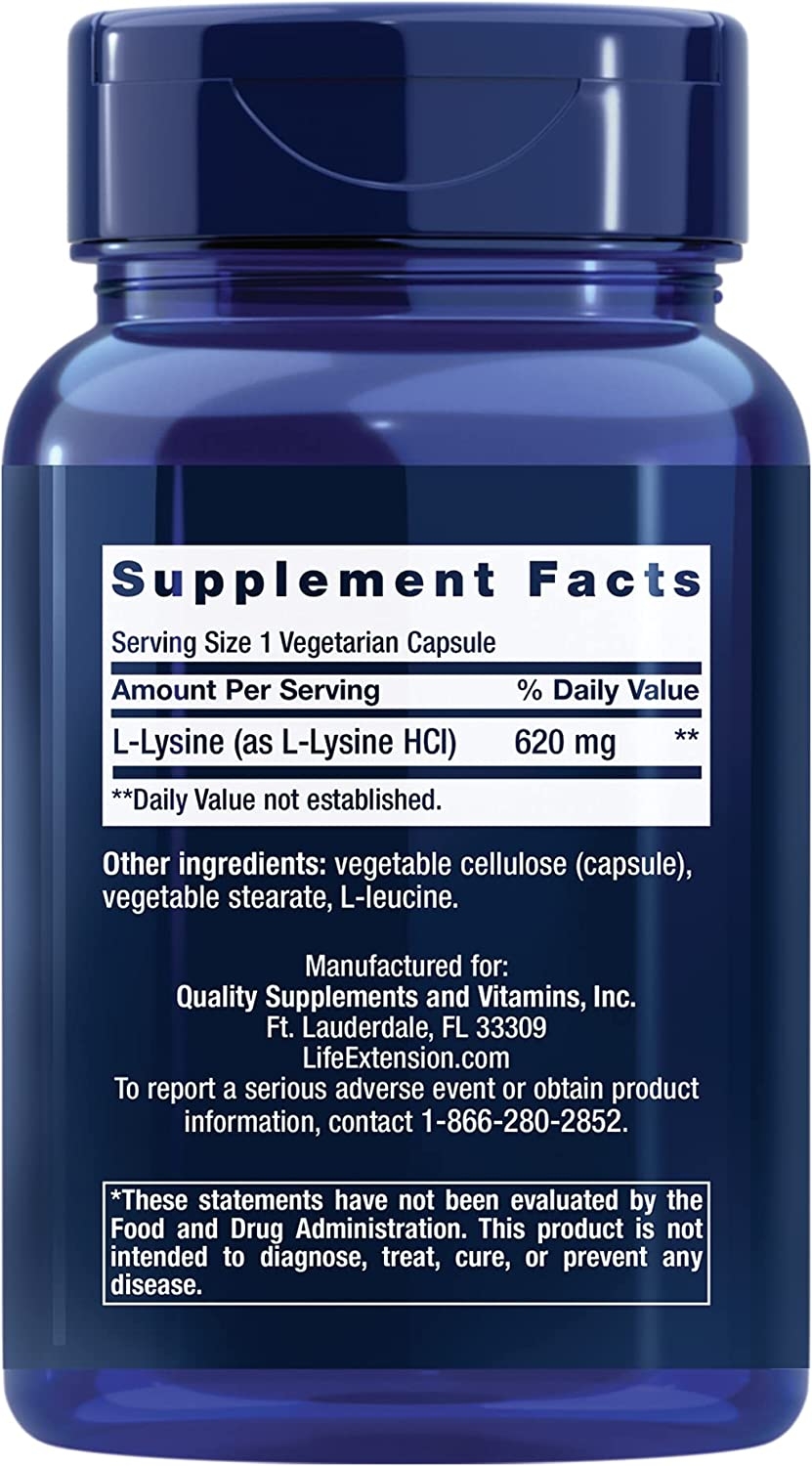
The 100-capsule bottle lasts 100 days at one capsule daily, about 33 at three. One thing the label does not say is whether the 620 mg is lysine itself or the weight of the hydrochloride salt, which contains somewhat less pure lysine. The 1984 trial dosed by the weight of lysine monohydrochloride, so the comparison below is like for like only if the label's 620 mg is also the salt weight; if it is lysine itself, each capsule supplies somewhat more lysine than the 624 mg trial dose.
| This product | Doses in cold sore trials | Adult requirement | Tolerable Upper Limit | |
|---|---|---|---|---|
| Lysine per day | 620 mg (1 capsule) to 1,860 mg (3 capsules) | 624 mg (not effective), 1,000 mg (no overall effect), 1,200 mg (no benefit), 1,248 mg (fewer recurrences), 3,000 mg (fewer outbreaks) | About 30 mg/kg, roughly 2,100 mg at 70 kg | None established; provisional no-adverse-effect level 6,000 mg |
Put in multiples, one capsule is about half the 1,248 mg dose that showed a signal, and three capsules is about 1.5 times it. The 3,000 mg used in the 1987 trial is about 1.6 times the label maximum; reaching it means taking more than the label directs, and the label says "do not exceed recommended dose", so that is a decision for a clinician, not something to try on your own. No Tolerable Upper Intake Level has been set for lysine; the 6,000 mg figure is a research estimate, not a regulatory limit.
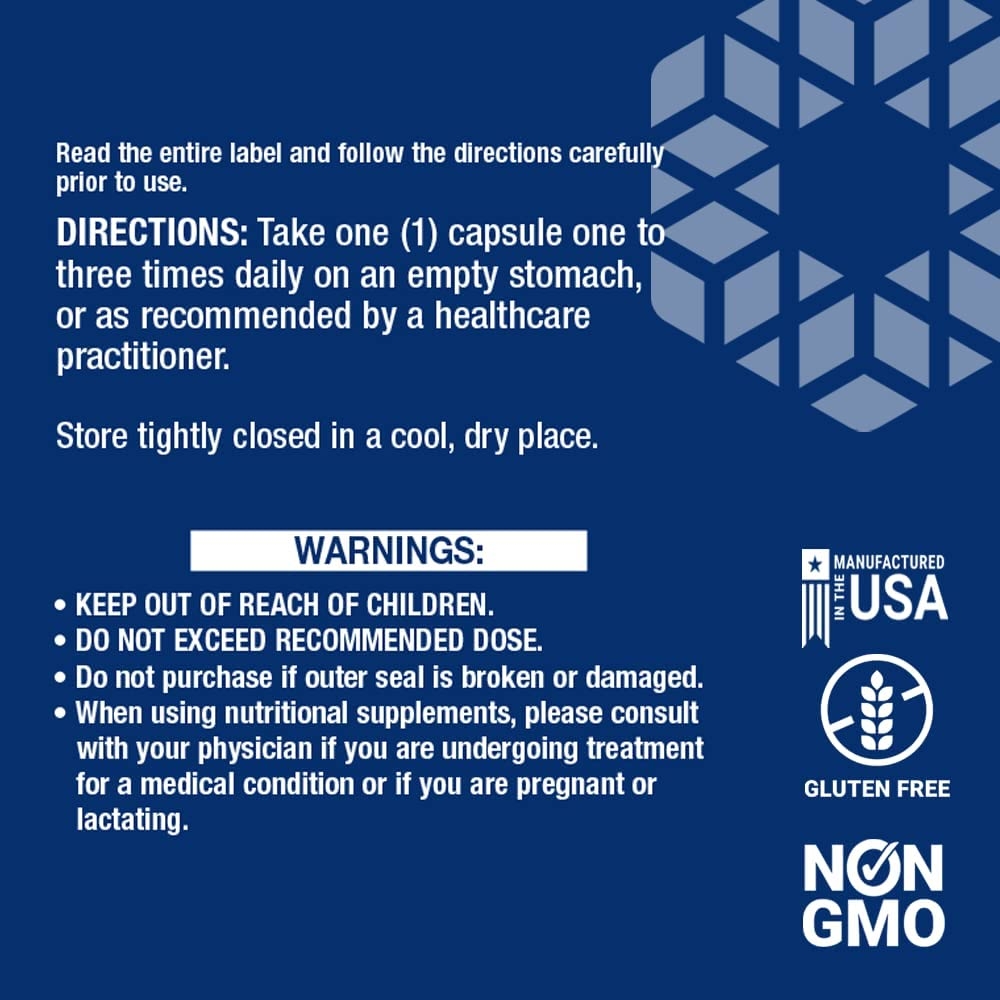
Manufacturer language versus evidence: The store listing for this product describes lysine as supporting "healthy nitrogen balance", "healthy calcium metabolism", "a healthy stress response" and as helping to "inhibit glycation", and the product title says "Immune & Collagen Support". Those are manufacturer claims; the sources we read tested cold sores and safety, not those outcomes. The front of the bottle itself says only "Essential Amino Acid Support".
How to Use Lysine Sensibly
Treat lysine for recurrent cold sores as an experiment with an uncertain payoff, not a treatment. Ask first whether your outbreaks are frequent enough to discuss a prescription antiviral: the Cochrane review found long-term oral antivirals can prevent cold sores, with a small clinical benefit, a better-supported option than lysine.
- Tell your clinician. Mention it if you have heart or gallbladder disease, kidney problems, take regular medication, or are pregnant or breastfeeding.
- Follow the label. One to three capsules daily; more is not shown to be better.
- Judge it fairly. Cold sores come and go on their own, so keep a diary before crediting a capsule.
Who this is for: Adults who get cold sores repeatedly, have discussed it with a doctor, and want to try a modest-dose amino acid alongside, not instead of, proven measures. Also people eating very little protein, for whom it supplements food.
Who should skip it: Most people. If you rarely get cold sores, you gain nothing a normal diet does not already provide. Skip it if you have heart or gallbladder disease unless a clinician agrees, if you are pregnant or breastfeeding without medical advice, or if you expect it to prevent outbreaks: the best systematic review found no evidence that it does.
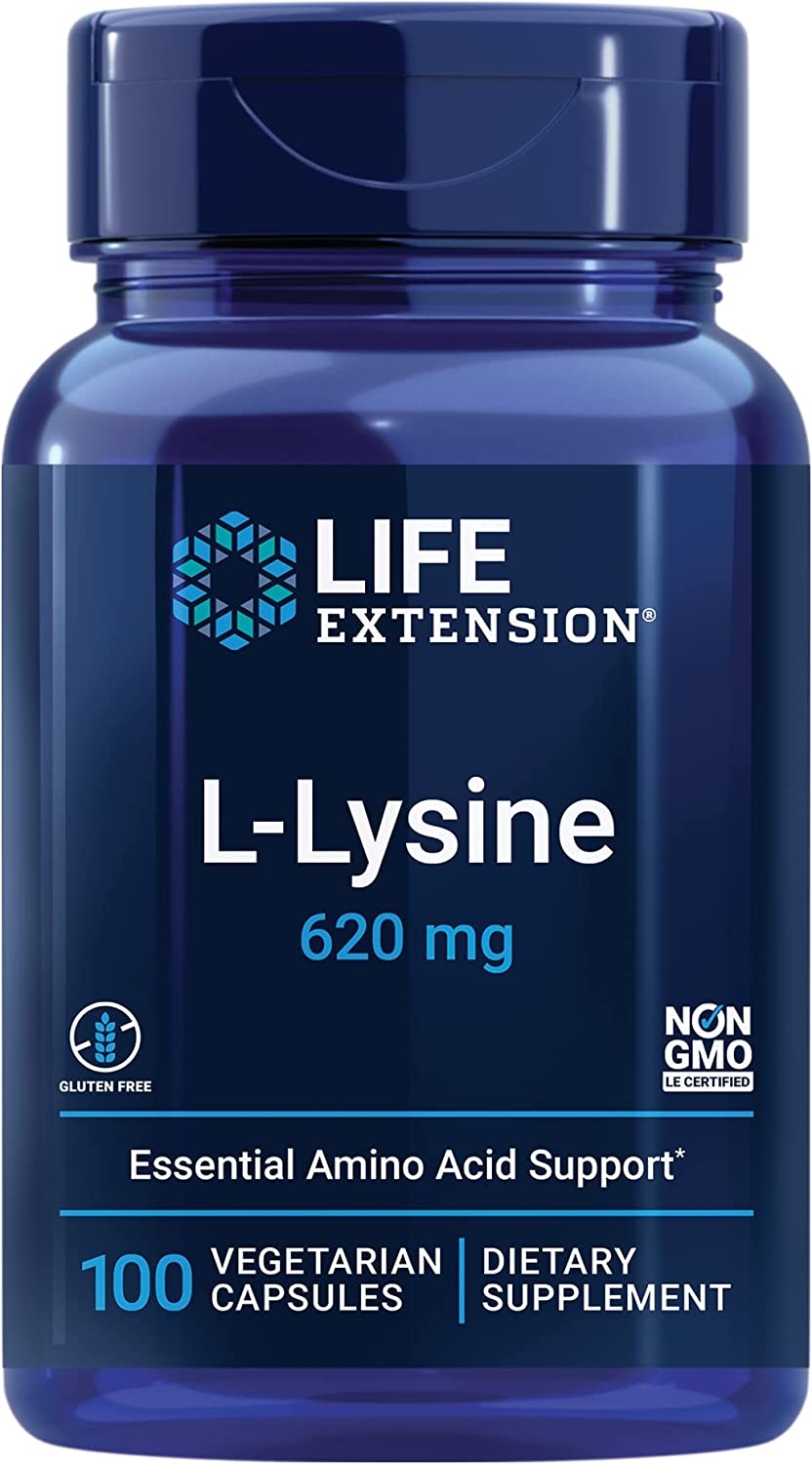
Life Extension L-Lysine 620 mg — 100 Vegetarian Capsules
620 mg of L-lysine (as L-lysine HCl) per capsule, labelled gluten free and non-GMO, with directions of one to three capsules daily. As covered above, the evidence that lysine prevents cold sores is weak; this product is a dietary amino acid supplement, not a treatment for any condition.
View Product DetailsFrequently Asked Questions
Does lysine really prevent cold sores?
The best evidence says no proof exists. A 2015 Cochrane review of 32 trials and 2,640 people failed to find evidence of efficacy for lysine in preventing cold sores. Two small trials at higher doses reported fewer outbreaks; others did not.
How much lysine is used for cold sores?
Trials used 624 mg to 3,000 mg a day. Doses of 624 mg, 1,000 mg and 1,200 mg showed no overall benefit; 1,248 mg (41 people, 1984) and 3,000 mg (52 people, 1987) were linked to fewer outbreaks. A 2017 review called for longer studies above 1.2 g a day. No dose is established as effective.
Is 620 mg of lysine enough?
One 620 mg capsule is close to the 624 mg dose that a 1984 trial found not effective. The label allows up to three capsules, 1,860 mg a day. Whether that is enough for cold sores has not been shown by any trial we read.
Is it safe to take lysine every day?
A 2019 review of 71 human studies found mainly mild stomach symptoms and set a provisional no-adverse-effect level of 6,000 mg a day for healthy people. It is not an official upper limit, so ask a clinician if you have a health condition.
Does lysine have side effects?
Reported effects were mostly gastrointestinal: nausea, stomach ache and diarrhoea. A 2017 review also advised caution for people with cardiovascular or gallbladder disease, citing theoretical risks. Ask a pharmacist first if you take regular medication.
Can I take lysine while pregnant or breastfeeding?
The product label advises consulting a physician if you are pregnant or lactating. We did not find a source we could read that establishes safe supplement doses in pregnancy, so speak to your doctor or midwife before taking a lysine capsule.
What is the best way to prevent cold sores?
MedlinePlus says antiviral medicines can help prevent cold sores in people who get them often, and sun-protective lip balm helps. Cochrane found long-term oral antivirals can prevent them, with small benefit. Discuss prescription options with a doctor if outbreaks are frequent.
Do I need a lysine supplement if I eat meat and dairy?
Probably not for nutrition. The adult requirement is about 30 mg per kilogram a day, roughly 2,100 mg at 70 kg, and that is commonly met in Western diets from meat and plant protein. A supplement adds to that and is not required to meet it.
Sources
- Chi CC et al. "Interventions for prevention of herpes simplex labialis (cold sores on the lips)." Cochrane Database of Systematic Reviews, 7 August 2015. Accessed 29 October 2026.
- Mailoo VJ, Rampes S. "Lysine for Herpes Simplex Prophylaxis: A Review of the Evidence." Integrative Medicine, June 2017. Accessed 29 October 2026.
- Hayamizu K et al. "Safety assessment of L-lysine oral intake: a systematic review." Amino Acids, April 2019. Accessed 29 October 2026.
- McCune MA et al. "Treatment of recurrent herpes simplex infections with L-lysine monohydrochloride." Cutis, October 1984. Accessed 29 October 2026.
- Milman N et al. "Lysine prophylaxis in recurrent herpes simplex labialis: a double-blind, controlled crossover study." Acta Dermato-Venereologica, 1980. Accessed 29 October 2026.
- DiGiovanna JJ, Blank H. "Failure of lysine in frequently recurrent herpes simplex infection. Treatment and prophylaxis." Archives of Dermatology, January 1984. Accessed 29 October 2026.
- Griffith RS et al. "Success of L-lysine therapy in frequently recurrent herpes simplex infection. Treatment and prophylaxis." Dermatologica, 1987. Accessed 29 October 2026.
- MedlinePlus, National Library of Medicine. "Cold Sores." Page undated. Accessed 29 October 2026.
- MedlinePlus Medical Encyclopedia, National Library of Medicine. "Herpes - oral." Reviewed 3 July 2025. Accessed 29 October 2026.
- Wikipedia. "Lysine." Page undated. Accessed 29 October 2026.
- US Food and Drug Administration. "Dietary Supplements." Page undated. Accessed 29 October 2026.
This article is for educational purposes only and is not medical advice. It is not intended to diagnose, treat, cure, or prevent any disease. These statements have not been evaluated by the Food and Drug Administration. Dietary supplements are regulated by the FDA under the Dietary Supplement Health and Education Act of 1994, under which manufacturers are responsible for evaluating the safety and labeling of their products. Talk to your doctor before starting any new supplement.