
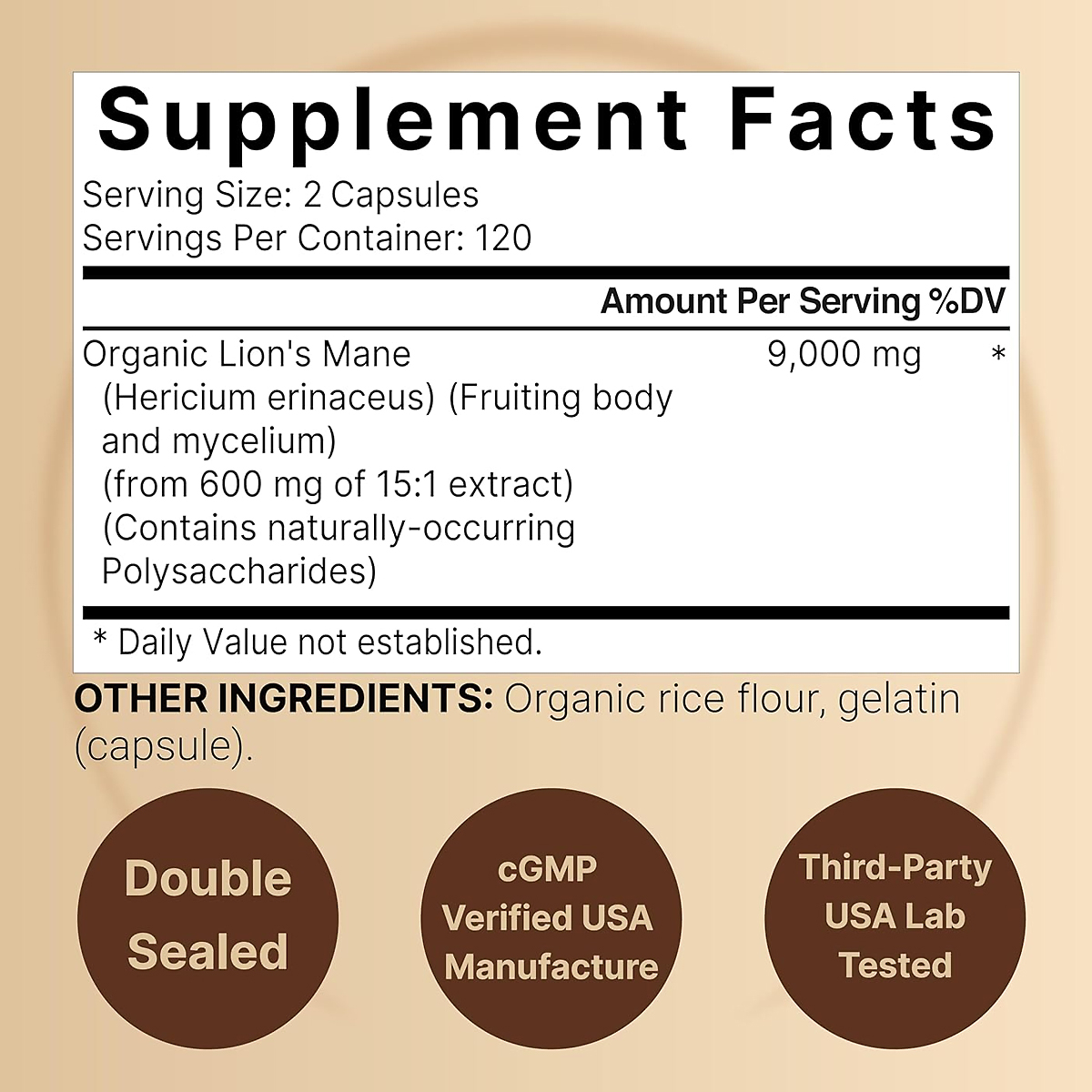
The bottle reviewed here says “9,000 mg per serving,” but the supplement facts panel shows that two capsules hold 600 mg of extract; the 9,000 comes from multiplying by the 15:1 extraction ratio, and most human trials of lion’s mane used 1.8 to 3.2 g of mushroom a day. Lion’s mane (Hericium erinaceus) is an edible mushroom used in traditional Chinese medicine and now sold as a memory supplement (Menon, Frontiers in Nutrition, 2025). This article covers what the small human trials found, who funded them, and where this store listing contradicts its own label.
Key Takeaways
- In the best-known trial, 30 adults aged 50 to 80 with mild cognitive impairment took 3 g of dried lion’s mane a day for 16 weeks and scored higher than placebo from week 8; scores fell significantly 4 weeks after stopping (Mori, Phytotherapy Research, 2009).
- In 41 healthy adults aged 18 to 45, 1.8 g a day gave faster Stroop-task responses once, at 60 minutes (p = 0.005), but the stress result after 28 days missed significance (p = 0.051) (Docherty, Nutrients, 2023).
- A 2025 systematic review found only 5 randomized trials of lion’s mane in people and reported a combined Mini-Mental State Examination gain of 1.17 points from just two studies (Menon, Frontiers in Nutrition, 2025).
- This bottle’s label lists 600 mg of 15:1 extract per 2 capsules, shown as “9,000 mg herbal equivalent”; the product name on this site says 2100 mg (label photo and store listing, read 26 October 2026).
- The listing calls the capsules “vegan” and free of “fillers or grain mycelium,” yet the label lists a gelatin capsule and “fruiting body and mycelium” (label photo, read 26 October 2026).
In this article:
What Lion’s Mane Is, and Why Nerve Growth Factor Gets Mentioned
Two groups of compounds drive the interest. Hericenones come from the fruiting body, the part you would eat, and erinacines come from the mycelium, the thread-like growth underneath. Both stimulate nerve growth factor, a protein neurons use to grow and survive, in laboratory work (Docherty, 2023).
That is a cell and animal case. The 2009 trial authors wrote that many of these reports “come from studies using cultured astrocytes from rodents,” and that it was unknown whether hericenones act the same way in human cells. A 2023 paper states these compounds cross the blood–brain barrier, but it cites an earlier paper for that, not a measurement in the volunteers it tested. Whether swallowing a capsule raises nerve growth factor in a human brain is, in the sources I read, not shown.
The NCCIH’s July 2022 clinical digest on supplements and cognitive function covers ginkgo, omega-3s and curcumin, among others; lion’s mane does not appear in it. On ginkgo it says “There’s no conclusive evidence that Ginkgo biloba is efficacious in preventing or slowing dementia or cognitive decline,” the bar a memory supplement is measured against; our ginkgo guide covers the 3,069-person trial behind it. MedlinePlus says of mild cognitive impairment: “At this time, there is no proven drug treatment for MCI” (read 26 October 2026).
The Human Trials, One by One
The 2025 systematic review (PubMed, 2000 to June 2024) found five randomized controlled trials, three pilot clinical trials and one cohort study in people (Menon, 2025). That is a small base. The table lists the ones with cognitive outcomes, using the doses the papers report.
| Study | Who, and how many | Daily dose and length | What it found |
|---|---|---|---|
| Mori, Phytother Res (2009) | 30 adults aged 50–80 with mild cognitive impairment; 15 per group | 3 g dried fruiting-body powder; 16 weeks | Higher scores than placebo at weeks 8, 12, 16; fell significantly 4 weeks after stopping |
| Saitsu, Biomed Res (2019) | 31 healthy adults, average age about 61 | 3.2 g fruiting-body powder; 12 weeks | One cognitive scale improved; per Docherty, no effect on other measures |
| Docherty, Nutrients (2023) | 41 healthy adults aged 18–45 | 1.8 g capsule blend; one dose, then 28 days | Faster Stroop task at 60 minutes (p = 0.005); stress trend p = 0.051; “null and limited negative findings” also seen |
| Grozier (2022), described in Menon (2025) | 24 healthy young adults | 10 g in muffins; 4 weeks | No significant effect on any measure |
| Li (2020), described by two sources | People with early Alzheimer’s disease | About 1 g erinacine A-enriched product; 49 weeks | Sources disagree on the cognitive result (see below); both mention daily-living scores |
The Li trial shows how thin the evidence is. Docherty (2023) says it “observed improvements on the Mini-Mental State Examination at week 49.” NutritionFacts.org (December 2024) describes the same trial as finding no cognitive benefit over placebo, with a possible gain in activities of daily living. I did not read the trial itself, so I cannot say which description is right.
“Given the small sample size, these findings should be interpreted with caution.”
— Docherty, Doughty and Smith, Nutrients (2023), on their 41-person lion’s mane trialWho Supplied the Mushrooms, and the Placebo Problem
The 2009 trial is the strongest result. Four of its five authors work at the Mushroom Laboratory of Hokuto Corporation, and the lion’s mane in the tablets “was cultured by Hokuto Corporation in its facilities,” according to the paper. That does not make the result false, but it is the maker of the test product reporting on it.
The authors also noted that the placebo group’s scores “also showed significant increases at weeks 8 and 16,” which they attributed to a placebo effect or to the subjects becoming used to the test. The treatment group improved more than that, and the gain faded after stopping: the authors concluded continuous intake would be needed to keep it. In the 2023 trial, Sempera Organics supplied the capsules and, per the paper, had no role in design, analysis or publication.
A NutritionFacts.org page, which I read as a summary rather than watching the full video, describes a later attempt to replicate the 2009 finding in cognitively healthy older adults at about 3 g a day: one of three cognitive measures improved. The acetyl-L-carnitine guide shows the same pattern of mixed trials.
NutritionFacts.org, “Does Lion’s Mane Mushroom Powder Have Benefits for Dementia?” (December 2024). I read the matching web page, not a transcript of the video, and have not checked every statement in it.
Side Effects and the One Serious Case Report
In the 2009 trial, seven people in the lion’s mane group and six in the placebo group reported mild stomach discomfort or diarrhea needing no treatment, with no difference between groups. The abstract says laboratory tests showed “no adverse effect”; the body of the paper is more complete. The 2025 review lists the potential side effects as stomach discomfort, headache and allergic reactions, noting these are commonly unreported (Menon, 2025).
One reported case was serious. The 2025 review found a case report of a 63-year-old Japanese man with mild untreated diabetes who had taken lion’s mane supplements regularly from December 2001 until emergency admission with acute respiratory distress syndrome. A lymphocyte reaction test on the extract was significantly positive, and the report concluded the mushroom contains a compound capable of triggering an allergic reaction; a causal link was “discussed,” not proven. It is one case, not a rate. Stop and seek care for breathing trouble, fever or a new cough while taking any mushroom supplement, and avoid it if you react to mushrooms.
I tried to read the NIH LiverTox entry on lion’s mane, but the page was blocked by a browser check, so I cannot report what it says about liver safety. I also found no interaction study with prescription drugs; that is a gap, not reassurance.
Inside the Bottle: Label Versus Listing
The product is the NatureBell Organic Lions Mane Mushroom, 240 capsules, listed at $15.48 and in stock on 26 October 2026. I read all five gallery photos, including the supplement facts panel, against the store text.
| Topic | Label photos | Store listing |
|---|---|---|
| Amount | 9,000 mg per 2 capsules, “from 600 mg of 15:1 extract” | Product name says 2100 mg; short text says “2,100 mg per 2-capsule serving”; long text says 9,000 mg |
| Part of the mushroom | “Fruiting body and mycelium” | Short text: “whole-fruiting-body” and “no fillers or grain mycelium”; long text: “both fruiting body and mycelium” |
| Vegan | Other ingredients: organic rice flour, gelatin (capsule) | Short text says “vegan” and “no fillers” |
| Organic | “Made with organic lion’s mane”; no USDA seal visible in the five photos | Short text: “Certified USDA Organic” |
| Immune and energy | Badge reads “Potent Cognitive Nootropic & Immune Health Mushroom” | Claims immune “boost” and energy; the cold-and-flu lines are customer testimonials |
The store’s own text disagrees with itself on the amount and the source, and the short description contradicts the label on three points. Gelatin is animal-derived, and rice flour is a bulking ingredient. I cannot tell from photos which description is right on the mushroom part, so treat the label as the better guide; it is the regulated document. Nothing in the studies I read tested lion’s mane for colds, flu or energy, so those listing claims have no support in this article’s sources. The FDA says manufacturers “are responsible for evaluating the safety and labeling of their products before marketing,” and it acts after products reach the market (content current as of 1 October 2024).
On the dose, 600 mg multiplied by 15 gives exactly 9,000 mg, so “herbal equivalent” is arithmetic on the extraction ratio, and the label does not say whether the starting mushroom was fresh or dried. Most trials used 1.8 to 3.2 g of mushroom a day (one used 10 g, another about 1 g of a mycelium product); none of the papers I read describes a 15:1 extract. The numbers cannot be compared directly, and a larger figure on the front does not mean a larger dose than the trials used.
| This product | Typical shelf dose | Trial doses | NIH RDA / AI | Tolerable Upper Limit | |
|---|---|---|---|---|---|
| Lion’s mane | 600 mg of 15:1 extract (label: “9,000 mg herbal equivalent”) per 2 capsules | Not surveyed for this article | 1.8 g, 3 g, 3.2 g of powder daily; 10 g daily in muffins (no effect) | None established; the label says Daily Value not established | None found; lion’s mane is not a nutrient, and I found no regulator limit |
The label directs two capsules daily, so 240 capsules is 120 servings. The “Third-Party USA Lab Tested” badge is a claim; I could view no certificate. This product was not tested in any trial I read.
Who Might Try It, and Who Should Skip It
Who this is for: adults curious about a low-risk memory supplement who accept that the evidence is a few small trials; people who will track their own focus over several weeks and stop if nothing changes; and those whose clinician has reviewed it alongside any memory concerns.
Who should skip it: most people expecting a noticeable memory gain, since the strongest trial had 15 people per group and the gain faded within 4 weeks of stopping; anyone with a mushroom allergy or unexplained breathing symptoms; anyone with diagnosed cognitive decline, who needs a clinician rather than a capsule; strict vegans, because the capsule is gelatin; and anyone buying it to prevent colds or flu, which the trials I read did not test. Pregnant or breastfeeding readers, children, and people on prescription medicines should ask a clinician first; I found no safety data for those groups.
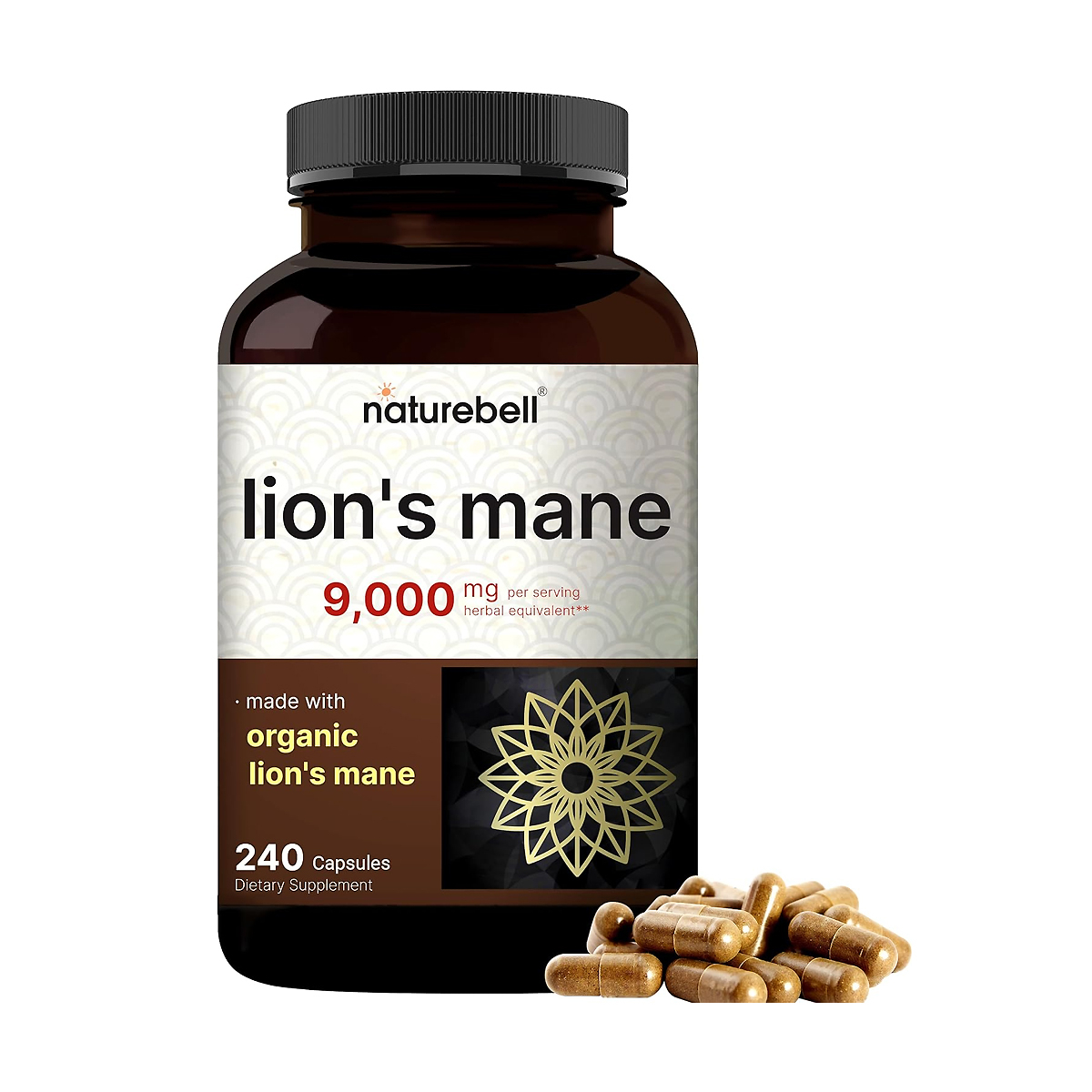
NatureBell Organic Lions Mane Mushroom, 240 Capsules
Two capsules per serving contain 600 mg of 15:1 lion’s mane extract from fruiting body and mycelium, with a gelatin capsule and rice flour; 120 servings per bottle. Browse more in our supplements collection.
View Product DetailsFrequently Asked Questions
What is lion’s mane mushroom?
Lion’s mane (Hericium erinaceus) is an edible mushroom native to North America, Europe and Asia, used in traditional Chinese medicine. Supplements use the fruiting body, the mycelium, or both (Menon, 2025). Interest centres on compounds that stimulate nerve growth factor in laboratory studies.
Does lion’s mane improve memory?
Possibly in older adults with mild cognitive impairment: 15 per group took 3 g a day for 16 weeks and outscored placebo from week 8 (Mori, 2009). In healthy adults the results are mixed, with one speed measure improving after a single 1.8 g dose (Docherty, 2023).
How much lion’s mane should I take a day?
No official dose exists. Most trials used 1.8 to 3.2 g of mushroom daily for 4 to 16 weeks; one gave 10 g a day with no effect. This bottle’s label directs two capsules a day, containing 600 mg of 15:1 extract, which is not directly comparable to powder doses. Follow the label and ask a clinician if unsure.
What does 9,000 mg “herbal equivalent” mean?
It is the extract weight times the extraction ratio: 600 mg of 15:1 extract is written as 9,000 mg. The capsules do not contain 9,000 mg of mushroom. The label does not say whether the starting mushroom was fresh or dried.
What are the side effects of lion’s mane?
Reported effects are mild stomach discomfort, diarrhea, headache and allergic reactions (Menon, 2025). In the 2009 trial, seven people taking lion’s mane and six taking placebo reported mild stomach upset. One case report described severe lung illness with a positive allergy-type test.
Is lion’s mane vegan?
The mushroom is a fungus, but this bottle’s supplement facts list a gelatin capsule, which is animal-derived. The store’s short description calls the product vegan; the label photo contradicts that.
Does lion’s mane help with immunity or energy?
The sources read for this article tested cognition, mood and stress, not colds or energy. The immune and energy claims on this listing are manufacturer copy and customer testimonials, not trial results.
How long does lion’s mane take to work?
In the 2009 trial, scores rose above placebo at week 8 and kept rising to week 16, then fell significantly 4 weeks after stopping. Healthy adults and extract products may differ.
Sources
- Mori K, et al. Improving effects of the mushroom Yamabushitake (Hericium erinaceus) on mild cognitive impairment: a double-blind placebo-controlled clinical trial. Phytotherapy Research 2009;23(3):367–372. Full text read as hosted by the Mushroom Council; link is the NCBI PubMed abstract record 18844328. Accessed 26 October 2026. ncbi.nlm.nih.gov
- Docherty S, Doughty FL, Smith EF. The acute and chronic effects of lion’s mane mushroom supplementation on cognitive function, stress and mood in young adults: a double-blind, parallel groups, pilot study. Nutrients 2023;15(22):4842. Accessed 26 October 2026. pmc.ncbi.nlm.nih.gov
- Menon A, et al. Benefits, side effects, and uses of Hericium erinaceus as a supplement: a systematic review. Frontiers in Nutrition 2025. Accessed 26 October 2026. pmc.ncbi.nlm.nih.gov
- NutritionFacts.org. Does lion’s mane mushroom powder have benefits for dementia? December 2024. Web page read; video not transcribed. Accessed 26 October 2026. nutritionfacts.org
- National Center for Complementary and Integrative Health. Dietary supplements and cognitive function, dementia, and Alzheimer’s disease: what the science says. July 2022. Accessed 26 October 2026. nccih.nih.gov
- MedlinePlus, National Library of Medicine. Mild cognitive impairment. No update date shown on the page. Accessed 26 October 2026. medlineplus.gov
- U.S. Food and Drug Administration. Dietary supplements. Content current as of 1 October 2024. Accessed 26 October 2026. fda.gov
This article is for educational purposes only and is not medical advice. It is not intended to diagnose, treat, cure, or prevent any disease. These statements have not been evaluated by the Food and Drug Administration; product statements come from its store listing and label photos. Talk to your doctor before using any supplement, especially if you have memory concerns, a mushroom allergy, take prescription medicine, are facing surgery, are under 18, or are pregnant or breastfeeding.