
In a 130-woman randomised trial published in 2017, DIM raised the urinary 2/16α-hydroxyestrone ratio, the estrogen-metabolite marker it is sold to shift, and in the same women it lowered blood levels of endoxifen, an active form of the breast-cancer drug tamoxifen. Diindolylmethane (DIM) is a compound the body forms from indole-3-carbinol, a substance in broccoli, cabbage and other cruciferous vegetables, and it is sold in capsules marketed for “hormonal balance”, including the 400 mg-per-serving product reviewed here.
Key Takeaways
- In the 2017 tamoxifen trial of 130 women, 150 mg of DIM twice a day for 12 months raised the urinary 2/16α-OHE1 ratio versus placebo (p < 0.001), but plasma endoxifen, 4-hydroxytamoxifen and N-desmethyltamoxifen fell (Thomson et al., 2017).
- The 2004 pilot study that is often cited used 108 mg a day for 30 days in only 19 women; the key ratio rose 47% (1.46 to 2.14) but that rise was not statistically significant (p = 0.059) (Dalessandri et al., 2004).
- A 64-woman trial of DIM at about 2 mg/kg a day for 12 weeks found no statistically significant difference from placebo on any outcome, and the Linus Pauling Institute (reviewed July 2017) reports a 551-woman, six-month, 150 mg/day trial that failed to promote HPV clearance.
- Memorial Sloan Kettering (updated 15 December 2023) says of the “detox” claim: “There is no scientific evidence to back this claim.”
- This product’s label shows 400 mg of DIM per 2 capsules, about 1.3 times the 300 mg a day used in two of the trials and 3.7 times the 108 mg pilot dose; no Tolerable Upper Intake Level exists for DIM.
In this article:
- What DIM Is, and What the Vegetable Version Does and Doesn’t Tell You
- Does DIM Change Estrogen Metabolism? Yes, the Marker Moves
- Does a Moved Marker Mean a Health Benefit? What the Outcome Trials Found
- Tamoxifen, Hormone Therapy, Pregnancy and Other Cautions
- Inside NatureBell DIM 400 mg: Label Versus Listing
- Who Might Consider It, and Who Should Skip It
- Frequently Asked Questions
What DIM Is, and What the Vegetable Version Does and Doesn’t Tell You
According to Memorial Sloan Kettering Cancer Center (MSK, updated 15 December 2023), DIM is a metabolite of indole-3-carbinol (I3C) and “the most studied of all I3C metabolites.” I3C comes from glucosinolates in cruciferous vegetables. The Linus Pauling Institute (LPI, reviewed July 2017) explains that in stomach acid I3C molecules combine with each other, and one product is DIM.
The National Cancer Institute’s cruciferous-vegetable fact sheet (NCI, reviewed 7 June 2012) says studies of vegetable intake in humans “have shown mixed results.” The LPI adds that the amount of I3C formed from food “is variable.” A finding about broccoli cannot simply be transferred to a 400 mg capsule.
Mayo Clinic, “Mayo Clinic Minute: Cruciferous finds at the farmers market.” About the vegetables, not DIM capsules; we could not read a transcript, so treat it as context, not evidence.
Does DIM Change Estrogen Metabolism? Yes, the Marker Moves
This is the part of the DIM story that holds up. The body breaks estrogen down along several paths, and two of the products measured in urine are 2-hydroxyestrone (2-OHE1) and 16α-hydroxyestrone (16α-OHE1). The LPI describes 16α-OHE1 as “highly estrogenic” and 2-OHE1 as less so, and says it has been hypothesised that shifting metabolism toward the 2 path could lower the risk of estrogen-sensitive cancers. That is a hypothesis. What the trials do show, per the LPI, is that oral I3C or DIM “has consistently increased” urinary 2-OHE1 or the 2:16 ratio in women.
| Study | Who and how long | DIM dose | What happened |
|---|---|---|---|
| Dalessandri et al., Nutrition and Cancer, 2004 | 19 postmenopausal women with a history of early-stage breast cancer; 30 days; placebo-controlled | 108 mg/day | Significant rise in 2-OHE1 (p = 0.020); ratio up 47%, 1.46 to 2.14, not significant (p = 0.059) |
| Rajoria et al., Thyroid, 2011 | 7 women scheduled for thyroid surgery (goitre, benign adenoma or papillary carcinoma); 14 days; no control group | 300 mg/day | Urinary 2-OHE rose in 6 of 7; 16-OHE1 fell in all 7; no measurable toxicity on blood and liver tests |
| Thomson et al., Breast Cancer Research and Treatment, 2017 | 130 women taking tamoxifen (98 completed); 12 months; double-blind placebo-controlled | 150 mg twice daily | 2/16α-OHE1 ratio +3.2 versus −0.7 on placebo (p < 0.001); SHBG up; no change in breast density; tamoxifen metabolites down |
| Newman and Smeaton, BMC Complementary Medicine and Therapies, 2024 | Retrospective lab data: 909 premenopausal women reporting DIM versus 18,385 not; plus 53 with before-and-after tests | Self-reported; dose not stated in the abstract | Significant differences in almost every urinary estrogen measure; 2-OHE1:16-OHE1 ratio rose in both comparisons |
Two cautions apply. The first three rows are small or specific populations, and the last is observational, with people reporting their own DIM use. Every result is also a urinary biomarker: none of these studies measured whether anyone felt better or avoided a disease. The Newman and Smeaton authors state that “research into DIM’s effect on the estrogen profile is lacking in the published literature.”
Does a Moved Marker Mean a Health Benefit? What the Outcome Trials Found
The LPI (reviewed July 2017) answers the marker question directly: “large case-control and prospective cohort studies have failed to find significant associations” between the urinary 2:16 ratio and risk of breast and endometrial cancer. A ratio that moves is not the same as an outcome that improves.
Where DIM has been tested against actual outcomes, the results are unimpressive. In a randomised trial of 64 women scheduled for a procedure on biopsy-proven cervical lesions, DIM at about 2 mg/kg a day for 12 weeks was well tolerated, and the authors reported that “There was no statistically significant difference in any outcome between the DIM and placebo group” (Del Priore et al., Gynecologic Oncology, 2010). Many women in both arms improved. The LPI also describes a six-month randomised trial of 150 mg/day in 551 women in which DIM “failed to promote HPV clearance.” MSK says studies are “mixed” for cervical cell abnormalities and that “clinical data are limited.”
“There is no scientific evidence to back this claim.”
— Memorial Sloan Kettering Cancer Center, on the claim that DIM works as a “detoxifier”, updated 15 December 2023Taken together: DIM reliably shifts a laboratory marker, and no trial cited here shows that the shift translates into a benefit a reader would notice. Nor did any source we read include a controlled trial in men, so the “both men and women” framing used for this kind of product rests on thinner ground than the women’s data above.
Tamoxifen, Hormone Therapy, Pregnancy and Other Cautions
The same property that makes DIM interesting, its effect on how the body handles estrogen and drugs, is the source of its main cautions.
Safety warning — tamoxifen: in the 2017 randomised trial, plasma endoxifen, 4-hydroxytamoxifen and N-desmethyl-tamoxifen were all reduced in women taking DIM versus placebo (p < 0.001). The authors said further research is needed to determine whether this “attenuates the clinical benefit of tamoxifen.” Do not add DIM to tamoxifen without your oncologist’s agreement.
- Estrogen therapy. In a 2025 observational study of 1,458 postmenopausal women using a transdermal estradiol patch, the 108 who also took DIM had significantly different urinary estrogen profiles; the authors warned of “unexpected changes” and a possibility that the effect might “decrease the overall estrogenic impact” of hormone therapy (Newman and Smeaton, Menopause, July 2025). It is one retrospective study, not proof.
- Other medicines. MSK says DIM modulates several CYP450 liver enzymes and may make drugs processed by them less effective, and it advises women on birth-control pills to check with a clinician first.
- Pregnancy and breastfeeding. MSK: “Because of potential hormonal effects, women who are pregnant, planning to get pregnant, or nursing should not take DIM.”
- Case reports. MSK lists a visual disturbance (central serous chorioretinopathy) after two months of excessive daily intake that resolved 8 weeks after stopping, a drug rash with eosinophilia, an ischaemic stroke in a 38-year-old woman, and a pulmonary embolism with deep-vein thrombosis in a 65-year-old man. Case reports cannot show that DIM caused these events.
- Long-term unknowns. The LPI notes that contradictory animal results led several experts to caution “against the widespread use of I3C and DIM supplements in humans until their potential risks and benefits are better understood.”
Tolerability in the trials was generally good: Del Priore reported nausea in 2 of 64 women, and Thomson reported minimal adverse events that did not differ from placebo.
Inside NatureBell DIM 400 mg: Label Versus Listing
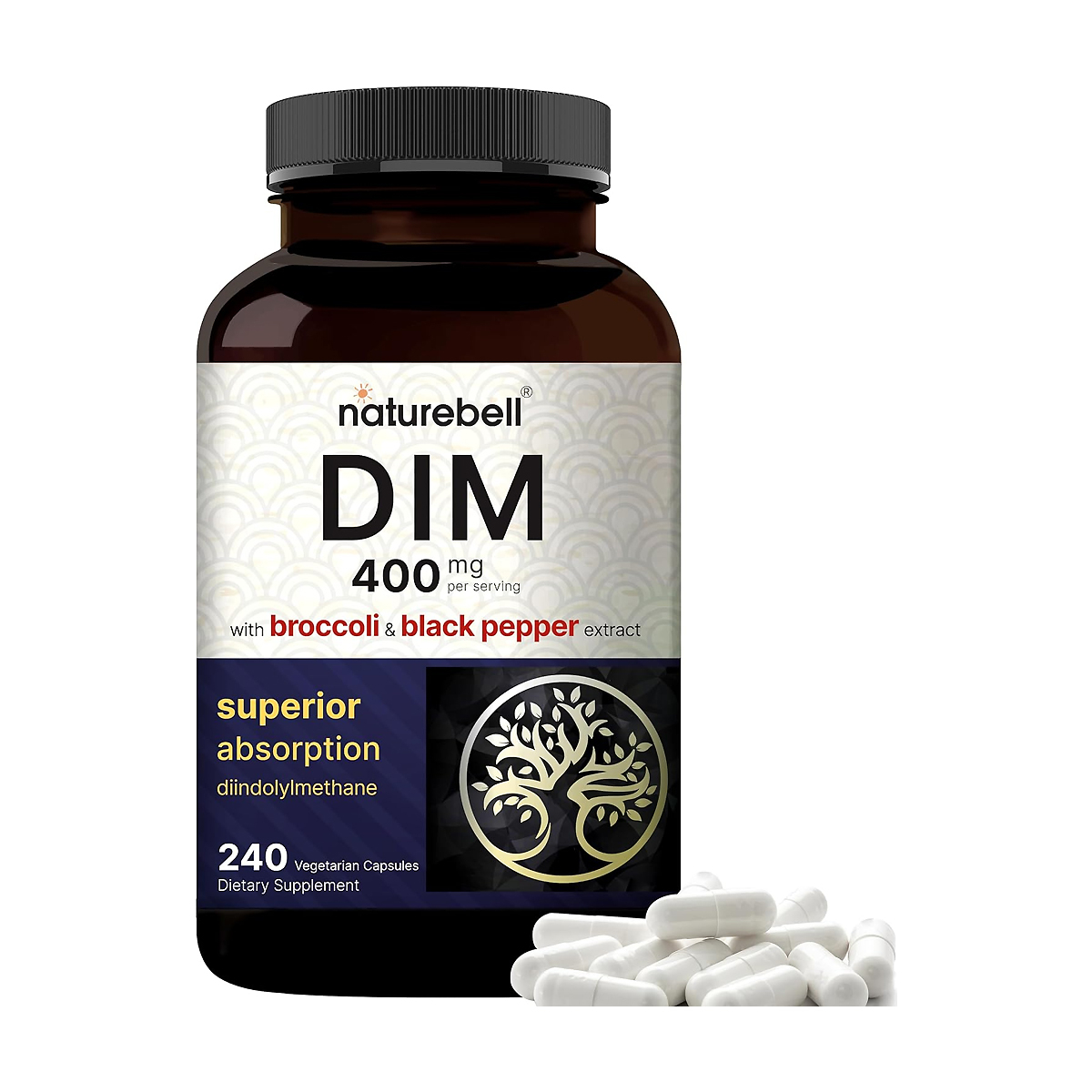
The product is NatureBell DIM 400 mg with broccoli and black pepper extract, 240 vegetarian capsules. Its Supplement Facts panel gives a serving as 2 capsules and 120 servings per container: DIM (as diindolylmethane) 400 mg, broccoli powder 25 mg and black pepper extract (Piper nigrum) 2.5 mg, each with no Daily Value established. Other ingredients are rice flour, magnesium stearate, silicon dioxide and a vegetable cellulose capsule. At 2 capsules a day the bottle lasts 120 days; each capsule holds about 200 mg of DIM.
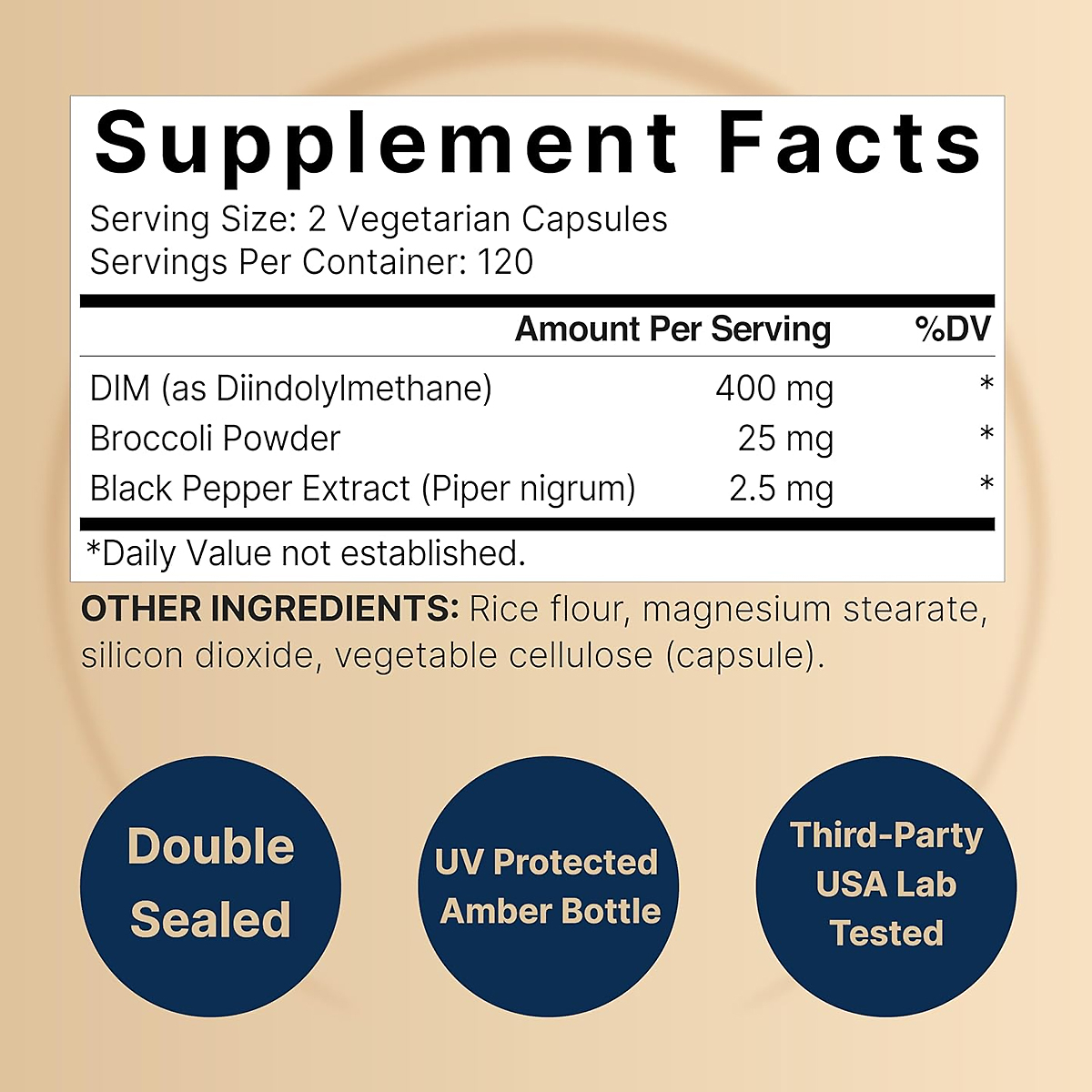
| This product (per 2-capsule serving) | Dalessandri 2004 (per day) | Rajoria 2011 and Thomson 2017 (per day) | Del Priore 2010 (per day) | NIH RDA / UL | |
|---|---|---|---|---|---|
| DIM | 400 mg | 108 mg | 300 mg | About 2 mg/kg (roughly 130 mg for a 65 kg adult, our calculation) | None established |
| Multiple of this product’s dose | 1× | 3.7× lower | 1.3× lower | About 3× lower | Not applicable |
No RDA, Adequate Intake or Tolerable Upper Intake Level exists for DIM because it is not a nutrient. The 400 mg serving is the highest single daily amount in this comparison, 1.3 times the 300 mg used for 14 days (Rajoria) and 12 months (Thomson), and 3.7 times the 108 mg pilot dose. We found no controlled trial at 400 mg. The trials also used a specific absorbable preparation (BioResponse-DIM), and we have no data showing this product delivers the same blood levels.
| Claim | Store listing or listing graphic | What the evidence says |
|---|---|---|
| Detox | “DIM detox* support helps the body … assisting in the elimination of toxins” | MSK (updated 15 December 2023): “There is no scientific evidence to back this claim.” |
| Absorption | Bottle says “superior absorption”; black pepper extract “enhances the efficacy and bioavailability of DIM”; the short description names BioPerine | The label names only “Black Pepper Extract (Piper nigrum)” at 2.5 mg, with no trademark or piperine percentage; we found no human absorption data for this formula |
| Hormones | “Supports estrogen and hormonal health in both men and women”; a listing graphic says “Supports Management of Menopause” | Trials show a urinary marker shifting in women; none cited here tested menopausal symptoms or men |
| Testing | “Third-Party USA Lab Tested” badge | No results or laboratory name appear in the photos or listing we read |
The listing’s directions (2 capsules daily with a meal) and 120-day claim match the panel, and the capsule is vegetable cellulose, so “vegetarian” holds. Under DSHEA, the FDA (FDA, content current as of 21 October 2022, accessed 17 October 2026) does not approve dietary supplements before they are marketed. Not verified: this product’s potency, purity, contaminant testing or the source of its DIM.
Who Might Consider It, and Who Should Skip It
Who this is for: adults who are not pregnant, not breastfeeding, not on tamoxifen, hormone therapy, hormonal contraception or other prescription medicines, and who understand that the evidence is of a urinary marker moving, not of a symptom improving. Ask a pharmacist or physician first, particularly if you have a hormone-sensitive condition.
Who should skip it: most people. Skip it if you take tamoxifen or any estrogen product, are pregnant or trying to conceive, are breastfeeding, have a history of blood clots or stroke, take medicines cleared by CYP liver enzymes, or want it for “detox”, menopause symptoms or any medical condition.
NatureBell DIM 400 mg with Broccoli and Black Pepper Extract, 240 Capsules
400 mg DIM, 25 mg broccoli powder and 2.5 mg black pepper extract per 2-capsule serving; 120 servings. Browse more women’s health supplements.
View Product DetailsFrequently Asked Questions
What is DIM?
Diindolylmethane (DIM) is a compound formed in the stomach from indole-3-carbinol, found in cruciferous vegetables such as broccoli and cabbage. Memorial Sloan Kettering (December 2023) calls it the most studied I3C metabolite. It is sold in capsules marketed for estrogen metabolism.
What does DIM do to estrogen?
Trials show DIM raises the urinary ratio of 2-hydroxyestrone to 16α-hydroxyestrone. In the 2017 trial of 130 women, the ratio rose significantly versus placebo. These are laboratory markers; the trials cited here did not show a symptom benefit or a change in disease outcomes.
Does DIM balance hormones?
It changes how estrogen is broken down, but “balance” is a marketing term, not a measured trial outcome. The Linus Pauling Institute (July 2017) found large studies had not linked the urinary ratio to cancer risk, so a shifted ratio is not proof of better health.
Is DIM safe to take every day?
Trials of 14 days to 12 months reported mostly mild effects, but the 2017 trial authors noted limited long-term safety data, and MSK lists case reports of rash, vision disturbance, stroke and blood clots.
Can I take DIM with tamoxifen?
It is not advised without your oncologist. In the 2017 randomised trial, plasma endoxifen, 4-hydroxytamoxifen and N-desmethyl-tamoxifen were lower in women taking DIM than placebo (p < 0.001), and the authors said the effect on tamoxifen’s benefit needs study.
Can men take DIM?
The studies in this article enrolled women, so evidence for men is thin; MSK describes only limited human data in prostate cancer. Men with hormone-related concerns should have levels checked by a clinician.
Does DIM help with menopause symptoms?
No trial cited here tested menopausal symptoms. A 2025 study found DIM changed estrogen metabolites in women using an estradiol patch and warned it might reduce the effect of hormone therapy.
Does DIM detox the body?
No evidence supports this. Memorial Sloan Kettering (updated 15 December 2023) states, “There is no scientific evidence to back this claim.” DIM does alter how liver enzymes process some drugs, which can matter for medicines.
Sources
- Memorial Sloan Kettering Cancer Center. “Diindolylmethane.” About Herbs database. Updated 15 December 2023. Accessed 17 October 2026. mskcc.org
- Linus Pauling Institute, Oregon State University. “Indole-3-Carbinol.” Micronutrient Information Center. Reviewed July 2017. Accessed 17 October 2026. lpi.oregonstate.edu
- National Cancer Institute. “Cruciferous Vegetables and Cancer Prevention.” Reviewed 7 June 2012. Accessed 17 October 2026. cancer.gov
- Thomson et al. “A randomized, placebo-controlled trial of diindolylmethane for breast cancer biomarker modulation in patients taking tamoxifen.” Breast Cancer Research and Treatment, August 2017. Accessed 17 October 2026. PubMed Central
- Dalessandri et al. “Pilot study: effect of 3,3′-diindolylmethane supplements on urinary hormone metabolites in postmenopausal women with a history of early-stage breast cancer.” Nutrition and Cancer, 2004. Accessed 17 October 2026. PubMed record 15623462 (NLM)
- Rajoria et al. “3,3′-Diindolylmethane modulates estrogen metabolism in patients with thyroid proliferative disease: a pilot study.” Thyroid, March 2011. Accessed 17 October 2026. PubMed Central
- Del Priore et al. “Oral diindolylmethane (DIM): pilot evaluation of a nonsurgical treatment for cervical dysplasia.” Gynecologic Oncology, March 2010. Accessed 17 October 2026. PubMed record 19939441 (NLM)
- Newman and Smeaton. “Exploring the impact of 3,3′-diindolylmethane on the urinary estrogen profile of premenopausal women.” BMC Complementary Medicine and Therapies, 22 November 2024. Accessed 17 October 2026. biomedcentral.com
- Newman and Smeaton. “The impact of 3,3′-diindolylmethane on estradiol and estrogen metabolism in postmenopausal women using a transdermal estradiol patch.” Menopause, July 2025. Accessed 17 October 2026. PubMed record 40298801 (NLM)
- US Food and Drug Administration. “Information for Consumers on Using Dietary Supplements.” Content current as of 21 October 2022. Accessed 17 October 2026. fda.gov
This article is for educational purposes only and is not medical advice. It is not intended to diagnose, treat, cure, or prevent any disease. These statements have not been evaluated by the Food and Drug Administration. Talk to your doctor before starting any new supplement, especially if you take tamoxifen, hormone therapy or other prescription medication, are pregnant or breastfeeding, or have a hormone-sensitive condition.