
The systematic review most often cited for astaxanthin’s anti-wrinkle effect reports in its own abstract that oral astaxanthin “did not significantly decrease wrinkle depth” (p = 0.11), then concludes in the next sentence that it “reduces wrinkles.” Astaxanthin is a red xanthophyll carotenoid that microalgae, bacteria and yeasts make naturally, and the alga Haematococcus pluvialis is its most promising biological source for commercial production. The stake is what the capsule can honestly be said to do: the pooled skin data show gains in moisture and elasticity, the best eye trial helped only adults aged 40 and over, and the label on this 4 mg softgel sits below the dose in that trial.
Key Takeaways
- A 2021 meta-analysis in Nutrients pooled randomised trials of oral astaxanthin: moisture improved (SMD 0.53, p = 0.03) and elasticity improved (SMD 0.77, p = 0.009), but wrinkle depth did not change significantly (p = 0.11) (Zhou et al., 2021).
- In a 2023 trial of 60 healthy adults given 9 mg a day for 6 weeks, the visual-acuity benefit after screen work appeared only in people aged 40 and over; younger adults showed no difference (J Clin Biochem Nutr, 2023).
- EFSA’s 2020 opinion judged up to 8 mg a day from algal supplements safe for adults, with an acceptable daily intake of 0.2 mg per kg of body weight (EFSA NDA Panel, 2020).
- A 2019 safety review of 87 human studies found no safety concerns with natural astaxanthin, 35 of them at 12 mg a day or more (Phytotherapy Research, 2019).
- This softgel provides 4 mg of astaxanthin; the label allows one or two a day, so 4 to 8 mg, against 9 mg in the eye trial.
In this article:
- What Astaxanthin Is, and Whether You Lack It
- Skin: What the 2021 Meta-Analysis Found
- Eyes and Screens: One Small Trial, One Subgroup
- How Much Is Safe: EFSA and the 87-Study Review
- Inside Life Extension Astaxanthin 4 mg
- Safety, and What We Could Not Verify
- Who Might Consider It, and Who Should Skip It
- Frequently Asked Questions
What Astaxanthin Is, and Whether You Lack It
A 2018 review in Nutrients (Davinelli et al.) describes astaxanthin as a xanthophyll carotenoid that bacteria, microalgae and yeasts make naturally. It says chemical synthesis was the traditional commercial route, while H. pluvialis now looks the most promising biological source. The same review is candid that the mechanisms proposed for skin, including antioxidant, photoprotective and anti-inflammatory effects, are “still debated.”
No source we read sets an RDA or Adequate Intake for astaxanthin, and none describes a deficiency in healthy people. Unlike vitamin C or iodine, it is not an essential nutrient, so the case for a capsule rests entirely on whether extra of it changes an outcome in trials. Vitamin E, another antioxidant capsule, was tested in a 35,533-man NIH trial; a good mechanism does not guarantee a good result.
One distinction matters below: the 2019 safety review argues synthetic astaxanthin is chemically different from the algal form. The Life Extension label names an extract of Haematococcus pluvialis algae.
Skin: What the 2021 Meta-Analysis Found
The strongest pooled evidence is a meta-analysis by Zhou and colleagues, published in Nutrients in August 2021. It found eleven studies: nine randomised controlled studies of oral astaxanthin and two open-label studies of topical or oral-plus-topical use, and pooled the randomised trials against placebo.
| Skin outcome | Effect size (SMD) | 95% confidence interval | p-value | Heterogeneity (I²) |
|---|---|---|---|---|
| Moisture content | 0.53 | 0.05 to 1.01 | 0.03 | 52% |
| Elasticity | 0.77 | 0.19 to 1.35 | 0.009 | 75% |
| Wrinkle depth | −0.26 | −0.58 to 0.06 | 0.11 | 0% |
Read the table before the conclusion. Moisture and elasticity cleared the usual significance threshold; wrinkle depth did not, and its confidence interval crosses zero. The elasticity result carries an I² of 75%, meaning the trials disagreed substantially.
“Ingestion and/or topical usages of ASX may be effective in reducing skin ageing and have promising cosmetical potential, as it improves moisture content and elasticity and reduces wrinkles.”
— Zhou et al., Nutrients, August 2021, abstract conclusionThe last clause does not match the authors’ own wrinkle-depth result. We would read it as: moisture and elasticity, probably; wrinkles, not shown. The review notes that some trials were commercially funded. The trials used roughly 2 to 12 mg a day for 4 to 16 weeks, as we read it.
That is a modest, plausible result about hydration and elasticity in small trials, not evidence that a softgel reverses ageing.
Eyes and Screens: One Small Trial, One Subgroup
The best-known recent eye trial is Sekikawa et al., published in the Journal of Clinical Biochemistry and Nutrition in 2023. It randomised 60 healthy adults, 30 per group, to a diet containing 9 mg of astaxanthin a day or placebo for 6 weeks. Vision was measured before and after screen work.
| Outcome | Result vs placebo |
|---|---|
| Corrected visual acuity after screen work, dominant eye, age 40 and over | Higher in the astaxanthin group (p < 0.05) |
| Corrected visual acuity, under 40 | No significant difference |
| Functional visual acuity | No significant difference |
| Pupil constriction rate | No significant difference |
Three of the four outcomes were null, and the one positive result is a subgroup of a 30-per-arm trial. Trade press (NutraIngredients, March 2023) reports the study was funded by Beijing Gingko-Group, which also supplied the astaxanthin.
The store listing says astaxanthin “has been demonstrated to improve visual acuity.” That is the manufacturer’s wording; the trial supports only a narrower one, a protective effect on one acuity measure in older participants.
Mayo Clinic Minute, “How staring at screens can affect your vision,” cited as background on screen-related eye strain, not as evidence about astaxanthin.
The American Optometric Association’s computer vision syndrome page lists eyestrain, headaches, blurred vision, dry eyes and neck and shoulder pain as the common symptoms. Its remedies contain no supplement: the 20-20-20 rule (“take a 20-second break to view something 20 feet away every 20 minutes”), a yearly eye exam, computer glasses, less glare and frequent blinking. It also lists uncorrected or under-corrected vision problems among the causes. For the long-term eye supplements that do have a major trial behind them, see our lutein and zeaxanthin guide.
How Much Is Safe: EFSA and the 87-Study Review
We found no US Tolerable Upper Intake Level for astaxanthin in the sources we checked, and it is not an essential nutrient. Two sources give the nearest thing. The first is the European Food Safety Authority’s opinion on astaxanthin as a novel food in supplements (EFSA Journal, published 5 February 2020). The panel set an acceptable daily intake (ADI) of 0.2 mg of astaxanthin per kg of body weight a day, derived from a rat-study LOAEL of 40 mg/kg a day (more liver cells with multiple nuclei) and an uncertainty factor of 200. It concluded the proposed maximum of 8 mg a day from supplements, plus background diet, is safe for adults, and found astaxanthin neither mutagenic nor carcinogenic.
EFSA’s exposure figures show the ADI reached at ages 14 to under 18, exceeded by 28% at 10 to under 14, and by 123% to 524% in younger children.
The second source is a 2019 safety review by Brendler and Williamson in Phytotherapy Research. It found approved or recommended doses varied by country from 2 to 24 mg, and reviewed 87 human studies, none showing safety concerns with natural astaxanthin, 35 at 12 mg a day or more. It argued that an EFSA-proposed ADI of 2 mg rested on a rat study of synthetic astaxanthin and should not be applied to the natural form.
| Source | Date | Scope | Finding |
|---|---|---|---|
| EFSA NDA Panel | 2020 | Algal astaxanthin in supplements | ADI 0.2 mg/kg body weight a day; up to 8 mg a day safe for adults with dietary intake included |
| Brendler and Williamson, Phytotherapy Research | 2019 | 87 human studies of natural astaxanthin | No safety concerns found; 35 studies at 12 mg a day or more; approved doses worldwide 2–24 mg |
As our arithmetic, not an EFSA statement: 0.2 mg per kg is 14 mg a day for a 70 kg adult, before dietary intake. A dose of 4 to 8 mg sits inside every range above; 12 or 24 mg rests on the 2019 review’s reading of studies, not on an authority’s clearance.
The FDA’s FDA 101 page (content dated 2 June 2022) says the agency “does NOT have the authority to approve dietary supplements for safety and effectiveness” before sale, so the safety record here is the trial and EFSA record, not an FDA clearance.
Inside Life Extension Astaxanthin 4 mg
The product is Life Extension Astaxanthin with Phospholipids, 4 mg per softgel, 30 softgels. The front label reads “DNA and Cellular Protection*”. The Supplement Facts panel (from the back-of-bottle photo) lists one softgel per serving and a single line: an “Astaxanthin Phospholipid Proprietary Blend” of 84 mg, which contains phospholipids and astaxanthin from an extract of Haematococcus pluvialis algae, “providing 4 mg astaxanthin.” Other ingredients are sunflower oil, gelatin, glycerin, extra virgin olive oil and purified water.
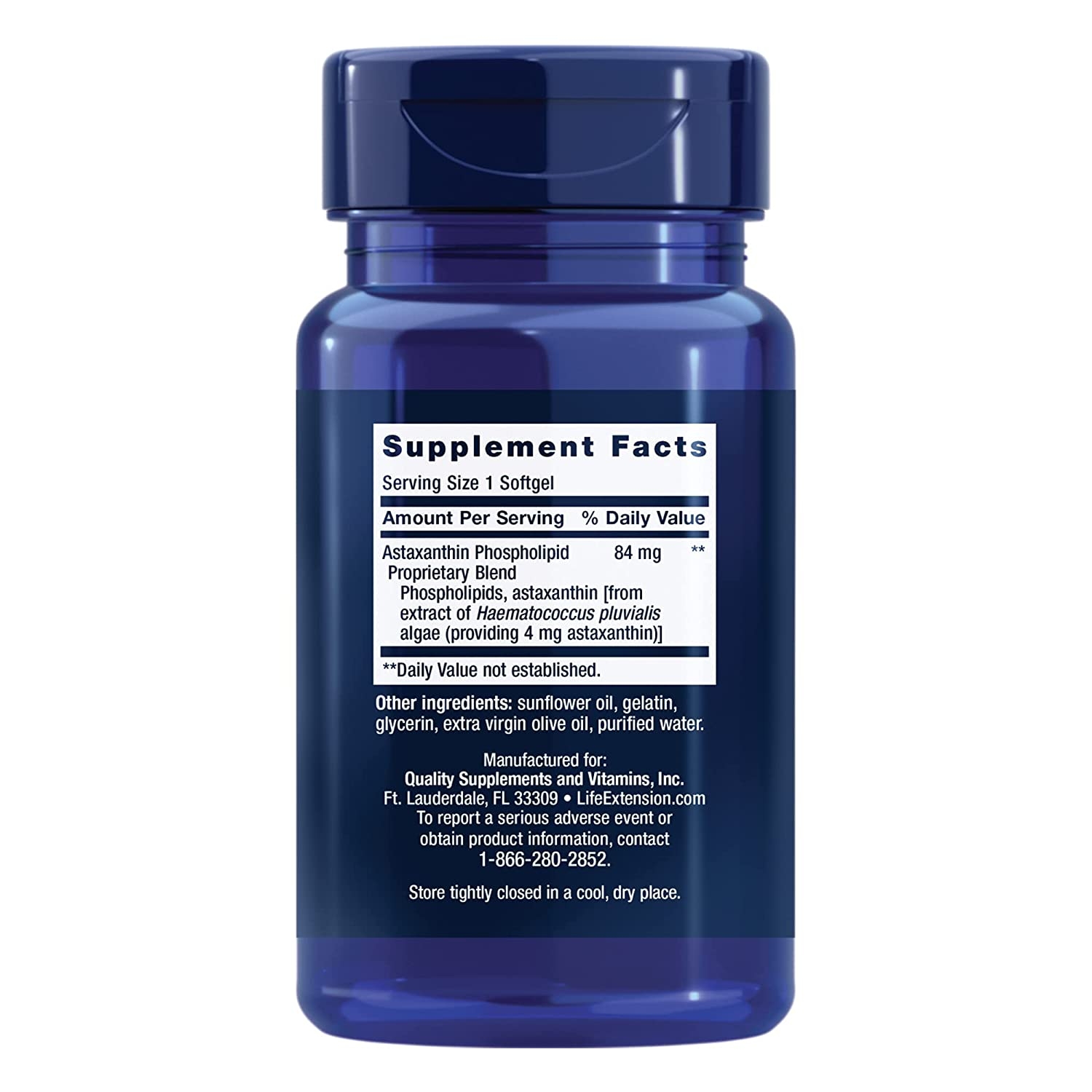
The 84 mg is the blend, not the astaxanthin dose. The label directs one softgel once or twice daily, or as advised by a healthcare practitioner, which gives 4 to 8 mg a day and makes a 30-count bottle last 15 to 30 days.
| This product | Doses in the trials above | NIH RDA / AI | Tolerable Upper Limit | |
|---|---|---|---|---|
| Astaxanthin, per day | 4 mg (one softgel) to 8 mg (two softgels), per label directions | 9 mg (2023 eye trial); roughly 2–12 mg (skin trials in the 2021 review) | None found in the sources we checked; astaxanthin is not an essential nutrient | None found in the US sources we checked; EFSA ADI 0.2 mg/kg body weight a day, and 8 mg a day judged safe for adults (2020) |
At two softgels the label dose is 8 mg, which equals EFSA’s assessed maximum and falls just under the 9 mg of the eye trial; at one softgel it is less than half that eye-trial dose. The listing says the phospholipid mixture “promotes absorption”; that is a manufacturer claim, and none of the trials we cite tested this blend against plain astaxanthin.
The listing also claims support for immune response, memory and cardiovascular health, and says formulas use “the precise substances and dosages utilized in the studies.” We read no trial of this exact formula, so treat those lines as marketing. We also found no human trial in our sources that measured DNA protection, the front-label claim.
Safety, and What We Could Not Verify
Zhou et al. reported no adverse events in the skin studies reviewed, and the 87-study safety review found no concerns with natural astaxanthin.
Here is what we could not verify. We did not find an authoritative source on pregnancy or breastfeeding beyond the label’s own advice to consult a physician, nor on interactions with blood thinners, blood pressure or other prescription medicines, nor on use for years rather than weeks. The label warns that anyone treated for a medical condition, or pregnant or lactating, should consult a physician. If you take any prescription medicine, ask a pharmacist or doctor first.
Who Might Consider It, and Who Should Skip It
Who this is for: healthy adults curious about skin hydration and elasticity who accept that the pooled evidence covers a few weeks to a few months in small, partly industry-funded trials; and adults aged 40 and over with heavy screen use who have already had an eye exam and fixed the basics, and who want a short experiment alongside the 20-20-20 rule.
Who should skip it: most people. There is no deficiency to correct, no trial shows it removes wrinkles, and the eye result was one subgroup in one trial. Also skip it, or ask a clinician first, if you are pregnant or breastfeeding, take prescription medicines, are buying it for a child, or avoid gelatin.
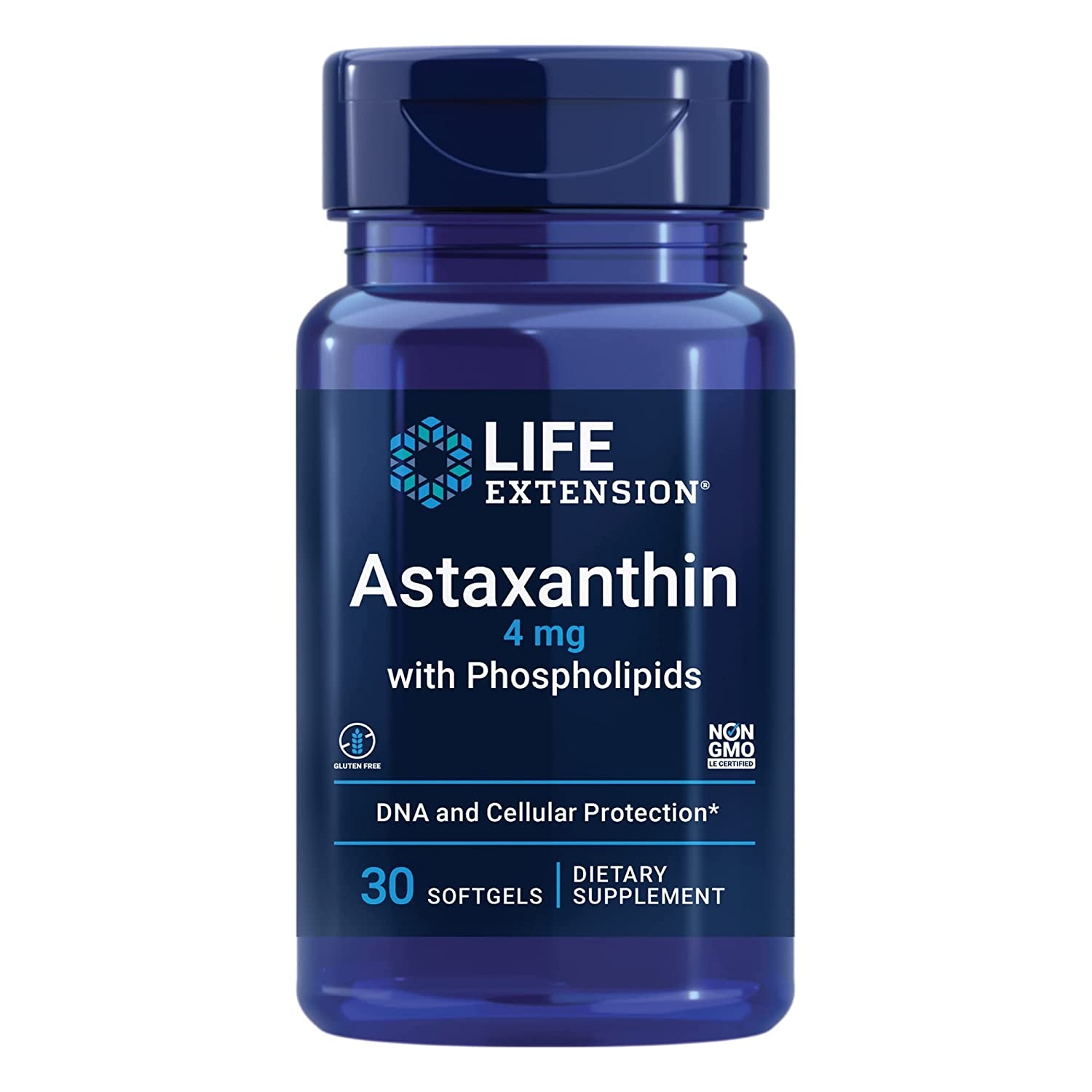
Life Extension Astaxanthin with Phospholipids 4 mg, 30 Softgels
4 mg of astaxanthin per softgel from Haematococcus pluvialis algae extract, 30 softgels, with directions of one softgel once or twice daily or as advised by a healthcare practitioner. Browse our supplements.
View Product DetailsFrequently Asked Questions
What is astaxanthin?
Astaxanthin is a red xanthophyll carotenoid that microalgae, bacteria and yeasts make naturally. The alga Haematococcus pluvialis is its most promising commercial source. It is not an essential nutrient, and no RDA exists for it.
Does astaxanthin reduce wrinkles?
Not in the pooled trial data. A 2021 meta-analysis of randomised trials found improved skin moisture and elasticity but no significant change in wrinkle depth (p = 0.11), even though its abstract conclusion mentions reduced wrinkles.
Does astaxanthin help eye strain from screens?
The evidence is thin. A 2023 trial of 60 adults at 9 mg a day for 6 weeks found a benefit to one acuity measure after screen work only in people aged 40 and over. The American Optometric Association recommends breaks and eye exams.
How much astaxanthin should you take a day?
No official intake exists in the US. Trials used roughly 2 to 12 mg a day, and EFSA judged up to 8 mg a day safe for adults in 2020. This product’s label allows 4 to 8 mg. Ask a clinician.
Is astaxanthin safe to take every day?
In trials, yes at studied doses. A 2019 review of 87 human studies found no safety concerns with natural astaxanthin, 35 at 12 mg a day or more. We found no authoritative data on use over years or in pregnancy.
What are the side effects of astaxanthin?
The skin trials in a 2021 meta-analysis reported no adverse events. We found no authoritative data on drug interactions, so check with a pharmacist if you take medicines.
Is natural astaxanthin better than synthetic?
They are chemically different, and a 2019 safety review argues the two should have separate safety limits because few safety studies exist for the synthetic form.
Can children or pregnant women take astaxanthin?
Not without medical advice. EFSA’s 2020 figures show the acceptable daily intake exceeded in children under 14, and this product’s label advises anyone pregnant or lactating to consult a physician first.
Sources
- European Food Safety Authority, NDA Panel. “Safety of astaxanthin for its use as a novel food in food supplements.” EFSA Journal, published 5 February 2020. Accessed 12 October 2026. PMC7448075
- Zhou et al. “Systematic Review and Meta-Analysis on the Effects of Astaxanthin on Human Skin Ageing.” Nutrients, August 2021. Accessed 12 October 2026. PMC8472736
- Brendler and Williamson. “Astaxanthin: How much is too much? A safety review.” Phytotherapy Research, December 2019. Accessed 12 October 2026. PubMed 31788888
- Sekikawa et al. “Effects of diet containing astaxanthin on visual function in healthy individuals: a randomized, double-blind, placebo-controlled, parallel study.” Journal of Clinical Biochemistry and Nutrition, 2023. Accessed 12 October 2026. J-STAGE
- NutraIngredients. “Astaxanthin supplements may reduce visual stress from screens: RCT.” 3 March 2023 (trade press, used for funding detail only). Accessed 12 October 2026. nutraingredients.com
- Davinelli et al. “Astaxanthin in Skin Health, Repair, and Disease: A Comprehensive Review.” Nutrients, 2018. Accessed 12 October 2026. PubMed 29690549
- American Optometric Association. “Computer Vision Syndrome.” Current page, no review date shown. Accessed 12 October 2026. aoa.org
- U.S. Food and Drug Administration. “FDA 101: Dietary Supplements.” Content current as of 2 June 2022. Accessed 12 October 2026. fda.gov
This article is for educational purposes only and is not medical advice. It is not intended to diagnose, treat, cure, or prevent any disease. These statements have not been evaluated by the Food and Drug Administration. Talk to your doctor before starting any new supplement, especially if you are pregnant or breastfeeding, have a medical condition, or take any prescription medication.